





Shortly before Christmas, we published an article about the BBC’s “superflu” propaganda campaign, which had mysteriously gone silent. It included a tweet from British pathologist Dr. Clare Craig, who noted that the “superflu” propaganda had not only been spread in the UK but across Europe and even Israel.
In a tweet posted on Christmas Eve, Dr. Craig said “Superflu was all branding and no substance.” In the following article, she explained why.
Let’s not lose touch…Your Government and Big Tech are actively trying to censor the information reported by The Exposé to serve their own needs. Subscribe to our emails now to make sure you receive the latest uncensored news in your inbox…
SuperFlu is Flagellistic (expialidotious)
By Dr. Clare Craig, as published by Health ethics Research and Advocacy Team (“HART”) on 16 December 2025
Once again, as Christmas approaches, we are told the NHS is on the brink. Headlines warn of a “superflu” season threatening to overwhelm hospitals, with language that feels uncomfortably familiar. The sense of déjà vu is striking. In 2020, the public was told that extraordinary interventions were justified because the situation was exceptional. There is nothing exceptional about the current circumstances, yet across Europe, the same crisis framing has returned.
Despite the absence of evidence for anything exceptional, there is a strong sense of Déjà vu. In the UK, schools have begun closing pre-emptively, particularly in Wales – some describing this as a “firebreak” as if transmission can be controlled by wiping surfaces. In Leeds, with Christmas on the horizon, children have been banned from singing in assembly. Vaccination messaging has intensified, too. Flu vaccines are being pushed beyond traditional risk groups, including toddlers, once again framed as a moral duty, to “protect granny.”
What does the data show to justify this? The overall hospital admission rates are broadly in line with recent years, merely shifted earlier by perhaps a week or two. The WHO admitted the earlier start way back in November.
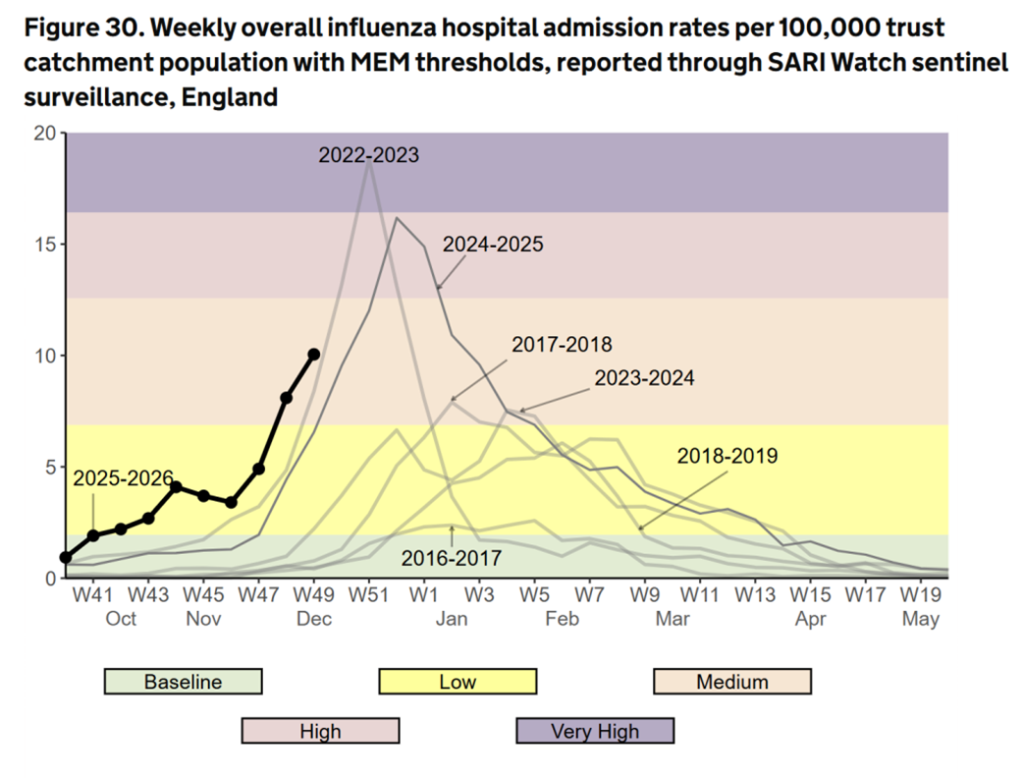
Test positivity for influenza has begun to slow over recent days, suggesting an approaching first peak for the season.
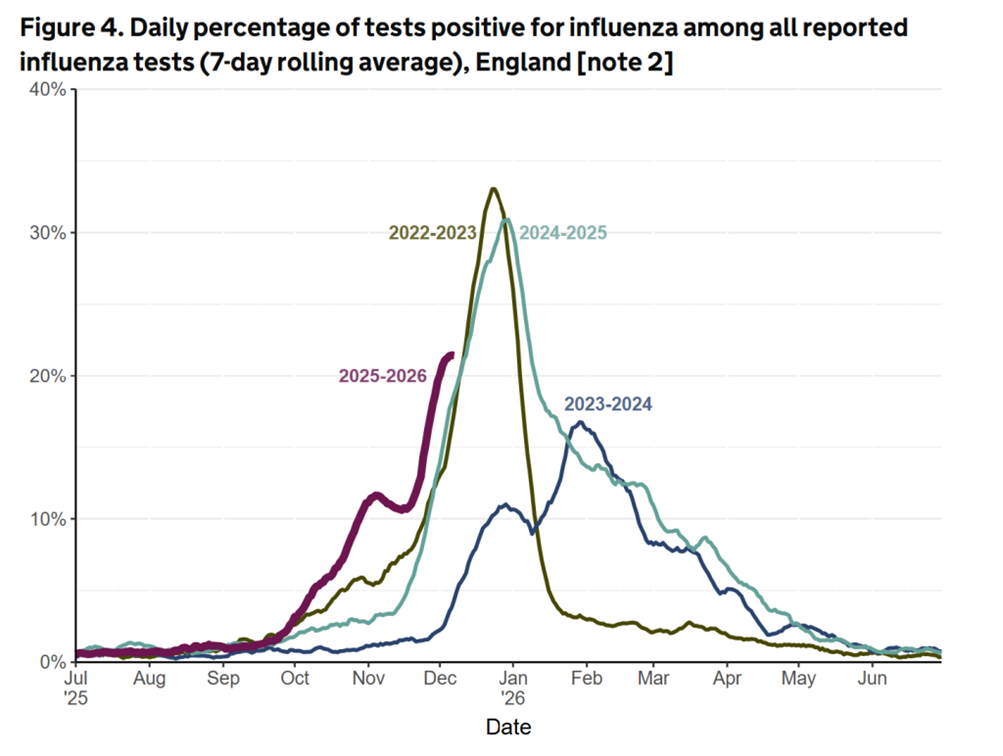
Part of the problem is the use of a model to estimate the amount of flu at any one particular time of year. This model is only comparing current levels with levels that day or week in previous years. It is incapable of noticing that the same trajectory has simply moved to be earlier.
Whether there is a second peak later in the winter remains to be seen, but this is not in itself a cause for alarm. Multiple peaks are a familiar feature of some flu seasons. Across hospital admissions, test positivity and primary-care surveillance, current levels remain well below those seen during more severe recent winters, including 2022–23 after accounting for an earlier start.
Perspective matters. NHS England recently reported around 2,600 patients in hospital with flu. Spread across more than 1,000 hospitals, this equates to an average of roughly three patients per hospital. Any additional pressure on an already stretched system matters, especially with uneven distribution of cases – but this is a long way from an unprecedented national emergency.
We are told influenza travels the world, peaking in Australia during our summer and in the northern hemisphere during their summer. We are told that influenza vaccines can be modelled on the Australian variants for use in the northern hemisphere. This year, the Australian flu peak was less high and the overall wave was more spread out.

More Testing, More “Cases”
One factor almost entirely absent from media reporting is the impact of surveillance itself.
We now test for respiratory viruses at a scale and intensity that would have been unthinkable before 2020. Multiplex PCR panels are widely used in hospitals. Sentinel GP surveillance has expanded. Schools, care settings and hospitals are all more likely to test, earlier and more often.
Much of what is being labelled “record flu” is therefore better understood as record detection, not record disease. Increased testing inflates case counts, shifts thresholds and makes comparisons with earlier years unreliable unless surveillance intensity is properly accounted for. Also, the monitoring systems have alerts when rates are high for the day or week of the year, with no accounting for an earlier season.
The Illogical Position On Masking
There is a deeper inconsistency at the heart of current messaging.
During Covid, the public was repeatedly told that SARS-CoV-2 was fundamentally different from influenza, and that extraordinary measures were justified precisely because it was not like flu. That claim underpinned lockdowns, mask mandates and school closures.
That logic has now quietly flipped.
Across Europe, people are once again being encouraged to adopt population-wide interventions – including masking – in response to a virus that is flu: a seasonal pathogen that returns every winter and always will.
This matters because the evidence showed masking did not work for preventing respiratory viruses. The evidence based that is used to support masking relies on either models that assume masks work and then conclude they work well, or on laboratory studies that attempt to collect virus projected forward but ignore the fact that air is redirected to the sides with masking. The best-quality evidence, including real-world natural experiments such as medical-grade mask mandates in Austria and Germany, failed to demonstrate meaningful benefit during covid and there is no reason to expect different results for other aerosolised respiratory viruses. Wes Streeting is failing to lead on this, saying he will not issue country-wide mandates because of this lack of evidence, yet he “supports”NHS leaders who want to issue them locally.
Re-deploying the same interventions year after year for endemic seasonal viruses risks normalising emergency measures without ever demonstrating that they meaningfully work. Masks are not a benign intervention. They strip humans of the emotional connections made with smiles and our ability to assess danger such that every stranger becomes someone to be cautious of. They measurably affected language development in children who need to see mouths when in their finite window of language development. They hamper communication with devastating effects for deaf people and create real risks in healthcare settings where clear communication can be a matter of life and death.
Flu does not warrant covid-era responses and covid was also never exceptional in the way the public was told.
Vaccination
Uptake of flu vaccination among children has risen sharply in recent years, particularly following expansion into secondary school age groups. It is children this age who have the highest positivity rates for flu.
There is an additional and largely unexamined issue. As with covid vaccines, trials of children’s nasal flu vaccines typically ignore what happens in the first two weeks after administration. Any primary school head teacher can attest that these campaigns are often followed by widespread illness in the immediate aftermath, yet this observation has not been examined systematically. The obvious questions are never asked. Are these vaccines simply bringing infections forward? Was the earlier vaccination campaign itself a contributor to this year’s earlier surge?
These are not fringe concerns. They are questions of critical importance and their consistent absence from official discussion is itself revealing.
Conclusion
There is no “super-flu,” just the usual flu trajectory happening a week or two earlier. The response has been close to hysterical but is revealing in terms of its lack of logic, evidence base and lessons learned since 2020. A striking feature of the current moment is not the epidemiology, but the synchronisation of alarm across Europe. Within the same weeks, multiple countries have issued near-identical warnings of hospitals being “on the brink,” invoked exceptional seasonal pressure from influenza and floated or re-introduced non-pharmaceutical interventions such as masking in healthcare settings.
Public health depends on credibility. When every winter is framed as unprecedented, and every seasonal virus as an emergency, the result will be a drop in trust. Enough damage has been done. This must stop.
STOP PRESS: Smile Free and Together Declaration have joined forces with a campaign tool to write to Wes Streeting and Dame Jenny Harries to stop further calls for masks. Link HERE.
About the Author
Dr. Clare Craig is a pathologist with over 20 years of experience. She is the Chair of Health ethics Research and Advocacy Team (“HART”).
The Expose Urgently Needs Your Help…
Can you please help to keep the lights on with The Expose’s honest, reliable, powerful and truthful journalism?
Your Government & Big Tech organisations
try to silence & shut down The Expose.
So we need your help to ensure
we can continue to bring you the
facts the mainstream refuses to.
The government does not fund us
to publish lies and propaganda on their
behalf like the Mainstream Media.
Instead, we rely solely on your support. So
please support us in our efforts to bring
you honest, reliable, investigative journalism
today. It’s secure, quick and easy.
Please choose your preferred method below to show your support.

Categories: Breaking News, UK News
It’s so good to have this common sense research-backed article by Dr Clare Craig. The madness we have to suffer from those running health concerns has indeed become so hysterical with every year bring a claim of ‘the worst ever recorded’ about something. It has indeed led me and I know many others, to ignore anything announced about diseases supposedly sweeping through the country with threats great enough, so they say, for us to be subjected yet again to unnecessary and ridiculous restrictions.
I’m fed up with the crazy health fascists who love to wield their unearned power and invent new ‘science’.
Along with the hysteria about imagined threats, there’s silence or denial of alternate treatments for illness the ‘system’ can’t treat. The suppression of Ivermectin while a dangerous vaccine that didn’t work was developed and sold under EUA that limited liability, is a striking example of horrible ‘practice’.
Masks and shots… utterly useless. *Prevention* is the key. Self-care and doctoring at home are the keys. Somehow we used to live just fine without this madness!
Re-empowering individuals is absolutely necessary, the first step in a complete reformation of our health care ‘system’.
Currently, doctors are no longer doctors, they’re too busy seeing patients to keep current and for the most part are Big Pharma shills pushing pills. If there’s no pill for what you’ve got you’re out of luck and are on your own with little to no power to do anything about it unless you’re a genius with money,
Insurance companies seldom fund ‘experimental’ treatments. Health Care insurance for the most part has become an extortion racket. If you don’t have a card and have money, you won’t have it long because the charges will be astronomical.
Authoritarianism over the last 100+ years has ruined the health care ‘system’ for the vast majority. I would hazard a guess more than half the time spent by employees has nothing to do with people’s health. Making it worse, the ‘system’ which has been captured by Big Pharma, Big Tech and Big Insurance, is primarily focused on profits and the needs of patients are secondary or completely irrelevant. Making it even worse, people are clandestinely being used as Guinea Pigs.
A deliberate lack of focus by the ‘system’ on how to maintain health, such as setting the RDA low, which causes a deficiency that over time leads to serious health issues Big Health makes a fortune ‘treating’. Same is true for recommended vaccines, with no long term studies, that most likely are causing immune system disorders such as Crohn’s disease, Big Health also makes a fortune ‘treating’
The Covid Plandemic brought it into sharp focus. Big Health made the virus, let it leak out, suppressed known treatments so it could make billions selling a produce than not only didn’t work but caused serious problems. The fact they got government and big industries mandating their experimental product, in direct violation of law, along with failing to provide patients with information required for informed consent, is overwhelming evidence the whole damn system needs to be scrapped and redesigned in accordance with the principles America was founded on.
We get the same BS from Dr Paul Griffin in Qld Australia who is in charge of infectious diseases
Someone needs to follow the money trail
My feeling on the whole matter is that prior to 1963 when there were no immunisations and the Vaccination we had was a skin scraping for Smallpox! We were all healthy even during the War especially as men women and children were healthy and slim and had sufficient good food THANKS TO OUR SEAMEN WHO BRAVED THE GERMAN UBOATS! TO SAIL INTO OUR HARBOURS WITH FOOD FOR US! In those days NO FAST FOOD OUTLETS! The destruction of Health! NOW INJECTIONS FOR BABIES, CHILDREN, ADULTS THOSE ARE THE CULPRITS FOR ILL HEALTH AND ENABLED THE CRIMINALS TO INJECT THE COVID VAXX TO UNSUSPECTING PEOPLE!
Or, get this; there is no flu, because viruses don’t exist.
https://open.substack.com/pub/anthonycolpo/p/another-fatal-flaw-in-the-virus-scam?utm_source=share&utm_medium=android&r=4mb6b8
https://open.substack.com/pub/anthonycolpo/p/viruses-dont-exist-deal-with-it-part?utm_source=share&utm_medium=android&r=4mb6b8
Those of us who spoke up constantly about convid being a hoax during the plandemic woke a few people up. People who got jabbed and then got sick put two and two together after their folly was pointed out. A group of us mounted a serious sticker campaign, never wore face nappies, and if any one dared to try and intimidate us they were met with the full force of our vitriol over their stupidity. If I see anyone wearing a mask I openly call them brainwashed morons or sheep. It seems to be working.
The Super Untrue Flu
Deja flu or Deja poo
happy new year to all expose staff and readers
Hi John, thank you. Happy New Year to you too!
I never feel for the convid lies.
As a nurse, I knew masks were useless.
In fact, before convid, some theatres were experimenting with not wearing meals during operations, as the AIR IS, CHANGED EVERY 30 MINUTES. Never heard that research mentioned again, during or after convid.
Not to mention fresh air is healing, but we were told to study indoors with CLOSED WINDOWS.
As a Christian, I couldn’t go to church, and did quietly listening to a sermon.
But I COULD go out and have a meal and a drink, talk, laugh and eat with friends, as long as we didn’t stay longer than two hours.
I couldn’t go near my granny, or my pathogens, that we had both shared for many years, we’re going to kill her.
But an 18 year old school leaver, never been best an elderly person in her life, would be perfectly safe, as she would be wearing a uniform!