





Back in August, we published this article signalling that the UK might finally be nearing a reckoning on asylum hotels. First came the temporary injunction over the Bell Hotel in Epping. Then our updated piece suggested that the crisis was worsening, not easing, with courts, ministers, and local communities colliding in full view. And now, a new ruling has made the picture even clearer. Epping Forest District Council has lost its latest attempt to stop the Bell Hotel from housing asylum seekers, with the Court of Appeal refusing to let the challenge proceed. The judges said the council’s case was “unarguable.”
For UK taxpayers, residents, and anyone who believed ministers were serious about ending hotel dependency, this is another reminder that the asylum system is still consuming vast sums of public money while overriding local opposition. The political language has shifted repeatedly, but the underlying reality remains intact: hotels are still in use, councils are still fighting, and the bill is still landing on the public.
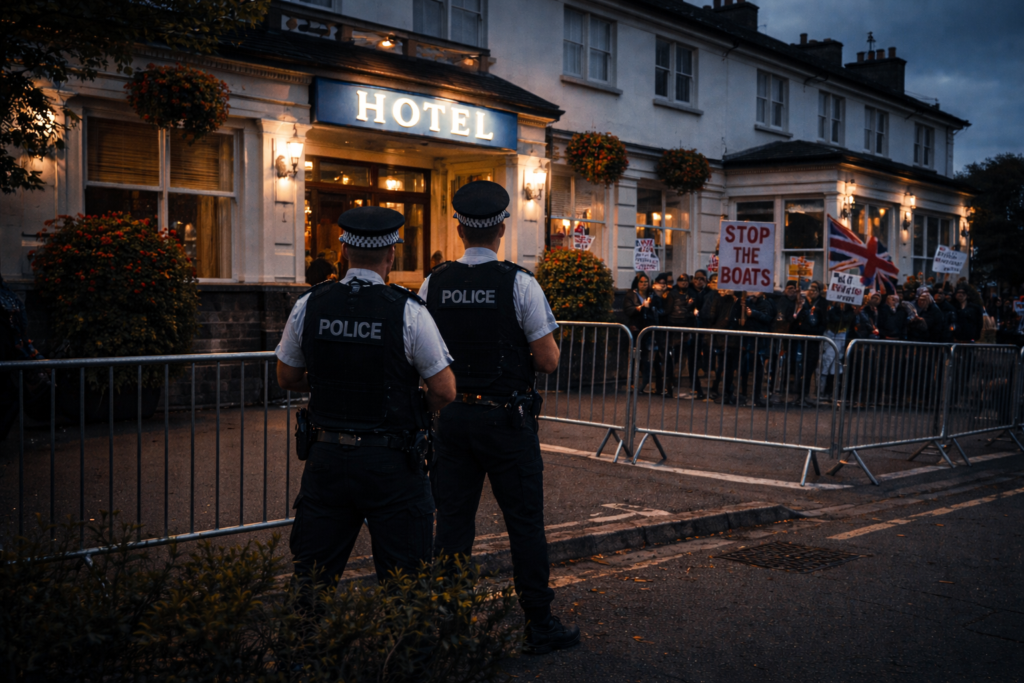
Local Residents Lose Again: Asylum Seekers Remain in Epping Hotel
The latest decision follows months of legal and political conflict around the Bell Hotel in Epping. Back in August 2025, we reported that the hotel had become a flashpoint for protests after a resident was charged with sexual assault, which he denied, and after the UK High Court initially granted a temporary injunction stopping the Home Office from housing asylum seekers there. Ministers immediately sought to appeal, arguing that removing residents would itself inflame tensions.
That earlier legal setback for the government did not last. On 29 August 2025, we then reported that the government had won a court ruling allowing asylum seekers to remain at the Bell Hotel, a decision we described as a worsening of the wider asylum disaster. The hotel remained open for asylum accommodation, and protests continued.
Now the position has hardened further. GB News and LBC report that Lady Justice Andrews and Lord Justice Holgate refused Epping Council permission to pursue its appeal, holding that the High Court judge had not “ducked the issue” and that there was “no arguable basis” for criticising his refusal to grant relief. In plain terms, the Bell Hotel stays in the asylum system.
The Astronomical Cost of Housing Asylum Seekers Continues Mounting
The financial burden is still enormous. A House of Commons Library briefing published in September 2025 said the Home Office spent £4 billion on asylum support in 2024/25, including £2.1 billion on hotel accommodation, which works out at £5.77 million per day. That represents an extraordinary daily charge on UK taxpayers for a policy ministers keep hinting is temporary.
The Home Affairs Committee cited even wider structural costs in its scrutiny of asylum accommodation. It said the contracts, originally expected to cost £4.5 billion over ten years, are now estimated at £15.3 billion, and that in 2024/25 hotel accommodation accounted for 76% of the annual cost of asylum contracts while housing only 35% of people in asylum accommodation. That is not an efficient emergency measure. It is a bloated system that devours money while delivering politically toxic outcomes.
See the National Audit Office report & Home Affairs Committee inquiry
Rulings Like Epping Directly Contradict UK Government Claims
Labour insists it wants to phase out asylum hotels, and ministers have repeatedly pledged to restore order. The government’s own asylum and returns policy statement in November 2025 conceded that asylum seekers in the UK receive “generous support, funded entirely by the taxpayer,” while promising tougher reforms. Yet those promises are running into the same hard reality that defeated previous governments: a legal system that slows removal, a backlog that keeps people in accommodation longer, and an appeals process that is now swelling rather than shrinking.
The Guardian reported this week that the asylum appeal backlog has nearly doubled within a year, rising 91% to more than 80,000 cases by the end of 2025. The average wait for an appeal has reached 63 weeks, and many of those involved remain in temporary government accommodation, including hotels, while their cases drag on. That makes the Bell Hotel case more than a local dispute. It is a symbol of a national system that is structurally incapable of delivering the quick exits ministers keep promising.
That is why the latest Epping ruling matters beyond Essex. It confirms that the public is being asked to bankroll an asylum regime that remains legally entrenched, politically combustible, and administratively sluggish. A government can make speeches about reducing hotel use all it likes. If councils cannot stop local sites, if appeals continue to mount, and if removals remain too slow, the hotels will stay.
Local Communities Continue Absorbing Costs and Consequences of Asylum Seeker Hotels
What has happened in Epping is part of a wider pattern. Local residents object, councils try to push back, courts intervene, and ministers eventually argue that the immediate logistical need to house asylum seekers outweighs planning objections or local anger. The legal language sometimes sounds technical, but the practical effect is simple: communities don’t get a say in the arrangement, and UK taxpayers involuntarily fund it.
That helps explain why the Bell Hotel became such a flashpoint. It hosted repeated anti-immigration demonstrations there in August 2025, with protestors carrying signs such as “Epping says no” and “Stop the boats”. However, those protests were not just about one hotel. They reflected a wider sense that national policy is being imposed locally without consent, and at a financial cost that would be politically intolerable in almost any other policy area.
The asylum hotel story has now been running for years. Ministers of both parties have promised control, efficiency, reform, and an eventual end to emergency accommodation. Yet the latest court defeat in Epping shows how little the political rhetoric really means. Regardless of what’s said, the hotels stay open, the costs rise, and public frustration snowballs.
Final Thought
The latest Epping ruling underlines how little has changed since August. The Bell Hotel remains in use, councils remain unable to stop placements, and taxpayers remain on the hook for a system that still costs millions of pounds a day. What was once presented as emergency accommodation has hardened into a costly and politically entrenched feature of the UK asylum regime. The result is a policy that is expensive, locally destabilising, and increasingly difficult for any government to bring back under control.
The Expose Urgently Needs Your Help…
Can you please help to keep the lights on with The Expose’s honest, reliable, powerful and truthful journalism?
Your Government & Big Tech organisations
try to silence & shut down The Expose.
So we need your help to ensure
we can continue to bring you the
facts the mainstream refuses to.
The government does not fund us
to publish lies and propaganda on their
behalf like the Mainstream Media.
Instead, we rely solely on your support. So
please support us in our efforts to bring
you honest, reliable, investigative journalism
today. It’s secure, quick and easy.
Please choose your preferred method below to show your support.

Categories: UK News
This just a symptom of the basic disease, which is that our government is captured by the globalist elite who’s aim is to remove all borders and mix us all up with no national identity. Allowing unvetted foreigners into our country illegally is a deliberate government policy. There are no “gangs”. Starmer has openly declared his allegence to Davos and the globalists who run it. The tories are no better. We will not see an end to this, and other atrocities, until we fundamentally change our system of government. Government must get back to serving the people with independant, quality MPs and no party system. Extreme vetting of MPs will be needed to make sure there is no corruption and severe penalties on MPs for breaking their contract with the people.
The vetting of the potential MP is controlled by their employers … the Crown. Democracy is only a facade that only serves the illusion, that the public holds a voice in government via the so-called vote.
There is no vote, for only a citizen is eligible to register, but the citizen is a legal entity and is the property of the Crown.
So who is the actual voter?
🙏🙏
What the Holy Bible says of this horrific decade just ahead of us.. Here’s a site expounding current global events in the light of bible prophecy.. To understand more, pls visit 👇 https://bibleprophecyinaction.blogspot.com/
Project montuak
https://www.unexplained.co/news/montauk-project-camp-hero-history-myth
black project
https://fighterjetsworld.com/air/abandoned-and-declassified-black-projects/525/?amp=1