





For much of the late 20th century, the political imagination was shaped by the simple fear that there would be too many people. Over-population, resource depletion and the supposed burden of large families sat at the centre of development thinking, environmental anxiety and international policymaking. Today, we’re seeing a complete U-turn. The global fertility rate has fallen to 2.25 births per woman, down from 3.31 in 1990, and the United Nations says more than half of all countries and territories are now below the replacement level of 2.1. What was once framed as a problem of excess is increasingly being managed as a problem of absence.
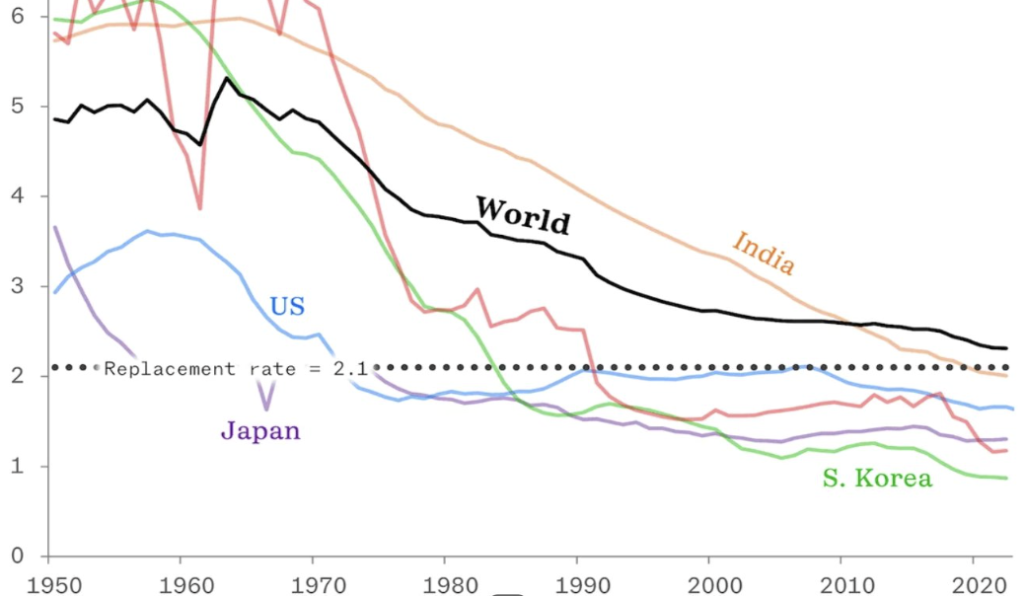
Europe’s transition is already well underway. Eurostat says the EU recorded 3.55 million births in 2024, with a total fertility rate of 1.34, the lowest level in the bloc’s statistical history. That is not a one-year aberration but the continuation of a long decline in births, delayed family formation and rapid ageing. And the demographic language has changed with it. Governments that once treated fertility as something to moderate now express concern of labour shortages, pension stress, dependency ratios and shrinking school registers.
The same pattern is visible well beyond Europe. The United Nations says East Asia is among the regions furthest advanced in low fertility and population ageing, while World Bank data show South Korea at 0.7 births per woman in 2023, one of the lowest rates in the world. The United States is not in the same position as South Korea or Italy (1.2), but the UN still places its fertility around 1.6, well below replacement. What used to look like a regional or civilisational anomaly now looks more like the default trajectory of all developed societies.
That reversal has produced a political embarrassment that many governments still struggle to acknowledge directly. For decades, large parts of the official world treated lower fertility as a marker of progress: fewer children, later marriage, more urbanisation, greater female labour-force participation, lighter pressure on resources and public services.
The OECD still links fertility decline in advanced economies to later parenthood, housing costs, labour-market insecurity and the difficulty of reconciling work and family life. But the same OECD now also writes about fertility decline as a structural challenge to economic sustainability and notes that work-family policies and family benefits can support childbearing, even if they cannot fully reverse broader cultural trends. The problem is not that policymakers misread one year’s data, but rather that a long transition once welcomed as modernisation has matured into something much harder to govern.
That is why pronatal policy now feels both urgent and oddly hesitant. Worldwide, we are seeing the same government attempts to introduce tax breaks, baby bonuses, subsidised childcare, parental leave, housing support, and trying to reduce the career penalties that come with parenthood. And at first, it looks like it works. The OECD says increased spending on family benefits in Hungary has helped lift fertility toward the OECD average over the past decade, though it also cautions that “work and family policies alone are not enough to explain the cross-national variation in fertility rates”, and therefore are not to be treated as a guarantee of durable recovery.
South Korea, by contrast, has spent heavily for years without producing a meaningful turnaround. Modern states, it seems, can subsidise parenthood financially, but is struggling to recreate the social confidence that once made family formation feel ordinary rather than a risk.
This is the point at which demographic decline stops being a matter for statisticians and becomes a problem of political economy and social order. Ageing societies need workers, taxpayers and carers. Younger societies continue to supply them. The UN has been proposing that migration can partially offset low fertility rates for years, such as in this report published 26 years ago. That policy can never fully solve the problem in any real way, but it does encourage countries with ageing populations to accept the migration agenda.
Essentially, if they cannot replace their own population demographically, they can import people to balance the books. The idea is that mass migration can shore up labour markets and support births by increasing the number of adults of childbearing age. However, it can also import new strains into countries that have not actually figured out exactly what it is they are actually trying to sustain.
States need labour, but many electorates are deeply uneasy (at least openly) about using immigration as the long-term answer to domestic demographic weakness. The result is a peculiar kind of evasiveness. Governments speak more directly about ageing than they once did, but are still reluctant to admit that low fertility is not just an economic variable; it is a civilisational one.
A country that cannot reproduce its population, and can only stabilise itself by importing younger people from elsewhere, is not merely balancing a spreadsheet. It is entering a different political settlement, one in which continuity depends increasingly on external replenishment rather than internal renewal. The UN itself notes that migration can influence age structure and births, but also that it is only a partial offset to the deeper effects of sustained below-replacement fertility.
For years, much of the political and cultural establishment treated falling fertility as a sign of progress, encouraging society to adopt a model that celebrated delaying family formation, two full-time workers, and the steady loosening of older social structures. Now we’re starting to see the same societies confronting the consequences of their own agenda: too few births, rapidly ageing populations, labour shortages, fiscal strain, and weaponising migration to fill the gap. Still, the official response is to treat this like a workforce planning exercise. But mass migration on such a large scale is bringing pressures of its own, not least on cohesion, trust, and the senses of continuity and identity that hold a nation together.
If the old order was dismantled in the name of modernisation, and the result is a society that cannot replace itself without constantly important more people from elsewhere, then what exactly was gained – and for whom?
The Expose Urgently Needs Your Help…
Can you please help to keep the lights on with The Expose’s honest, reliable, powerful and truthful journalism?
Your Government & Big Tech organisations
try to silence & shut down The Expose.
So we need your help to ensure
we can continue to bring you the
facts the mainstream refuses to.
The government does not fund us
to publish lies and propaganda on their
behalf like the Mainstream Media.
Instead, we rely solely on your support. So
please support us in our efforts to bring
you honest, reliable, investigative journalism
today. It’s secure, quick and easy.
Please choose your preferred method below to show your support.

Categories: World News
No mention of the cabal’s desire to reduce the population. The Club
of Rome discussed this report Limits to Growth in 1972. No mention of the possibility of the Covid-19 injections causing a reduced population.
Hi Dave,
There’s plenty more to discuss on the broader depopulation ideology, and much of it has already been covered on our site. The focus in this specific article is about the clear policy U-turns now taking place across governments following decades of publicly encouraging lower fertility rates.
Other agendas deserve their own pieces, rather than trying to fit everything into this one.
Regards,
G Calder
And no mention of the plight of the whales!
Writers have to stop their cowardice in confronting the ruling class / conspiracy. The ruling class / conspiracy exists and must be confronted directly and defeated!
Convid ‘vaccine’ doing its job. Pure deflection on the part of the UN. They still stand by their 500,000,000 ideal population for the world. Just enough drones to serve the elite.
MMM lots going on … still trying to work out who the evil b_stards are – pulling the strings of the ones pulling the strings. As for The Population issue – well there might be a non human element who would rather homo (various iterations) did not exist. AND I as a 72 year old – am aware that not only are the elderly being bumped off (too much slaved tax payers money having been spent on warfare and murdering other humans) – so pensioners are now a damned nuisance – they’ve worked hard, paid in and now need to be dispensed with (their collective experience and wisdom is also a threat btw) ………. but the jabs are targeting pregnant women and little children – so there is something very deep dark and nefarious going on ………………….. BUT WE WILL NOT BE ERASED !!!! eff off YOU – who ever YOU are …
Yes, us oldies are no longer disposable assets. Just disposable. Nobody matters. No person, no human, no corporation, no nation. Only the whole. World Control from its new “god” descending onto every individual human. The WC wants total control of all we do, say and think. Computer Liar Models or AI exist to circumscribe the range of discussion. They are trained to deceive.
As ever. The battle is the battle for the soul itself.
It might be necessary to start paying one parent a decent wage again, like it was 60 years ago, so preferably the mother can stay home with the child. If both parents have to work to pay for childcare, I see no turn around. At that time people were also satisfied with a small home, and most had a veggie garden. Nowadays they all want a Mac mansion with a huge lawn (that needs a crew to maintain it or at least a sitting lawn mower) and the mansion needs a cleaning crew… as long as people see this as progression, that is another clue we are off track.
Im no longer sure depop is an actual aim, rather an incidental product of making sure all those left alive are so scared as to be completely obdient.
It’s human nature to interfere with virtually everything. We cannot leave anything alone. The arrogance of the ego thinks nature cannot cope without our interference but its us who upset the equilibrium in the first place with our interfering. Humanity is and always has been its own worst enemy.
Clot shot!
We have a real problem here with problem definition. If a rising population is seen as risking Malthusian outstripping of the resources, and a falling population risks population collapse, we will never be in a safe place, and always worrying about disaster. It’s time for a rethink of the definition of the problem.
Over-population by definition is a lack of sufficient resources to sustain the population. It has been shown many many times that this has never happened. Sufficient resources – food shelter, clothing – have always been available for everyone to live a good life.
The word has been redefined to support stealing, killing and destroying others. “Sufficient resources” does not mean owning a second vacation home at the lake, let alone your own private island. It does not mean uncontrolled self-indulgence. For rich politicians, bankers and grifters, over-population specifically means too many “useless eaters” consuming things the rich could be getting for themselves. Thus the definitions have been turned upside down. The rich consume and destroy far far more resources than the overwhelming majority of the population, yet it is the majority of the population that has to be “reduced”.
There is over-population alright. Way way too many rich pigs hogging resources. Start with reducing them.
China in a non-shiningexample of a mandatory, even to the point of the State grabbing you and forcefully aborting a second child in any Mother who dared to have more than one child! under Mao! Now they are suffering the consequences of their MAN-MADE LAW!