





Former BlackRock fund manager Ed Dowd recently joined the Coffee and a Mike Show to discuss how big finance shaped covid aid. During the discussion, he highlighted that the World Economic Forum has been promoting the idea of a “polycrisis” for years.
“WEF told us… three years ago in a paper called ‘Polycrisis’ [this would happen] … You got war, you got a hantavirus, and let’s just toss in aliens … You need people begging for money printing,” he said.
Let’s not lose touch…Your Government and Big Tech are actively trying to censor the information reported by The Exposé to serve their own needs. Subscribe to our emails now to make sure you receive the latest uncensored news in your inbox…
The clip in the tweet above is taken from a discussion with Michael Farris and Dave Collum uploaded on to Rumble on 10 May 2026. You can watch the full video HERE. In the clip, Dowd said:
“Well, let’s go back to what the WEF told us two, three years ago in a paper called ‘Polycrisis’. So, you know, first of all, none of us knew who the WEF was before covid. They had a coming out party with like, you know, Bond-like villains, Harari and Schwab.
“So these Bond villains come out and tell us about the Great Reset. Then they start talking about the next problem is the “polycrisis.” And they said cyberattacks, another pandemic and war. What do we have now? We got Bessent talking about AI could steal your money from the bank. You got war, you got a hantavirus, and let’s just toss in aliens as a distraction on top of that.
“Yeah, you need people begging for money printing. So that’s where – so you cannot just print money out – and say we’re going to print a bunch of money. You need an excuse, and covid was a perfect excuse.”
Polycrisis Meets A New Competitive Order
There appears to be no paper titled ‘Polycrisis’ as Dowd had mentioned. The World Economic Forum (“WEF”) propagated the term “polycrisis” in its 2023 Global Risks Report.
According to the Institute of Development Studies (“IDS”), “the term ‘polycrisis’ was popularised by Columbia University academic Adam Tooze, and in early 2023 the World Economic Forum followed suit by warning in its annual Global Risks Report that the world was on the brink of a polycrisis in relation to ‘shortages in natural resources such as food, water, and metals and minerals’.”
While reading IDS’ article, it’s worth noting that IDS is not as “independent” as it claims.
IDS is located at and has close links with the University of Sussex. And, “The UK Foreign, Commonwealth and Development Office (FCDO) is the Institute’s largest funder. IDS also receives funds from UK Research and Innovation (UKRI), the European Union, various UN agencies and a wide range of aid agencies, trusts and foundations,” IDS says.
Related:
- We’re on the brink of a polycrisis. How worried should we be? World Economic Forum, 13 January 2023
- This is why ‘polycrisis’ is a useful way of looking at the world right now, World Economic Forum, 7 March 2023
- Welcome to the age of the polycrisis: the Global Risks Report 2023, World Economic Forum, 11 January 2024
We highlighted WEF’s dystopian Global Risk Report 2023 in an article titled ‘Davos 2023: Referring to The Great Reset is out but censorship, hypocrisy and god complexes are still in’. We wrote that “the report has the expected alarmism, fear-mongering, hysterical narratives and predictions of chaos and collapse. The authors even managed to link climate change to terrorism.”
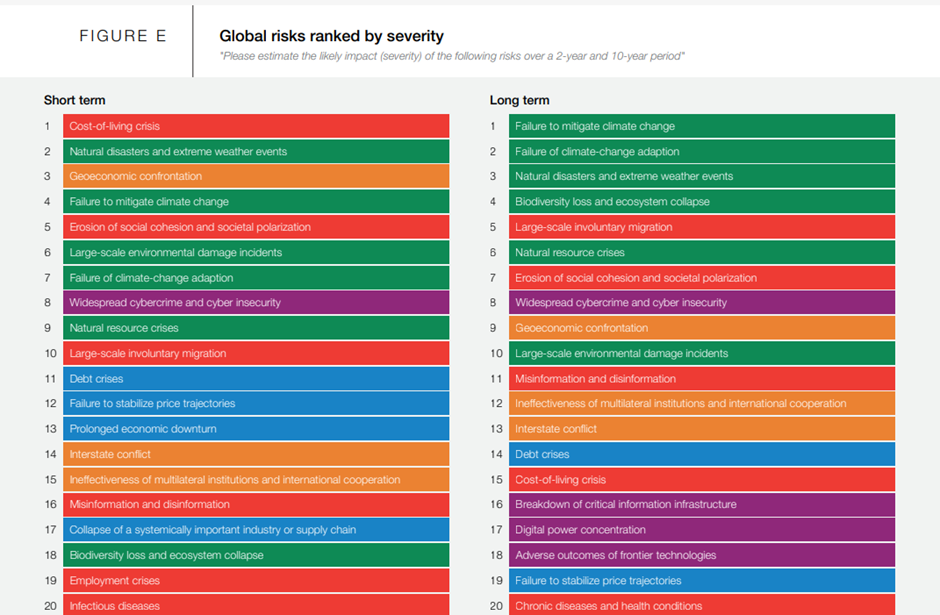
All WEF’s alarmism is summed up in a table of risks ranked by WEF in order of severity priority. Here is the top 20 from the table for 2023:
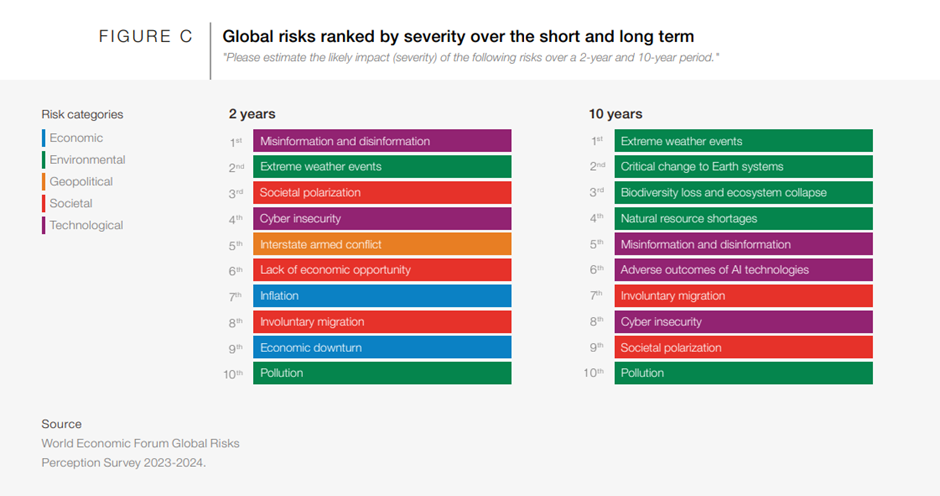
Ursula von der Leyen referred to WEF’s table of risks during her speech at WEF’s annual meeting in Davos in 2024. She referred to the table of 10 risks produced in WEF’s Global Risks Report 2024:
In its 2026 Global Risks Report, WEF boasted, “Three years ago, the 18th edition of the Global Risks Report considered the possibility of a ‘polycrisis’, as risks from multiple domains unfold at the same time. This 21st edition of the Global Risks Report explores how a new competitive order is taking shape and its impact across multiple concurrent risk domains.”
So, it seems they have now combined a ‘polycrisis’ with a “new competitive order.”
Here is the same table, adjusted for WEF’s new severity priority ranking for 2026:
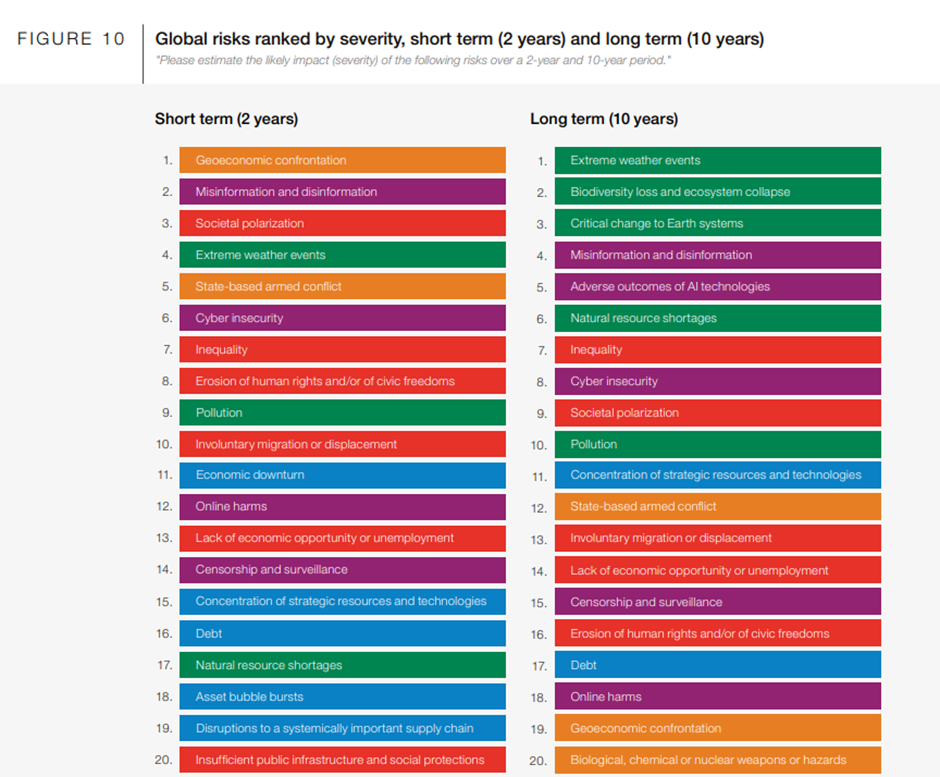
All is ticking along nicely according to the plan … well, as far as political and corporate media rhetoric is concerned, anyhow. Be warned, throughout WEF’s age of “polycrisis” and “a new competitive order,” there are the overriding aims of tackling “misinformation and disinformation” and “climate change.” These two goals are still very much on their agenda, for at least the next 10 years.
Note: When reading WEF reports and articles, remember that WEF uses Globalese and doublespeak. For example, “misinformation” and “disinformation” translate to commentaries, remarks and evidence that have not been approved by the establishment. “Climate change” is a catchall phrase to enable them to do as they please, as long as they can spin it so it “mitigates climate change.” And “adverse outcomes of AI technologies” means “artificial intelligence” is not having the desired results, for example, it is not being rolled out fast enough or giving them as much control over our lives as they are aiming for.
Featured image taken from ‘Geopolitical Fractures 2026 : Where the Next Crisis Already Lives’, Polycrisis.org (a project of the Cascade Institute working in consultation with the polycrisis community and the support of the V. Kann Rasmussen Foundation)
The Expose Urgently Needs Your Help…
Can you please help to keep the lights on with The Expose’s honest, reliable, powerful and truthful journalism?
Your Government & Big Tech organisations
try to silence & shut down The Expose.
So we need your help to ensure
we can continue to bring you the
facts the mainstream refuses to.
The government does not fund us
to publish lies and propaganda on their
behalf like the Mainstream Media.
Instead, we rely solely on your support. So
please support us in our efforts to bring
you honest, reliable, investigative journalism
today. It’s secure, quick and easy.
Please choose your preferred method below to show your support.

Categories: Breaking News, World News
The WEF have lost the plot completely compared to China.
“TOSS IN ALIEN AS DISTRACTION”
The sentence explained all about alien is fake and just for the distraction.
Alien just made up stories from pseudo-science make-believe own LIES of heliocentric model (solar system & planets) and outer-space, thus ALIEN do not exist.
The only ‘alien’ we have on earth was Satan Klaus (clown) Schwab.
The WEF claims by 2030 you will own nothing and be happy. MR Klaus Schwab has a very short time left on this cushy earth then it will be the flames of Hell for all eternity, oh, the torment waiting for him and all like him, if I were them I would be on my knees begging for forgiveness from our creator yeshua Ha’Mashiach so they too can miss living in the flames of Hell for all eternity.
Just picture in your mind Hell. The flame are from fire and brimstone, everyone knows that brimstone fire flames are blue and if you are close to burning brimstone you can’t breathe. Also brimstone fire is very different than wood or gas fires, it burns hotter. So, the folks that are already experiencing the flames of Hell are experiencing breathing in fire from the brimstone and the torments on there body, oh the torment, also the smoke is so black they can’t see, all they can do is hear screaming. I will take a hard pass on living in Hell for all eternity. Bad, bad place , stay away at all cost. Hell was not created for mankind, only the fallen angels. But, God gave us free will to choose him or his creation, and he will not interfere with our free choice, if you choose Hell you will regret it for all eternity.