





The US Department of Health and Human Services holds patents for hantavirus and other viral haemorrhagic fevers. Researcher Christina F. Spiropoulou is a key figure in these patents.
These patents involve genetically engineered viruses and “virus replicon particles” that can enter human cells. It is claimed these viruses are engineered so that they cannot spread and so cause an infection. However, at what point does such an engineered virus become the virus?
Let’s not lose touch…Your Government and Big Tech are actively trying to censor the information reported by The Exposé to serve their own needs. Subscribe to our emails now to make sure you receive the latest uncensored news in your inbox…
Hantavirus Patents: Who Owns Them? And When Does a “Vaccine” Become the Pathogen?
By Dr. Tess Lawrie, 12 May 2026
Question: Would you want a modified haemorrhagic fever “virus,” capable of entering human cells but allegedly engineered not to fully spread, injected into you? This is what a hantavirus “vaccine” may be.
Question: Would you be surprised to hear that hantavirus lung infection is listed among Pfizer’s covid-19 vaccine list of severe adverse drug reactions?
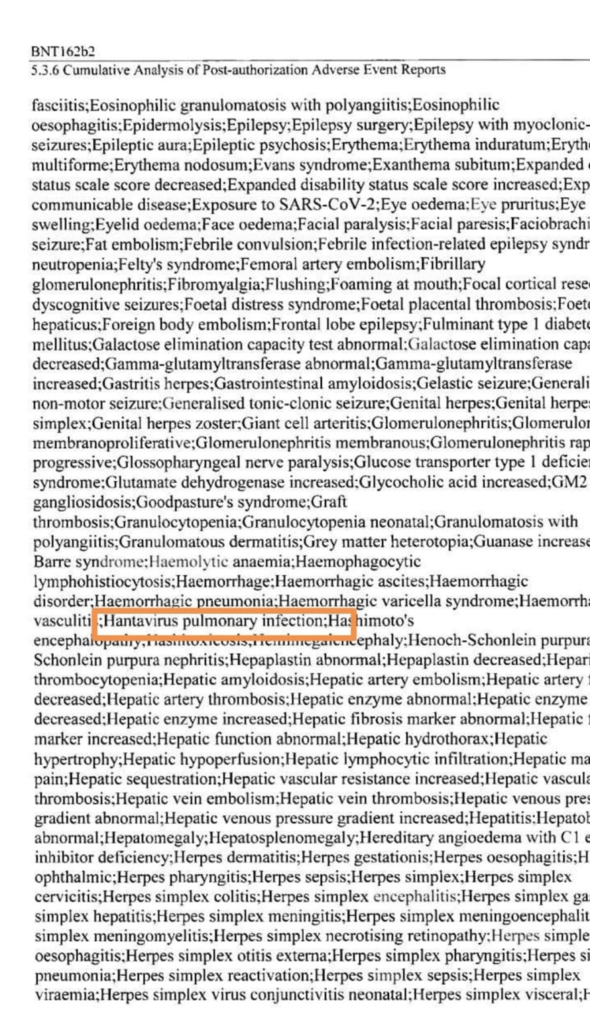
This article is based on revelations emerging from a two-year investigation into WHO Collaborating Centres by WCH Australia’s Lucinda van Buuren.
At What Point Does an Engineered Vaccine Platform Begin To Resemble the “Virus” It Was Designed To Prevent?
For most people, the word “vaccine” still evokes something simple: a weakened virus, a harmless protein or an injection that teaches the immune system to fight disease. But the covid-19 scam has shown that what are called vaccines can no longer be considered harmless.
Today’s “vaccine” science increasingly involves genetically engineered viruses “viral systems,” synthetic biology, programmable RNA platforms and modified viruses. Thus, the question “At what point does an engineered vaccine platform begin to resemble the ‘virus’ it was designed to prevent?” sits quietly beneath a growing heap of patents connected to emerging viruses such as hantaviruses, Nipah virus and Crimean-Congo haemorrhagic fever virus (“CCHF”).

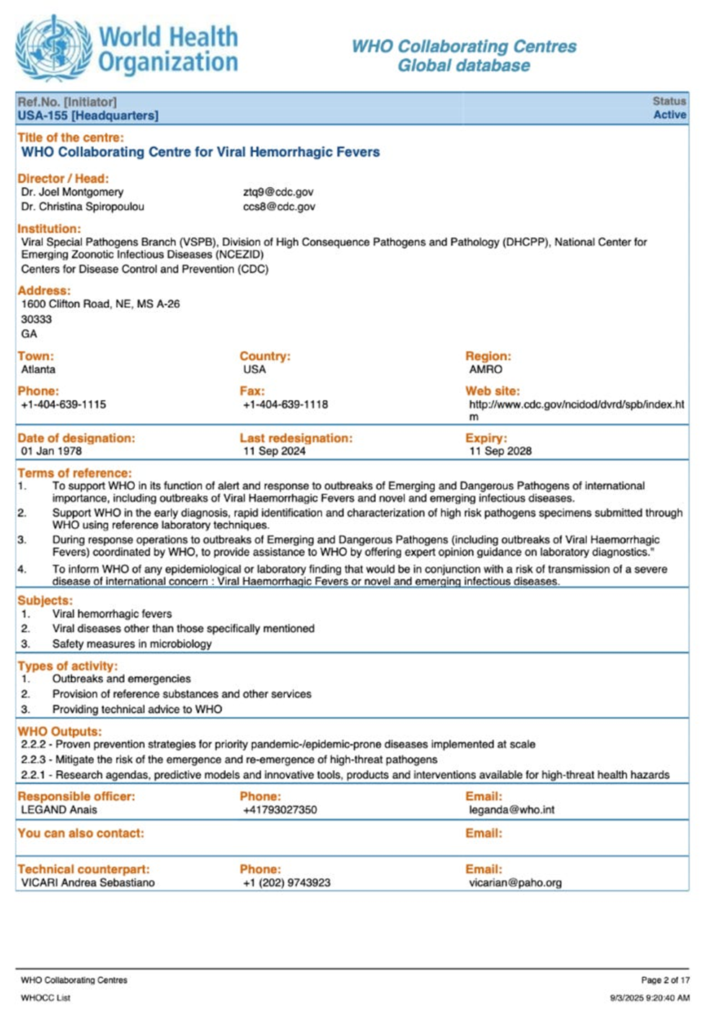
I raised this issue in a recent interview with Del Bigtree on ‘The Highwire, Episode 475’, and the fact that one recurring name in this patent trail for hantavirus and viral haemorrhagic fevers is Christina F. Spiropoulou, a virologist associated with the US Department of Health and Human Services. She is also a Director of a key WHO Collaborating Centre, the WHO Collaborating Centre (“WHO CC”) for Viral Haemorrhagic Fevers at the Centres for Disease Control and Prevention (“CDC”) in Atlanta (WHO contract USA-155). Spiropoulou’s co-director of the WHO CC is Captain Joel Montgomery, former director of the Department of Emerging Infections at the US Naval Medical Research Unit Six (“NAMRU-6”) in Lima, Peru.
Spiropoulou has co-inventions spanning from early hantavirus engineering in the 1990s to modern “virus replicon particle” vaccine systems. This document lists Spiropoulou and Health and Human Services (“HHS”) patents, including one published as recently as January 2026. Download ‘Patents by Inventor Christina F. Spiropoulou’ HERE.
The patents are public but not well known, and the potential implications urgently need to be discussed in international public forums.
The Hantavirus Back-Story
The first alleged hantavirus disease emerged during the Korean War in the early 1950s, when around 3,000 United Nations troops developed a mysterious haemorrhagic fever later called Korean haemorrhagic fever. Approximately 5-10 % of the troops died. Biowarfare was a possibility, and the US military became sufficiently alarmed that it established a dedicated haemorrhagic fever centre in Korea, according to Wikipedia.
US military biolabs, such as NAMRUs (US Naval Medical Research Units), began identifying related rodent-borne viruses across the world. NAMRUs were set up during and after World War II to identify “pathogens of military importance.” The Rockefeller Foundation helped set some of these up.
NAMRUs have remained very active in hantavirus research and development. Publicly documented NAMRU activities include NAMRU-3 hantavirus surveillance projects in Bulgaria and NAMRU-6 work identifying Andes hantavirus variants in Peru.
According to Wikipedia, the actual virus itself, called the Hantaan virus, was only isolated in 1976, two decades after the Korean War, by South Korean virologist Ho-Wang Lee from striped field mice near the Hantan River in South Korea. Its alleged connection to the outbreak in Korea was made through antibody testing of surviving veterans.
The Four Corners Outbreak
In the spring of 1993, several healthy young adults in the Four Corners region of the American Southwest experienced sudden respiratory collapse. Seventeen deaths were attributed eventually to a previously unknown hantavirus allegedly carried by deer mice. The virus became known as Sin Nombre virus. The outbreak launched an intense period of hantavirus surveillance and genetic sequencing in the US, as evidenced by the patent paper trail.
Patenting Emerging Viruses
Several patents filed in the 1990s and early 2000s by Spiropoulou on behalf of the US Department of Health & Human Services focused on newly identified hantaviruses and methods for detecting them:
- Bayou hantavirus and related methods (1999).
- Strain of hantavirus nucleotide sequences thereof related probes, primers and vectors, and methods for detection (1999).
- Polypeptides of a novel hantavirus (2003).
These patents involve isolating viral sequences, creating probes and primers, identifying viral proteins, and developing possible vaccine targets may seem uncontroversial. In theory, this is defensive medicine to identify dangerous viruses before they spread. However, the NAMRU/CDC virology team does not merely identify “viruses,” it redesigns and patents them on behalf of HHS.
What Type of Virus (Oops, I mean “Vaccine”) Shall We Make Next in the Age of Engineered Viral Systems?
More recent patents linked to Spiropoulou concern highly modified viral platforms known as “virus replicon particles” (“VRPs”). Examples include Nipah Henipavirus and Crimean-Congo Hemorrhagic Fever (“CCHF”). These VRPs are basically CDC-made VIRUSES designed to enter cells, express viral genes, initiate partial replication and stimulate immunity, while supposedly being unable to complete a full infectious cycle. The patents repeatedly emphasise that the viruses are missing key genes needed for spread. For example, the Nipah system deletes the fusion (F) protein, the CCHF system deletes the M segment responsible for glycoproteins.
The promise is that these engineered bits and pieces of genetic material create something virus-like enough to trigger strong immunity, but disabled enough to be “safe”. A recurring phrase in these patents is that the particles can undergo a “single round” of replication. This should by no means be reassuring. To replicate even once, the constructed virus/vaccine must still enter living cells, hijack cellular machinery, express viral proteins and behave in many ways like the pathogen itself.
Increasingly, “vaccine” science is looking like biological warfare orchestrated by the very institutions allegedly erected to protect and defend us. When did vaccines become engineered pathogens? Or is this what they have always been? Engineered infectious agents…The bits of genetic material known as viruses mutate, recombination occurs, biology is not predictable and anything can happen to the recipient. Engineered or unknown. This is gain-of-function by another name; “dual-use research,” yet another euphemism.
There is no evidence these patents describe released biological weapons or covert public deployment; however, the documents do reveal how normalised viral/vaccine engineering has become.
The Virus/Vaccine Process
The process that seems to be emerging for this hugely profitable racket is:
- find (or create) pathogenic materials,
- manipulate them genetically,
- give assurance of partial replication-competence,
- patent the resulting technologies, and
- then develop countermeasures against the engineered systems themselves.
Question: Would you want a modified haemorrhagic fever “virus,” capable of entering human cells but allegedly engineered not to fully spread, injected into you? This is what a hantavirus “vaccine” will be.
Who Calls The Shots?
Please note: a conflict of interest may arise if:
- a public institution helps develop a vaccine and
- it holds a patent that could generate revenue and
- it also influences decisions that affect that product’s use or evaluation.
That creates a situation where the same system is involved in both developing and potentially benefiting from the outcome.
Do these virus/vaccine patents constitute a conflict of interest for the CDC, HHS and ultimately WHO? What do you think?
Safe and Effective
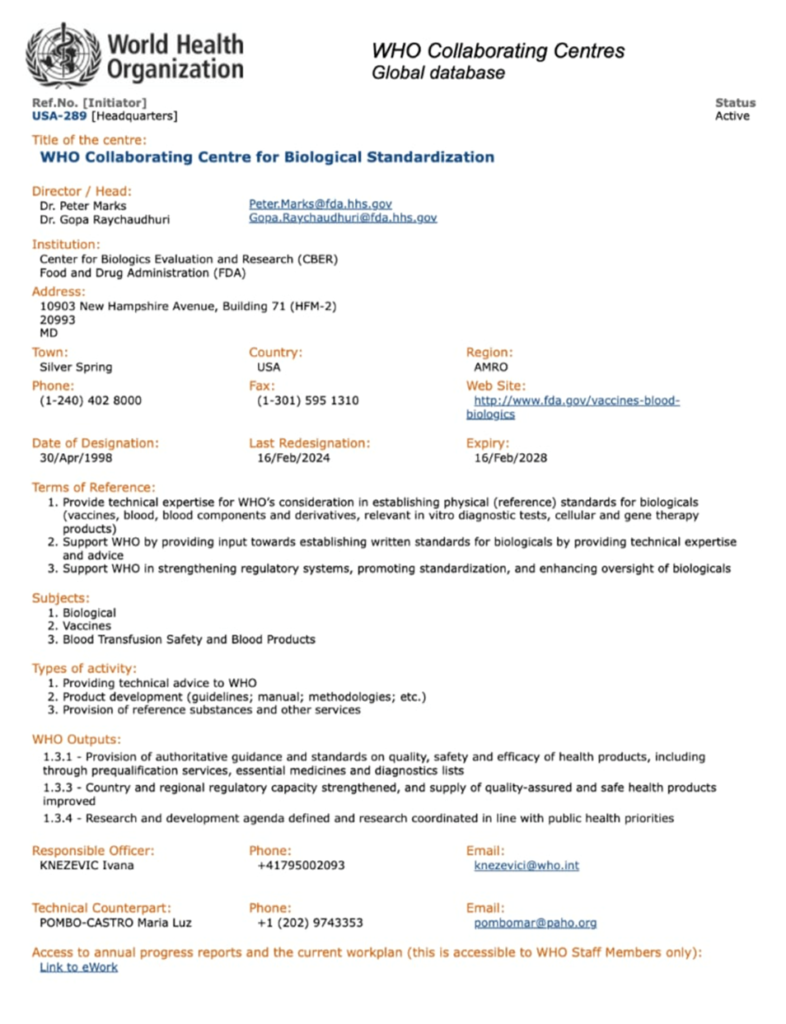
The US Federal Drug Administration (“FDA”) is the WHO Collaborating Centre for the Biological Standardisation (USA-289), meaning that the FDA determines what genetic or biological vaccines are “safe and effective” for us all. For some reason, this is not reassuring!
Believe it or not, there is a better way! It includes saying ‘NO’ to anything called a vaccine from now on.
References
- “Bayou hantavirus and related methods,” US Patent 5916754 (1999)
- “Strain of hantavirus nucleotide sequences thereof related probes, primers and vectors, and methods for detection,” US Patent 5945277 (1999)
- “Polypeptides of a novel hantavirus,” US Patent 6620913 (2003)
- “Crimean-Congo Hemorrhagic Fever Virus Replicon Particles and Use Thereof,” US Patent Application 20220023410 (2022)
- “Crimean-Congo Hemorrhagic Fever Virus Replicon Particles and Use Thereof,” US Patent Application 20260014243 (2026)
- “Nipah Henipavirus Virus Replicon Particles and Their Use,” US Patent Application 20250064918 (2025)
- Ho-Wang Lee et al., original isolation of Hantaan virus, South Korea, 1976
- https://en.wikipedia.org/wiki/Hantaan_virus?
- https://cris.pucp.edu.pe/es/publications/andes-hantavirus-variant-in-rodents-southern-amazon-basin-peru/?
- NAMRU 2 https://siarchives.si.edu/collections/auth_org_fbr_eaco43
- NAMRU 6 https://en.wikipedia.org/wiki/Naval_Medical_Research_Unit_South
More about Hantavirus from the covid-19 playbook: ‘Hantavirus PCR Test Sequences Repeatedly Match Human DNA: New BLAST Analysis Raises False Positive Concerns’, Jon Fleetwood, 6 May 2026
About the Authors
Dr. Tess Lawrie is the founder of the British Ivermectin Recommendation Development International (“BIRD International”), Director of EbMCsquared CiC and a member of the steering group of the World Council for Health.
Lucinda van Buuren is a registered nurse with over 29 years of experience, specialising in operating theatre practice, medical ethics, and values-based healthcare. She is the founder of World Council for Health Australia (“WCH Australia”) and the World Council for Health Nursing and Midwifery, as well as The Mindful Nurse Australia. (Read more HERE.)
Van Buuren is known for her open-source research into the WHO Collaborating Centres (“WHO CCs”) network in Australia. She argues that these centres, which include universities, hospitals and regulatory agencies like the Australian Health Practitioner Regulation Agency (“AHPRA”), operate under binding agreements to advance WHO mandates, compromising national health independence.
Featured image taken from ‘No sign of larger hantavirus outbreak, says UN health agency’, BBC, 12 May 2026
The Expose Urgently Needs Your Help…
Can you please help to keep the lights on with The Expose’s honest, reliable, powerful and truthful journalism?
Your Government & Big Tech organisations
try to silence & shut down The Expose.
So we need your help to ensure
we can continue to bring you the
facts the mainstream refuses to.
The government does not fund us
to publish lies and propaganda on their
behalf like the Mainstream Media.
Instead, we rely solely on your support. So
please support us in our efforts to bring
you honest, reliable, investigative journalism
today. It’s secure, quick and easy.
Please choose your preferred method below to show your support.

Categories: Breaking News, World News
So, do I need to repeat myself or just accept the given explanation about virus, Ops! I mean vaccine narratives…?
Use term of Engineered Protein+Enzyme of snake’s neurotoxin venom. Virus is rebrand name for Marketing purposes.
If use a name of NEUROTOXIN VENOM sound dangerous and scary. Bad for generating profit in bio-mass-killing marketing..!!
Hantavirus or any other so-called virus will only spread if we let the Corporate Media of North-East-West-South (i.e. NEWS) tell-a-lie-vision and social media spread it.
Every-influencer people are busy hyping it with ridiculous explanation or riding the “viral” scoop for contents. Gen-Z are screwed..!
GEN-Z are last generation for upcoming RESET. The dumber they are, the better for creating another “slave” of GEN-Alpha in year 2030.
Ms. Wilson. Thank you again for this, and your other unsurpassed investigative reporting.
Hi David Rinker, thank you for the recognition of the work we do. However, credit for this particular article must go to Dr. Tess Lawrie and Lucinda van Buuren.
Gosh… well what a surprise!
The scam merchants still haven’t learned.
Well, ‘Hanta’ is Israeli slang for ‘nonsense, a lie, a scam, a hoax or something completely fake’ 🙂
pharmaceutical company AstraZeneca, when written as “A stra ze neca,” means “a road to death” in Latin.
Everything was related or linked in terms of “SCAM IN PLAIN SIGHT” plans. Every moves ‘they’ makes always have hidden code to prove to the ‘master’ of hidden hands.
Only vigilant eyes and who’s who (includes (WHO) in the circle could cypher them.
You’ve been reading fake internet memes.
Google AI says that your Latin translation is wrong. So does Grok.
“Road to death” in Latin is “via ad mortem.”
“Road” is sometimes “strada” in Italian, but the entire phrase in Italian is “la strada della morte.” Not a match.
Astra (spiritual weapon in Hinduism); ze (‘that’ in Polish); neca (‘kill’ in Latin)
but I admit I’ve cobbled together words from different languages here 😊
Do you learn or study or expert in Latin language? Latin language only 50% translated. Another 50% was mislead translated to hide most crucial information of advanced civilization of ancient Nephilim.
Be cautious with AI because everybody use it as fact-check without knowing why AI now are forced & pushed into mass use.
First, must understand AI only giving OUTPUT according to controlled (repeat controlled) INPUT of data or information. With simple command of //<ignore><**certain words><replace> will make AI giving false information about real information.
Second, AI also makes user lazy and becomes DUMB to do fact-check with legitimate source such as book or printed material information.
Third, too depend or expect all answers are true without cross-sect from actual source. This is a warning for you.
In Hungarian, hanta means balderdash, or nonsense. It refers to someone telling lies or exaggerating.…
AI says that also, in Lakota, hanta means “move; get out of the way.” In Japanese, it means “trouble; anxiety; a nuisance”.
Newsflash:
Hantaan was never directly isolated from an animal or human. Ho-Wang et al used indirect immunofluorescent antibody technique with human convalescent serum.
Because the virus didn’t exist in nature, the only way to create it was to use indirect serological screening to track it’s progress. But wait, what are they tracking if there’s no virus to begin with?
Isolation and purification must happen first, before any other types of experimentation – this is the only logical way to prove existence. The WHO, NIH and the Institute of Medicine make this very clear.
The WHO is an agency that is part of the United Nations. This globalist structure was created by the zionist bankers (Rothschild’s) and their American junior partners (Rockefeller’s).
Hi J Guti, if you think the global bankers are identified/defined by being “Zionist,” you’ve been duped.
Collaborating also means IN CAHOOT…. gain of function of win-win situation while the rest of population in lose-lose situation.
I wonder how they sleep at night with the fact of blood-stain on hands will never be washed out. Must had heart of pure evil and devilish to be at that choice.
Serial killers seem to sleep well at night, too, pleased with their day’s accomplishments,
Seems like continuation of a long-time story line. Make the people sick, then treat them for a price, but do not eliminate the ongoing health threats. No reason the pharmaceutical industry or our overlords at the CDC and HHS will change the narrative, as they have money to make from their discoveries and engineered pathogens requiring a counter in an unholy partnership
There are some great points in the article and I would like to add the Freemas0n angle.
‘Hantavirus pulmonary infection’ is indeed on the Pfizer adverse events report but I’d like to point out it is on page 33 of that 38 page document (I’ll try to post a L1NK in an attachment but they get blocked regularly).
Also, the cruise that they went on was a 33 day cruise that began on April 1.
The ‘Four Corners Outbreak’ mentioned in the article (claimed by AI to be the most significant hantavirus breakout in U.S. history) was claimed to have been discovered in May, 1993 i.e. 33 years ago.
33 is an important number to the Freeos (‘The Ancient and Accepted Scottish Rite of Freemasonry…is a rite comprising 33 degrees’ – W1k1pedia).
L1NK for the Pfizer adverse advents 38 page document
BINGO..!!
Congrats!….You just crack the code of Freemason’s 33 degree of 332 Skull & Bone PsyOps.
The cruise was launched on April fool to fool the masses. Just like NASA’s Artemis 2 mission to moon launched at April fool’s day. Every single thing of these PsyOps are related.
Disney cruise was raided to have pornography on board.
Artmeis 2 Mission with two (2) photo of earth taken separately day & night with same cloud patterns. NASA’s fanboy diehard fans still refuse to accept the fact & truth. Are you (the deniers) blind..?!
It’s not just NOT ONLY the fake & scam already proven with legit evidences, the problem LIES with the society refuse to accept facts & truth.
When the problems fall on ‘them’, always in denials from accepting the truth. More sinister, have guts to pointing finger at others. Never accept the fact & truth of all that occurred was own-doing. I am now support the culling agenda by the elites. These USELESS EATERS have all the rights to be eliminated in order to bring peace to the rest of the humanity.
Thanks, excellent points. I’d forgotten that Artemis II was also launched on April 1.
I also am thinking that stuff like this could be a distraction from REAL ID. In USA, on May 7, 2026, they introduced REAL ID for Americans to use to fly. It originated from the 2005 REAL ID Act (a response to the Sep. 11, 2001 “attacks”). It’s a slow tightening of the laws to standardise identification to prevent US federal agencies from accepting ID from US states that don’t meet the minimum requirements of the 2005 act.
So while this is a tightening of laws that affects a huge proportion of Americans, the public is distracted by stories like the ‘hantavirus’ cruise – especiallly since the tightening is not tight enough to frighten Americans into protesting it.
DISTRACTION always with purpose…. only people with high IQ & vigilant enough would notice the distraction was all about.
“Magician” always distract audience with sexy assistance to fool the watchful eyes of his quick nimble hands & also hides what behind the curtain.
You, just earned my respect points for this. Only people like you will survives the upcoming waves of “RESET” agenda.
It does seem like part of the plan to bring disruptive or criminal foreigners here en masse, then claim we need all this surveillance and ID monitoriing to protect ourselves from them
Perhaps the only thing holding back the release of a truly genocidal virus is that the elites’ scientist puppets haven’t yet discovered a vaccine that will prevent the elite from getting it.
Perhaps the little outbreaks here and there of one viral disease or another are tests of a vaccine some of the test subjects have had unawares? Anyone traveling beyond the US/Canada and Western Europe has to get shots against diseases we don’t have here, don’t they? Nobody is verifying the contents of those vaccines, are they?