





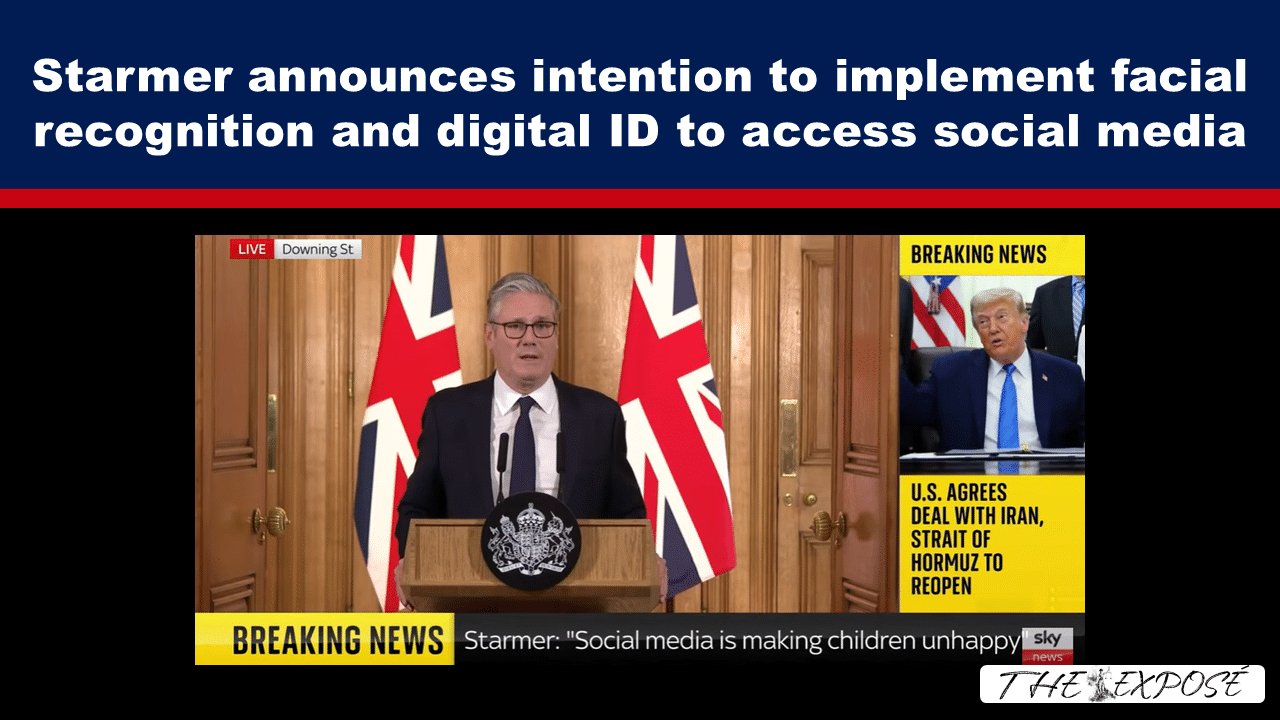
The UK government, reinforced by Keir Starmer at a press conference today, has announced its intention to ban social media access to under-16s from early next year.
The ban will be enforced using facial recognition software and digital IDs. To enable this, everyone wishing to use social media will be subject to facial recognition and digital IDs.
Aside from the obvious destruction to online privacy and freedom of speech, and the totalitarian control over every aspect of our lives which will ensue, how accurate is the technology that the UK government is imposing on the entire population?
Let’s not lose touch…Your Government and Big Tech are actively trying to censor the information reported by The Exposé to serve their own needs. Subscribe to our emails now to make sure you receive the latest uncensored news in your inbox…
Today, the UK government announced a ban on social media access for all children under the age of 16. Starmer is hoping the regulation will be passed through Parliament before Christmas and the ban enforced in the Spring of 2027.
Described as an “Australia plus” policy, this measure is one of the strictest online crackdowns in the democratic world and goes beyond the limits previously imposed in Australia.
The government plans to use “highly effective” age assurance systems, including age-recognition facial scans and digital IDs, to verify user ages.
Social media platforms that will require biometrics and digital IDs to be accessed will include:
- X (formerly Twitter)
- Snapchat
- TikTok
- YouTube
We should note that everyone, not just under-16s, will be subjected to facial scans and digital IDs – “to protect children online” is a ruse to implement control over the entire population using whatever digital technology they have at their disposal.
Apart from ending online privacy and aiming for complete control over the information we can share and have access to, their digital tools are not as fail-safe as they like to pretend.
Some might claim that some facial recognition software is 99% accurate. But this is under controlled environments with high-quality, cooperative images – i.e. under laboratory conditions. In real-world settings, the accuracy of facial recognition in sporting venues, for example, ranges from 36% to 87% depending on camera placement.
Related: Why We Shouldn’t Trust Facial Recognition’s Glowing Test Scores, Tech Policy Press, 18 August 2025
Coupled with facial recognition inaccuracies, social media platforms use artificial intelligence (“AI”) programmes to estimate user age through facial analysis. Apart from the “estimation” of age, AI programmes themselves are not accurate.
AI has inbuilt biases (all software is only as unbiased as its developer) and manipulations. But that’s not all. These computer programmes are prone to generating “hallucinations,” which are false, misleading or fabricated information that is confidently presented as factual even though it is incorrect. For example, a 2025 study found that 45% of AI queries regarding news and current affairs produce erroneous answers, with major platforms like ChatGPT, Copilot and Gemini frequently generating factual inaccuracies, hallucinations and biased outputs.
The following article shows how similar errors make their way into reports for large corporations and governments.
In one case, KPMG, one of the Big Four accounting firms, reproduced AI hallucinations as factual – ironically, the report, written by AI, was about agentic AI. Agentic AI is an artificial intelligence system that can accomplish a specific goal with limited human supervision.
In another example, a Big Four consultancy firm relied on inaccurate, unreliable AI-generated content to produce a report for the Australian government.
Related: Facial age estimation: Using AI to support initial age decisions (A guide), UK Government, 26 May 2026
KPMG’s AI Report Becomes An Accidental Demo of AI Hallucinations
By Carly Page, as published by The Register on 12 June 2026
KPMG’s October 2025 report on the wonders of agentic AI has been accused of demonstrating one of the technology’s less desirable talents: making things up.
Research outfit GPTZero claims a forensic review of the Big Four firm’s October 2025 report, ‘Total Experience: Redefining Excellence in the Age of Agentic AI’, found that only five of its 45 citations correctly pointed to the cited source; the rest ranged from mangled and misleading to partially fabricated or too vague to verify.
The consulting industry has form here. Last year, Deloitte ended up refunding the Australian government after AI-generated content slipped into a taxpayer-funded report.
GPTZero dubbed the phenomenon “vibe citing” – the citation equivalent of vibe coding – where generative AI appears to stitch together fragments of real sources, invent titles, or otherwise produce references that look convincing until someone actually clicks them.
GPTZero alleges that roughly half of the report’s factual claims were false, unsupported or attributed to the wrong source. Several case studies highlighting supposedly cutting-edge deployments of agentic AI appear to have been particularly creative.
Among the examples highlighted by GPTZero were purported agentic AI deployments at UBS, Swiss Federal Railways and Transport for London. According to GPTZero, the sources cited to support those case studies either did not substantiate the report’s claims or contained alterations and paraphrasing that undermined their reliability.
More Context:
- PwC will say goodbye to staff who aren’t convinced about AI
- Accenture tells staffers: If you want a promotion, use AI at work
- McKinsey wonders how to sell AI apps with no measurable benefits
- KPMG partner in Oz turned to AI to pass an exam on … AI
“These factual errors are not confined to the report’s footnoted passages,” GPTZero said. “On page 42, the authors claim that Emirates airline has adopted a mobile chatbot named Sara (false) that can converse directly with passengers (partially true) and change their flights (false). In fact, Sara is a robot assistant introduced by Emirates in 2023 (not a chatbot) that lacks the ability to alter flight bookings.”
Not all of the alleged problems involved external sources. GPTZero noted that the report appears to contradict KPMG’s own research, citing a figure of 55 per cent of CEOs ranking AI as their top investment priority. KPMG’s 2025 CEO Outlook, released the same month, put the number at 71 per cent.
KPMG has since removed the report from some of its websites while it investigates how the publication made it into the wild, according to the Financial Times. [You can find an archived copy of the report HERE.]
A spokesperson at KPMG told The Register: “KPMG International takes the accuracy and integrity of its published content seriously. The report has been removed and we are reviewing the circumstances surrounding its publication. We expect all our people to follow our guidelines on the responsible use of AI, including human oversight to validate content and verify independent sources.”
Consulting firms have spent years warning clients about AI hallucinations. According to GPTZero, KPMG may have just provided a live demonstration.
The Expose Urgently Needs Your Help…
Can you please help to keep the lights on with The Expose’s honest, reliable, powerful and truthful journalism?
Your Government & Big Tech organisations
try to silence & shut down The Expose.
So we need your help to ensure
we can continue to bring you the
facts the mainstream refuses to.
The government does not fund us
to publish lies and propaganda on their
behalf like the Mainstream Media.
Instead, we rely solely on your support. So
please support us in our efforts to bring
you honest, reliable, investigative journalism
today. It’s secure, quick and easy.
Please choose your preferred method below to show your support.

Categories: Breaking News, Latest News, UK News
If that includes this platform, then good bye!
Hi Stuart-James, this platform is a website, not social media or a messaging app. We will always hold out as long as we can – we may be censored and targeted for it as we have since our site began, but we, like you, have no desire to participate in the digital control or any other Globalist agenda.
Whether Starmers’s latest draconian initiative is also targeting websites remains to be seen. They are still working on the details of their plan and will, apparently, release these in a month’s time. If Starmer and his cronies get their way, it may not be websites now, but it will be at some stage. How do I know? Because they are seeking total control over everything you see, say and do on the internet, be that on social media, messaging apps, email, video conferencing (e.g. zoom), websites etc, globally.
This has always been part of the Globalists’ plan – no privacy, no freedom of information, no individual rights or freedoms, no private ownership, you will own nothing, and you cannot speak or act, or buy or sell anything (not even food and water) unless they allow you to do so. Every person in the world will be totally controlled centrally using biometric-based digital IDs linked to CBDCs (or another cryptocurrency) – that is their plan and we are watching it unfold, being rolled out bit by bit.
You go girl!
It’s already been implemented for Aussie users of Substack which is not a ‘social media’ platform but a place for writers to state what’s on their mind (much like The Expose’) with comments allowed for discussion of given topic
I had been a contributor on Substack for nearly 5 years and then one day, out of the blue, i was blocked from accessing the site unless i provided digital ID/facial verification, something which was/is never going to happen at my end
I don’t know how many Aussies are left on Substack or whether those still using the place have indeed surrendered themselves to the Dig ID program; If they have surrendered to the Dig ID, then they are not worthy of my time!
There will always be a way to circumnavigate this.
Could you put on a mask, or is every going to need facial recognition to use? Starmer is a fascist Nazi! That’s why he’s allowing the liberal platform Bluesky left on for the children so they can read and become brown shirts of the communist party. They are grooming the..
This cannot be stopped. We are rapidly approaching the time in which the KJV calls the time of Jacob’s trouble and 3 1/2 years layer Jacob’s trouble turns into the great tribulation. I shudder at the thought of the poor souls left behind to face this horrible time. Creator God will not be generous during this point in time.
It can if we get them out of power.
Nope, this is a God thing. And it can’t be stopped.
Prophecy unfolding before our very eyes. Pay attention!
Why did you down vote me, all I did is tell you truth.
There are definitely indicators we are building up to the last chapter before Christ returns. It seems like a lot of the infrastructure that could enable a ‘beast system’ – CBDC’s etc is either built or being built. I note also, there are allegedly plans to rebuild the Jerusalem temple, and a US president that seems to have a mouth of boasts from a country that in some ways resembles Rome with its republic, senate, eagle symbols etc.
However, people have long been predicting the end so I’m still watching for confirmation.
There was a time when none of us had smartphones, internet, smart cars etc. I personally can live without a lot of that stuff. It also highlights how we need parallel systems as well. We can do very well outside their horrible prison society they are creating – but our society would need infrastructure – different tech, hardware and software, networks, etc for starters….thankfully quite a bit of that is actually already available if people started using it and developing it.
Well if it happens, I will be closing my Facebook account and will stop using YouTube well before. It won’t take long to adapt.
That’s exactly what they want.
What’s amazing is that this joker still thinks he’s going to be in power by next year.
Then next puppet will continue where he stopped……
The European Union by implementing illegal aliens into the country was just a ploy so that they could implement their New World order surveillance system to track everything you do, just like the fascists did during world war 2. Is it any wonder we are moving quickly to the Tribulation period where the Mark of the Beast will rule. Pastor Gary Boyd
You forget Jacob’s trouble comes before the great tribulation.
Once the fall off in advertising becomes apparent the big platforms will drop the whole thing. Look at the adverts on YouTube.