




Just days before he announced his resignation, Keir Starmer announced a plan to ban under-16s in the UK from accessing social media.
The proposed ban will lead to a massive government-controlled surveillance infrastructure. It will be exploited to monitor and control the behaviour and speech of all, including adults. The UK government has form; the proposed ban will be used to shut down political dissenters rather than just restricting underage internet use.
Let’s not lose touch…Your Government and Big Tech are actively trying to censor the information reported by The Exposé to serve their own needs. Subscribe to our emails now to make sure you receive the latest uncensored news in your inbox…
Starmer Will Not Tell You About The Downsides of Social Media Bans
By David Thunder, 21 June 2026
This morning, Sir Keir Starmer announced his resignation as UK Prime Minister. Though his government is not the first to restrict citizens’ speech in Britain, one of his darker legacies is the intensification of Britain’s censorship regime. Indeed, his parting gift, just a week before his resignation, was the announcement of a plan to ban under-16s from accessing social media in Britain. Unless his successor does a U-turn in the coming months, Britain is on course to introduce one of the most far-reaching social media surveillance systems in the world.
Starmer announced his plan to exclude under-16s from social media at a press conference on 15 June. He planned to introduce a comprehensive social media ban for under-16s, a step he argued was necessary to “give kids their childhood back.” “Tech giants had their chance and failed,” he said, “but we’re stepping in to protect children, back parents and set a new normal for future generations.”
Starmer’s fighting words were dripping with benevolence and nobility. But as Ronald Reagan once said, “The nine most terrifying words in the English language are: ‘I’m from the Government, and I’m here to help’.” Government officials have a compelling interest in protecting their own power and enhancing their control over society. So, when they advocate a major intervention in the public sphere and wax lyrical about “saving our children,” it is not wise to just take their word for it.
Any massive intervention in social life, in particular one backed by coercive force or financial sanctions, is likely to have at least some significant downsides. And this is indeed the case for the proposed social media ban.
Unfortunately, many well-intentioned citizens do not see this. They focus on the “emergency” of social media harms and on the promised benefits of government action, and turn a blind eye to the potential risks of an age-based social media ban. One hears the argument, “What is your solution?” as if the absence of a quick-fix solution justified any alternative, no matter how destructive.
There are many problems with social media bans, not least the fact that they have limited efficacy for a generation that is quite tech-savvy and will easily find workarounds like VPN apps to get around regulations, and that they may potentially drive some teens into a “dark web” of platforms that operate “under the wire.” But it could be argued that partial efficacy is better than zero efficacy and that the unfortunate fact that some teens are driven into the “dark web” is an acceptable if regrettable cost of improving the lives of many young people.
Even if we accept these sorts of arguments, they do not remove the major risks a social media ban poses for freedom of speech on the internet. The main problem with age-based social media bans enforced or overseen by a government is that they alter the government’s relationship with all social media users, of all ages, in disturbing ways. Specifically, they give the government a new gatekeeping power over social media usage by requiring all social media users, of all ages, to present some form of identification as a precondition for accessing social media platforms.
Initially, this new surveillance system might be used exclusively to control underage use of the internet. But it also creates an unprecedented surveillance infrastructure that could later be leveraged by governmental actors to monitor and control the behaviour and speech of adult citizens on the internet.
If that seems far-fetched, consider the fact that people, including journalists, have been investigated by the police in the UK for political commentary on social media that might cause “offence” to some people. Or consider the fact that the Joe Biden administration secretly pressured social media companies like Twitter and Facebook into restricting content that contradicted official government propaganda on masks and vaccines during the pandemic.
With these precedents in place, it would be naive to think that a social media gatekeeping infrastructure would be restricted to its original purpose. It is only a matter of time before such an infrastructure is exploited to shut down political dissenters.
Those who are willing to endorse the creation of a massive, government-controlled surveillance infrastructure had better contemplate its risks head-on and honestly weigh them against its likely benefits. The outcome of that balancing act will depend on how much you trust the government to oversee an ambitious surveillance system without exploiting it to shore up its propaganda machine and silence its critics.
About the Author
David Thunder is an Irish political philosopher, currently a permanent research fellow at the University of Navarra’s Institute for Culture and Society in Pamplona, Spain. He authored the book ‘The Polycentric Republic’ and publishes articles on a Substack page titled ‘The Freedom Blog’. If you appreciate his blog posts, please consider supporting his work with a paid subscription by clicking HERE. You can also follow him on YouTube, Twitter, Spotify and Telegram.
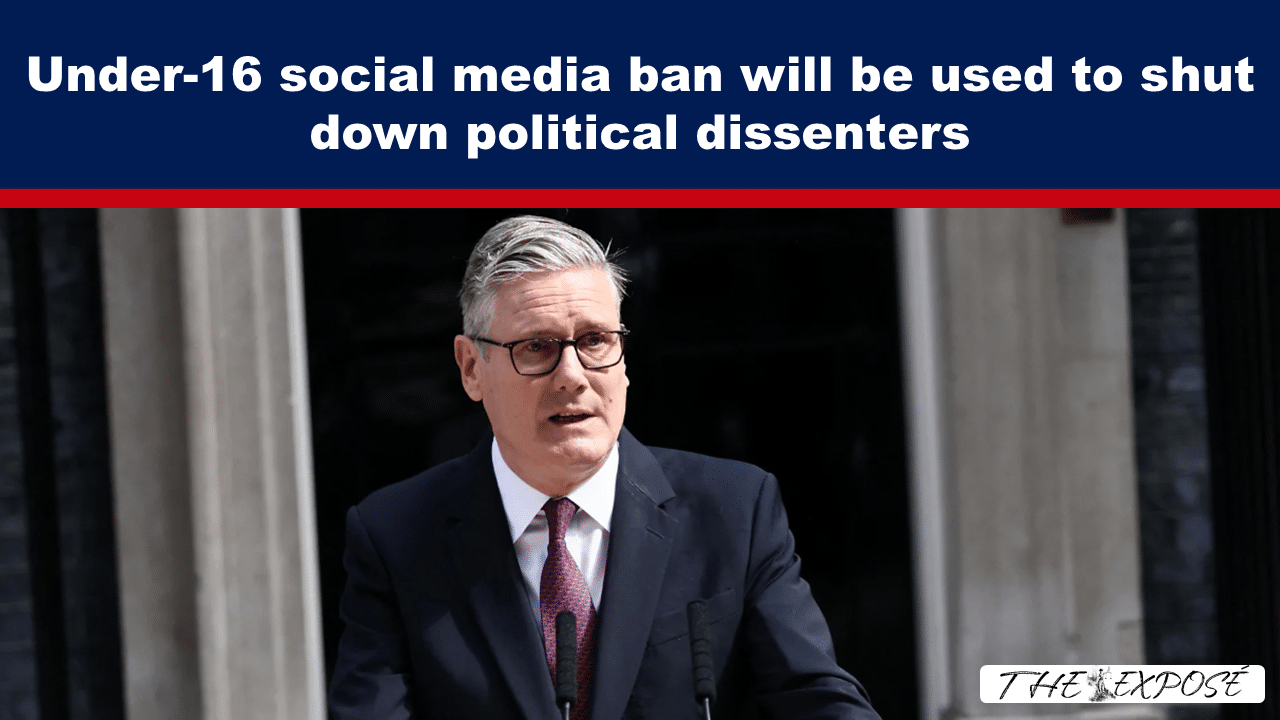
Featured image: Keir Starmer announcing his resignation as Labour Party leader, and therefore Prime Minister. Source: BBC
The Expose Urgently Needs Your Help…
Can you please help to keep the lights on with The Expose’s honest, reliable, powerful and truthful journalism?
Your Government & Big Tech organisations
try to silence & shut down The Expose.
So we need your help to ensure
we can continue to bring you the
facts the mainstream refuses to.
The government does not fund us
to publish lies and propaganda on their
behalf like the Mainstream Media.
Instead, we rely solely on your support. So
please support us in our efforts to bring
you honest, reliable, investigative journalism
today. It’s secure, quick and easy.
Please choose your preferred method below to show your support.

Categories: Breaking News, Latest News, UK News
Starmer doesn’t work for the nation, he works for the Crown.
Clearly, all draconian measures will backfire on the Crown and its government, do they ever learn?
By protecting rapist gangs for decades,
the government has lost its legitimacy to write laws.
In any case,
it’s not those at the bottom but those at the top
who need to be monitored.
Starmers an illuminati puppet and he’ll do as he’s damn well told,just like the rest of the grifters.
I verified a young hottie was 15 without any “ID”. She is an adult at the\at age in hew world.
The governments are working for the oligarchy globalists. They are definitely not serving the people. It is apparent that these globalists have infiltrated the political system, educational system, law enforcement and the courts/ legal system. It is a matter of treason and foreign occupation. The people sitting on the top positions in these government institutions need to be reminded of what the penalty for treason is.
But if one registers to vote, one enters a contract, that gives the Crown corporation an open mandate to do so as it pleases.
So how is it treason?
Just like Tony Blair smirked his way through the so-called enquiry of the 2003 engineered attack on Iraq.