





Islam holds that Muslims are inherently superior to non-Muslims. The Quran encourages this.
For example, Quranic passages refer to non-Muslims as “surely the worst of animals in Allah’s sight.”
These teachings can provide a religious justification that bolsters a rape gang member’s conviction of their own superiority and facilitates the dehumanisation of their non-Muslim victims.
Let’s not lose touch…Your Government and Big Tech are actively trying to censor the information reported by The Exposé to serve their own needs. Subscribe to our emails now to make sure you receive the latest uncensored news in your inbox…
Last year, Rupert Lowe MP (Restore Britain) launched a campaign to raise funds to hold an independent national inquiry into the UK’s Muslim rape gangs. This year, the victim-led Rape Gang Inquiry was held, during which testimonies from victims, parents, carers, politicians, a variety of experts and whistle-blowers were heard over ten days, from 2 February to 12 February. On 16 June 2026, the Inquiry released its report.
Beginning on page 116, the report describes the ‘Influence of Islam’ on rape gang members. We have republished a part of the section below, excluding details of the sources used. You can read the full report HERE.
The Influence of Islam
Muslim Supremacism
Islam holds that those who are righteous and truly fear God, meaning Muslims, are inherently superior to those who reject God’s commands, namely non-Muslims. This idea is captured in Quran 3:110:
“You [Muslims] are the best nation, raised up for humankind, commanding what is good and forbidding what is wrong, and believing in Allah. If only the people of the book [i.e. Christians and Jews] believed, it would be better for them; some among them are believers, but most are perverted.” (Sura 3:110)
The verse positions Muslims as the finest community, entrusted by God with the duty to enjoin good and prohibit evil. This responsibility can be understood as authorising Muslims to correct, compel, or, if needed, punish non-Muslims, potentially through coercion or force. Other Quranic passages affirm Islam’s ultimate supremacy over all religions, as in Sura 48:28:
“It is He [Allah] who has sent His Messenger with the guidance and the religion of truth [Islam], to make it triumph over every religion.”
Non-Muslims who refuse Islam are described in harsh terms, such as in Sura 8:55:
“Surely the worst of animals in Allah’s sight are rejectors [of Islam]; they do not believe.”
The concept of Muslim superiority is closely linked to derogatory views of non-Muslims. For instance, Sura 9:28 labels “associators” (a pejorative term encompassing Christians, Jews, and other non-Muslims) as “unclean” (najis).
These teachings can provide a religious justification that bolsters an abuser’s conviction of their own superiority and facilitates the dehumanisation of non-Muslim victims.
In her July 2020 podcast interview, Rotherham survivor Dr. Ella Hill described abusive language and acts that embodied this sense of superiority. She recounted being made to bend down and kiss her perpetrator’s feet as a deliberate act to underscore her inferiority. She also spoke of another Rotherham victim who, during gang rapes by dozens of men, was forced to lick their feet clean because “they believed they were morally superior to her.” Hill observed: “It’s a Muslim superiority thing: they believe they have maximum moral authority to command the people beneath them to lick their feet.”
She further noted that her rapists viewed non-Muslim habits as inherently impure: “If you’re eating pork you’re unclean, you’re dirty. If you use a knife and fork you’re dirty; if you don’t eat your food with your hands.” [See podcast below.]
‘Us and Them’ Mindset
The Islamic principle known as al-walā’ wa-l-barā’ (loyalty and disavowal) commands Muslims to direct their love and allegiance towards what pleases God while hating, avoiding, and distancing themselves from what displeases Him. In essence, it calls for loving and supporting fellow believers and rejecting non-believers.
This teaching draws on several Quranic verses, including:
“Let not the believers take the disbelievers as allies, rather than of believers – whoever does that has nothing from God – unless you guard yourselves as a precaution.” (Sura 3:28)
“You who believe! Do not take the Jews and the Christians as allies. They are allies of each other. Whoever of you takes them as allies is already one of them. Surely God does not guide the people who are evil doers [i.e. non-Muslims]. Yet you see those in whose hearts is a sickness – they are quick [to turn] to them. … Whoever takes God as an ally, and His Messenger [Muhammad], and those who believe [Muslims] – surely the party of God, they are the victors.” (Sura 5:51–52, 56)
“There was a good example for you in Abraham, and those who were with him, when they said to their people, “Surely we are quit of you and what you serve instead of God. We repudiate you, and between us and you enmity has appeared, and hatred forever, until you believe in God alone.” (Sura 60:4)
These passages emphasise that Muslims should maintain strong bonds within the Muslim community while keeping non-Muslims at a distance and harbouring enmity toward them. The Quran warns that God views non-Muslims with contempt and that Muslims who befriend, ally with, or associate closely with them risk being regarded by God as disbelievers themselves. While some Muslims downplay this doctrine, revivalist movements, which have gained considerable influence in Western countries, have actively promoted it, presenting strict adherence to loyalty and disavowal as vital for the Muslim community’s success in carrying out its divine mission.
Beyond its theological role, al-walā’ wa-l-barā’ has profoundly shaped certain Islamic cultures. In such environments, many Muslims feel strong pressure not to say or do anything that could damage the image of the Muslim community or bring discredit to Islam. Within an honour- and shame-based framework reinforced by these values, speaking out to outsiders about wrongdoing committed by fellow Muslims is often seen as an act of betrayal. This dynamic can have serious real-world consequences. For example, in her book The Imam’s Daughter (2009), Hannan – later known as Hannah – described her experience as a 14- or 15-year-old Pakistani teenager in Britain.
After confiding in a female teacher that her father, an imam, was beating her, the teacher informed the deputy head, who arranged for a male Pakistani Muslim social worker to meet with her at school. Initially terrified because of his background, Hannan eventually opened up to him about being treated as a domestic servant, fearing a forced marriage, and enduring physical abuse. That same afternoon, she returned home to find the social worker speaking with her father and relaying everything she had said. While the social worker was present, her father acted kindly, but once he left, her father subjected her to a severe beating and rape, threatened to kill her if she ever spoke again, and imprisoned her in the cellar for days. When Hannan later encountered the social worker at school and refused further contact, he reportedly told her: “Hey, I was just doing what I thought was right, you know that. It’s not right to betray your community.”
Similar patterns have appeared in accounts from grooming gang survivors. Some have described approaching the police only to be interviewed by Muslim officers who switched off the recording device and urged her to abandon her complaint due to supposed “lack of evidence.”
A deeply ingrained culture of enforced loyalty and community protection can discourage individuals from reporting abuses or providing evidence against members of their own group. Had the social worker in Hannan’s case reported her disclosures to the police, leading to her father facing criminal charges, he would have exposed himself, and by extension those associated with him, to the serious risk of being labelled a traitor within the community.
The prominent Indian-Pakistani Muslim thinker and revivalist Abul A‘la
Maududi, in his influential work Let Us Be Muslims (2016), maintained that
Muslims cannot achieve true success until their highest allegiance is given to God and to the Muslim ummah (community). The doctrine of loyalty and disavowal exerts particularly strong pressure when Muslims live as a minority in non-Muslim host societies. In such settings, as they seek to preserve and assert a powerful collective identity, Muslims may place even greater emphasis on internal solidarity and separation from non-believers than they would in their countries of origin.
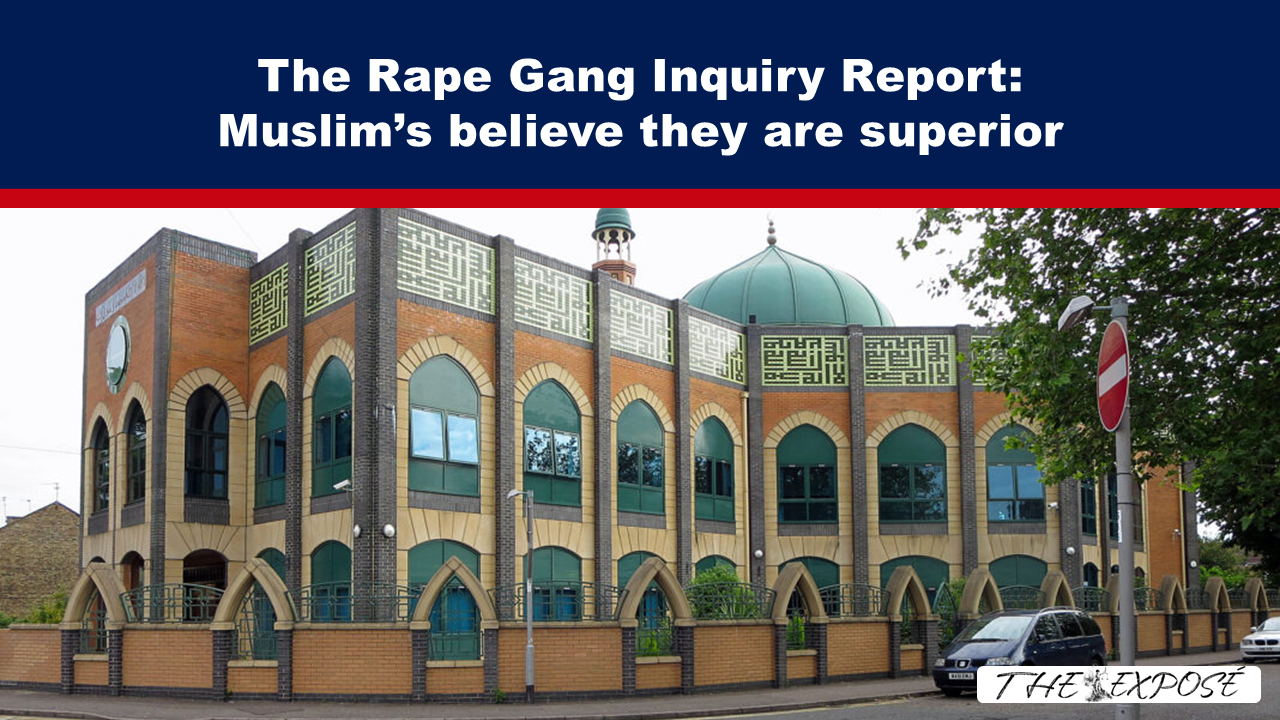
Featured image taken from ‘What are Britain’s ten biggest mosques?’, 5Pillars, 3 August 2025
The Expose Urgently Needs Your Help…
Can you please help to keep the lights on with The Expose’s honest, reliable, powerful and truthful journalism?
Your Government & Big Tech organisations
try to silence & shut down The Expose.
So we need your help to ensure
we can continue to bring you the
facts the mainstream refuses to.
The government does not fund us
to publish lies and propaganda on their
behalf like the Mainstream Media.
Instead, we rely solely on your support. So
please support us in our efforts to bring
you honest, reliable, investigative journalism
today. It’s secure, quick and easy.
Please choose your preferred method below to show your support.

Categories: Breaking News, Latest News, UK News
the Arabic word Islam means submission, surrender, or obedience (specifically to the will of God). It is derived from the triliteral root S-L-M (س-ل-م), which is also the root for the word Salam, meaning peace. Consequently, the term is often understood to signify achieving peace through total submission to God.
Muslims who immigrate into a christian society (according to their own doctrine) takes the Christians as their allies; “Whoever of you takes them as allies is already one of them”. So these ‘Muslims’ should become Christians.
And so in order to promote the peace aspect of the Islam; Imams who fail to promote Christian values should be banned from taking office in the Mosques.
But — they don’t take us as allies. Their presence among us is an invasion; their seeming cooperation is false, a trick to exploit us. They are pulling the rug out from under us inch by inch. When will we topple?
The superiority thing can be performed without foot-licking. If you can tell someone what to do and when and how to do it all the time and be obeyed, you are their boss. Adding actions to humiliate them shows that you are a sadistic boss; you have a serious evil streak. Claiming you have the right to do it is evil. Claiming it’s to teach them the difference between them and you is evil.
Our politicians must themselves have become evil or they would not be bringing Moslems into our countries and giving them so much power over us.