





Since early November, the BBC and its accomplices have been trying to get the public to fear a “superflu” employing a similar but a played down version of the covid operation. But the public hasn’t fallen for it, more than ever planned a night out on 19 December.
On 20 December, the BBC published an article acknowledging that the “superflu” narrative was false – and the “superflu” has suddenly disappeared.
Let’s not lose touch…Your Government and Big Tech are actively trying to censor the information reported by The Exposé to serve their own needs. Subscribe to our emails now to make sure you receive the latest uncensored news in your inbox…
Some people assumed the “superflu” propaganda in recent weeks was being disseminated ahead of yet another strike being planned by junior doctors in England.
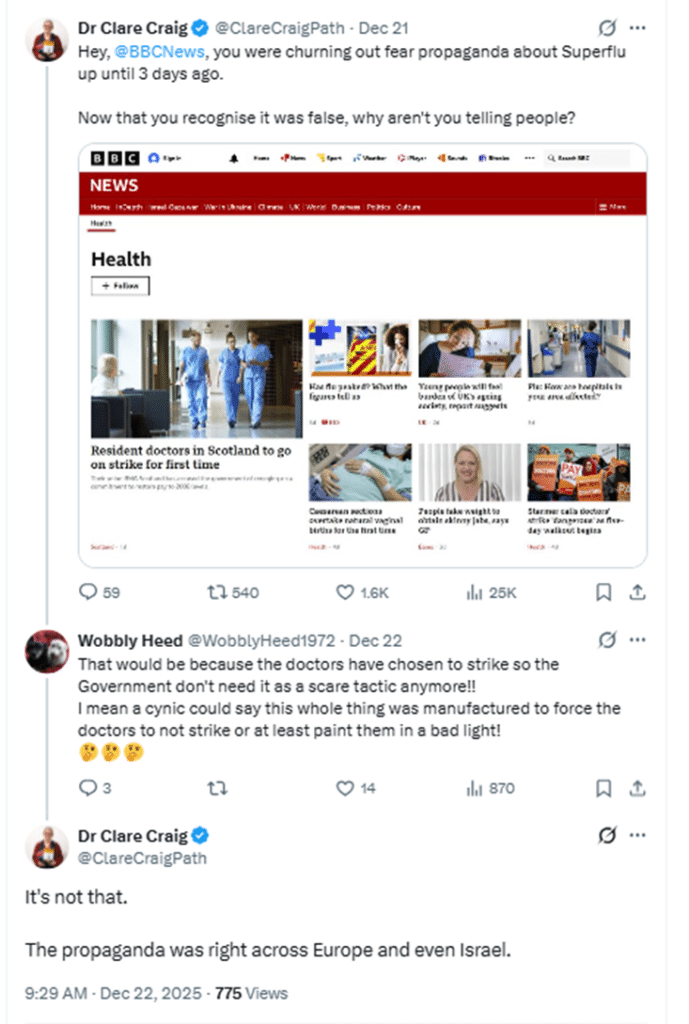
Whatever the reason, the British public didn’t fall for it. Some on social media met stories about a “superflu” with ridicule and others took the view that it was an attempt at a rerun of the covid operation, but what is evident is that, each for their own reasons, the British public chose to ignore it.
A survey conducted by taxi company Veezu found that 34% of people surveyed said they planned on going out on Mad Friday, one of the names given to the last Friday before Christmas, when revellers let their hair down by painting the town (Christmas) red. The company’s data showed over half a million more Brits were set to party the night away this year.
On Monday, Tom Jefferson and Carl Heneghan published an article summarising the “superflu” story so far. Since early October, the two researchers had been warning that the government-media conglomerate was preparing to declare another public health emergency.
“Large stocks of vaccines and antivirals were purchased and renewed and are awaiting use. The avian influenza terror did not [take off] … As early as the 6th of November, the recently appointed Sir Jim Mackey warned the UK was facing a long, tough flu season. Delivered through the BBC, of course,” they wrote. “Then we had the ‘carnage’ and ‘superflu’ with an ambulance and bed crisis, which did not fit with the government’s own data.”
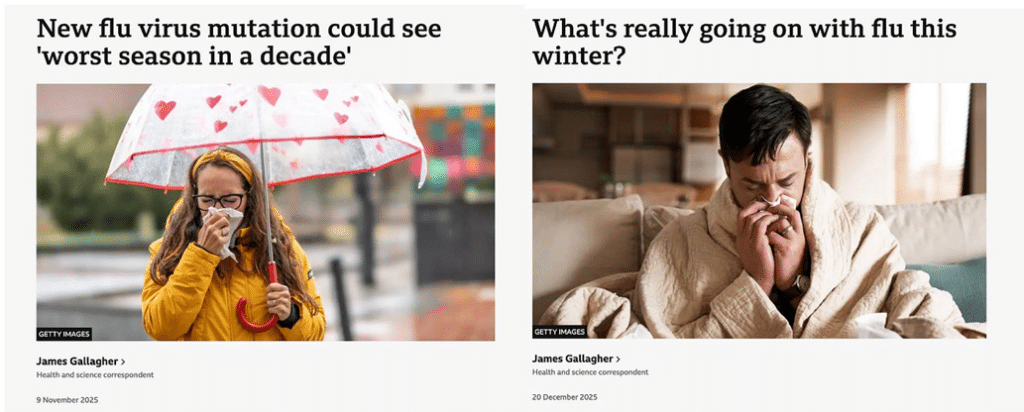
Commenting on Jefferson and Heneghan’s article, Helen McArdle pointed out the contradictions between statements made by “experts” in an article the BBC published on 9 November and statements made by the same “experts” in an article the BBC published 5 weeks later, on 20 December.
The BBC “Superflu” Contradiction
By Carl Heneghan and Tom Jefferson, as published by Trust the Evidence (“TTE”)
In response to the “Superflu” story, Helen McArdle pointed out the stark contradiction between the BBC’s position and its commentators on the 9th of November and the 20th of December.
1. James Gallagher, Health and science correspondent forBBC News:
9th November: New flu virus mutation could see “worst season in a decade.” These are not covid-style lockdowns, but short-term measures the country uses to disrupt the spread of the virus.
20th December: But a “broadly typical flu season” is probably not the sense you’d get from watching or reading the news. Statistical artistry was used to compare an early flu season to one that started much later, allowing claims of flu cases being “an incredible 10 times higher” than in 2023.
2. Prof Chris Fraser, Pandemic Sciences Institute at the University of Oxford:
9th November:“It’s highly likely it’s going to be a bad flu season, and it’s going to happen quite soon – we’re already well into it … There are indicators that this could be worse than some of the flu seasons we’ve seen in the last 10 years.
20th December: “It was basically spreading at a very similar speed to previous years, it was towards the upper end, but it wasn’t an outlier …I don’t think it’s a helpful term, there isn’t a particularly unusual set of symptoms, there’s no indication of it being associated with exceptional severity, exceptionally rapid spread or exceptional health impact.”
3. Prof Nicola Lewis, the director of the World Influenza Centre at the Francis Crick Institute
9th November: “We haven’t seen a virus like this for a while, these dynamicsare unusual … It does concern me, absolutely,” she adds. “I’m not panicking, but I am worried … We’re miles ahead,” says Prof Lewis. “I think it’s going to be a strong flu season …H3 is always a hotter virus, it’s a nastier virus, it’s more impactful on the population.”
20th December: the virus was “not particularly unusual” and that she saw “no evidence” the virus was “particularly different” and superflu “wouldn’t be my description.”
“Meanwhile, NHS hospitals are still requiring staff to wear masks, with all the predictable adverse effects on dementia patients. Absolutely shameless reporting, as if there are no consequences of irresponsible fear messaging other than they’ve twigged that this particular strategy might backfire if overused,” commented Helen McArdle. Indeed, Helen, why let the facts get in the way of a good story?
Related: The “Superflu” story shows that the health MSM is utterly untrustworthy
About the Authors
Carl Heneghan is a professor of Evidence-based Medicine at the University of Oxford, Director of the Centre for Evidence-Based Medicine (“CEBM”) and an NHS Urgent Care general practitioner who regularly appears in the media. Tom Jefferson is a clinical epidemiologist and a Senior Associate Tutor at the University of Oxford. Together, they publish articles on a Substack page titled ‘Trust the Evidence’ (“TTE”).
Featured image: ‘I had the jab – but super flu still left me in hospital’, BBC, 12 December 2025 (Note: Perhaps she got “superflu” because of, and not in spite of, “the jab”).
The Expose Urgently Needs Your Help…
Can you please help to keep the lights on with The Expose’s honest, reliable, powerful and truthful journalism?
Your Government & Big Tech organisations
try to silence & shut down The Expose.
So we need your help to ensure
we can continue to bring you the
facts the mainstream refuses to.
The government does not fund us
to publish lies and propaganda on their
behalf like the Mainstream Media.
Instead, we rely solely on your support. So
please support us in our efforts to bring
you honest, reliable, investigative journalism
today. It’s secure, quick and easy.
Please choose your preferred method below to show your support.

Categories: Breaking News, UK News
Oxford University, captured by big Pharma, remember the Recovery Trial when those elderly seriously ill patients were given probably the highest Hydroxychloroquine dose ever at 9.2 grams over 10 days late in the cause of the Viral Covid infection when viral replication had already ended and their lungs had been destroyed. Those two researchers must have known the timing and high dose were wrong for HCQ
s weak based antiviral action, HCQ has to be started within 3 days of infection, the longer you wait, the less effective HCQ is, (HCQ cant stop viral replication after its ended), they knew that. Oxfords Recovery trial was NEVER intended to show HCQ`s highly effective antiviral effect it was designed to show failure.Do not trust Oxford.do not trust any ‘official’ or ‘newspaper’ propaganda! they made an elephant out of a mosquito as usual. News! shout hard enough and the people might buy out. I think they wisened up after all.
You are right that Oxford University has been captured by big pharma for a long time. For many years they have been pushing cholesterol lies and encouraging the use of statins which do nothing but poison people.
What were the seriously ill elderly patients in the Recovery Trial actually suffering from? We know that Covid-19 doesnt exist. It is a misdiagnosis based on fraudulent PCR testing and common symptoms.
You mention “viral covid infection” and “viral replication” but there is no good evidence to support any of that. Dr Stefan Lanka and Jamie Andrews have clearly demonstrated experimentally that virology is a fraudulent pseudoscience. There is no good evidence supporting the existence of human pathogenic viruses at all.
Hydroxychloroquine is an antiparasitic drug which might also modify the immune response. Any clinical benefit seen with this drug has nothing whatsoever to do with its supposed “antiviral effect”.
All one can say in response to the fear-mongering from the media is: “unvaxxed and unafraid”.
Many have tried to explain “Seasonal flu as to why it is seasonal,
or as denial as “No such thing as a virus”, or sunlight immunodeficiency bio-resonance “infection” transmission, or pseudo-scientific conjecture as a lack of vitamin D.
Not least a flu jab as probably more the disease than the cure such is the increasing use of highly toxic adjuvants.
What is certain is hospital admissions to NHS for supposed flu UKHSA data suggests an early than usual surge in September 2025 to then “stall” by December, and has stopped increasing as now flat (my UKHSA Hospital admissions for Flu, Chart).
For those that believe in viruses, whatever the fear mongering Main Stream Media agenda, there was valid concern until the “stall” in December, however what about Flu seasons 2022, or 2024 as actual even worse and little said.
I assume made-up pandemics sells papers and as a money-making exercise to online readers.
Current media hysteria about Flu 2025 10.32/100,000 somehow ignores similar issues for Flu 2022 as nearly twice that at 18.9/100k Hospital admissions and for Flu 2024 16.18/100k
A Flu 2025 that has flattened at 10.32/100k admissions is still bad, but a Media that failed to report fear porn for significant surges in Flu 2022, and Flu 2024 outbreaks.
All of which fails to explain the Flu2025 media hysteria.
What happened to the Flu reporting media in 2022 to ignore 18.9/100k admissions, yet for 2025 as only half that.
A profit making Main Stream Media on overdrive hysteria “fear porn”?
https://johnblundell.substack.com/p/how-dangerous-is-this-years-flu?r=3fft71
https://johnblundell.substack.com/p/the-infection-fatality-rate-ifr-of?r=3fft71
UKHSA Hospital Admissions Data source; https://ukhsa-dashboard.data.gov.uk/respiratory-viruses/influenza
Most seasonal flu follows the seasonal vaccines that people still take my mother always got pneumonia after her jab she had long term Alzheimers none of the care home staff ever took the vaccine and I asked them all !!!
They have cried wolf too often…the net result is that they look like clowns with zero credibility…a total joke and a farce to be laughed at
Cancel your TV Licence folks
The BBC has now made it totally Superfluous
I did 5years ago when they tried on the Covcon19. You dont get any problems provided you call them once a year and state you dont watch BBC, I player or anything live. I dont. I have nothing but contempt for lying journalists. My sister watches the BBC News and her opinions on world affairs are utter garbage because of it. Their propaganda is constant and dangerous to our society. What’s changed?
https://x.com/realstewpeters/status/2003114710322000189/mediaViewer?currentTweet=2003114710322000189¤tTweetUser=realstewpeters
Be interesting Rhoda to get your feedback on the clip below from Charlie Kirk talking about the stand down order.
Guess there are thousands of reasons people in the media are not interested in covering this.
It’s not like he was assassinated shorty afterwards!
Investigative journalism vs the greenback.
Same people regularly quote scripture!!
Talk about cognitive dissonance…
Hi Paul Watson, you are obsessed with Charlie Kirk while ignoring everything else that’s going on in the world … I wonder why that is?
It is reminiscent of the covid PsyOp, when they endeavoured to get the world to focus on a single virus. Why? Because while people were focused on one thing, it allowed them to get on with their other plans unnoticed. Fortunately, many of us didn’t fall for it.
Why are you attempting to focus people on one thing while ignoring all else? What are you attempting to distract people from? Whose agenda are you attempting to further?
PS, the link to the tweet you’ve shared is unavailable. If you click on the link you provided it says, “Hmm… this page doesn’t exist. Try searching for something else.”
Rhoda, was that canal embankment incident in Shropshire, sabotage? Any thoughts!?
Hi Islander, I hadn’t given it much thought. When I walk along the canal that goes through our town to a nearby village, about 1-2 miles out of town the canal bank is in such bad condition that I suspect it will collapse any day. We used to walk along this tow path to the next village to have a pub dinner etc. But I wouldn’t recommend anyone walk along this tow path after dark now: you’re likely to end up in the canal and if you’ve had a few glasses of wine (or mulled wine in the winter), who knows if you’d survive your late night swim.
Our town is on the Oxford canal which is popular with narrow boats for people who live on narrow boats, people who operate businesses from narrow boats and tourists, so the canal sees a lot of traffic and walkers etc.
About 3 years ago, I was walking along the canal (where the tow path is still in tact and we don’t have to hop over gaps where the path has disappeared/eroded into the canal), someone who had been employed by the council stopped and asked me what the condition of the tow path was like. I told him that it was fine for about a mile and then it is in an appalling state and will one day soon be impassable. He mentioned that his remit was only to survey/ensure tow paths in the built up area (i.e. close to town) were walkable.
I conclude from this brief encounter that investment in the maintenance of the canals are one of the projects that the UK government has ignored in favour of the “green” revolution, immigration, imposing woke ideology through educational and public institutions, development of an AI driven society/economy, investment in the war in Ukraine and propping up the EU etc. So to me, a collapse of a canal walls is inevitable – a disaster waiting to happen through lack of maintenance – and we are likely to see more of it in coming years. Fortunately in the recent instance no one was killed … next time this might not be the case.
Rhoda,
Sabotage through lack of maintenance, perhaps?
If I were to be entrusted with the maintenance of your car and knowingly overlooked the poor state of your car’s braking system; what could be the consequence thereof? I shudder to think.
As a kid in the early 70’s I lived but a stones throw from the Stroudwater canal and river flowing into it-I near daily walked our dogs up and down the towpaths (before the awful poo-bags!) and spent many an hour fishing there. I was mindful back then of the poor state of repair the lock gates and canal were in. There were no artificial man-made embankments like the one that collapsed in Shropshire, so a potential disaster such as the one that could have unfolded there was never “on the cards”.
TPTB are very aware where these embankments/aqueducts are, and whether they are structurally sound, or not. But more than this, the narrowboat owners and hire companies would (or should, you would think?) also be aware where these pre Victorian man made waterways are, and the possibility of an imminent collapse at any moment?
Presently, in the UK there are hundreds, if not thousands, of old road, rail, and waterway bridges/ducts that are daily being assessed and ‘temporarily’ closed due to deterioration-Oh! how this well fits in with the 15 minute city agenda!
If TPTB were to invest the wasted £trillions they are currently spending (as you assert) on the renewable energy sector on our aging road, rail, and canal networks, can you imagine how wonderful our travel infrastructure would be…but alas…
Hi Islander, you say, “Sabotage through lack of maintenance, perhaps?” It’s possible, but is it probable? Canals are no longer used for transport, they’re now used for recreation and tourism. What reason would the government have to sabotage the canals, i.e. what purpose would it serve?
Rhoda,
There has been talk in certain circles regarding the reinvigoration of the canal system.
I took interest in this particular episode because I know that the “recreation and tourism” industries are being taken apart by TPTB-in the aim of creating a dystopian and fear regulated regime.
Do you know anything of the One Coast Agenda? Coastal Partnership Network-and a whole host of other NGOs?
From reading the testimonies of two of those narrow boaters that escaped disaster in the Shropshire incident-they don’t want to live on the water again.
I’m surrounded by water-everywhere I look!
Don’t all rivers/canals flow into the sea?
Hardly focused on one thing Rhoda if you check my posts the last 5 years.
Your coverage of the topics that MSM clearly avoid is admirable, especially Covid and CC.
That’s what saddens me is that you avoid the assassination of CK, as it’s so obvious (with a little research) that TR did not do this or if he was involved it was as a patsy. Who paves over a crime scence within 48 hours or cleans and sells the vehicle used to ferry him to hospital in 24 hours or that the FBI DON’T check his mobile phone!!
It’s clearly a politically motivated assassination and cover up.
Media paid like JFK to remain silent.
Guess I was hopeful you may cover it but the tentacles are far reaching.
Apologies for the link not working, next time I come across CK discussing the stand down order for Israel I will post it again..
Hi Paul Watson, what is the point of checking your comments over the years? Charlie Kirk wasn’t murdered years ago, so unless you claim to have “clairvoyance” you wouldn’t have been commenting on it over the years.
No need to provide the link of “CK discussing the stand down order.” It has been posted hundreds of times on social media, so much so that no one, by now, could have missed it. Every time I’ve seen it, it is accompanied by anti-Jewish rhetoric – very obviously anti-Jewish propaganda and activism. The anti-Jewish lobby have lost all sense of logic and reason at this stage.
As I said, you’ve become obsessed. I provided a link to more recent discussion of the theories in the aftermath of his murder in response to an earlier comment of yours – there have been a few, including false accusations against me and The Expose to try to harass us into publishing something that promotes your worldview. That link showed the bizarre claims being made and why they are debunked. I guess, it didn’t suit your narrative so you haven’t bothered watching it … If you had bothered to watch it, you will have seen that Candice Owens has egg on her face due to the bizarre claims she’s been making, but at least she has had the courage to admit she was wrong and was spreading nonsense.
Now … take a break from getting anxious about Charlie Kirk and focus on what is important in the next few days. What’s more important than Charlie Kirk, you might ask? Jesus died for our sins – if you are unable to be grateful for what He did throughout the year, give Him at least one day in the year when we focus on Him – when we contemplate why He was born, lived, suffered and died. In case you’re unaware, it was so that we might live.
Merry Christmas to you and yours. May you choose to accept the greatest gift of all that only Jesus can give – eternal life.
https://youtu.be/OUShpD8YUkU?si=SnpSpBNsFHtxs8J9
https://rumble.com/v73ceoe-charlie-kirk-did-israel-give-a-stand-down-order-on-october-7.html
I to have been very concerned about the murder of Charlie Kirk. It was done in front of crowds of young people and on a world wide stage. Like you I am aware they had a patsy lined up and FBI are refusing to investigate. As far as I am concerned they must not be allowed to murder and walk away without repercussions.
I am worried that this murder is political and it is possible that CK was going to stand for President up against Vance. That wasn’t going to be allowed? Also Mrs E Kirk is so obviously up to her fraudulent neck in this.
Saying that like you I am more than capable of being able to also focus on issues going on all over the world.
As a Christian I don’t accept “good men should do nothing”. I have been watching Candace Owens and Jimmy Dore. I want to see justice done, as do they. I want justice for everything dark that is going on in the world. All we can do is push back against the obvious evils surrounding us.
I don’t accept that we are living in the end times,
just that we are living in very difficult times and we are being tested, and being forced to awaken to a reality we weren’t aware of, that governments are against us, not for us. I heard an ex EU Banker stating their are 3 classes in the world “The Elites” “The Enforcers” “The Slaves”. Very sobering when you realise what class your in.
“Covid” was also a flu/cold event… just like we have had for centuries every year. There was NEVER a “pandemic” except for a pandemic of propaganda, lies, and fear. But there was a sick agenda behind it all in 2020… the rollout of “safe and effective” mRNA gene editing injections conveniently re-classified as “vaccines.” We should probably remember that if these monsters had a new “vaccine” they wanted to roll out on the whole world they would be pushing the fear narrative much harder than they are. We must *never* forget what has happened over the last 5 plus years and resolve to *never* allow it to happen again. Colds, “flu”, bacteria, mold, fungus… these have been with us for the entire existence of humanity and they are never going away. “There is nothing to fear, but fear itself.”
Flu is the bodies detox no such thing as a virus…
Hi Andy, have you ever undertaken a detox regimen?
Thank you Andy,
For understand the fairy tales of Pseudo-science from some people who labelled themselves a scientist or professors but actually a fraud and they claim can see on a small particals that CAN’T even be seen with most advanced or high-tech microscope.
This is because VIRUS was 100% does NOT exist.
Electron Microscope can’t detect virus. Most of the BLACK-&-WHITE image captured was not a virus but our own cells releasing a dead-toxic shedding cellulars.
VIRUS actually a VENOM…… Example: venom manufactured by a snake venom gland, not a living organism but a smart protein with specific instructions embedded to attack & stop function of certain organs such as Heart or nerve system.
The same method (immitate venom) was manufactured by BigTech Pharma in vaxx, to attack the specific organs such as Brain Cells, Heart, Reproductive Organ & nerve systems…
Soon, more VAXXED people will contracted Auto-Immune disease, ADHD, Dementia, Cancer, Heart problems & becomes barren (can’t have children).
Pushing another questionable vaccine ?