





“National CO2 emissions do not include emissions from: imported goods; the UK’s international investments; UK companies’ overseas factories; nor from international shipping and aviation not allocated to the UK.
“These exemptions have led successive governments trying to win the Net Zero accounting game to promote offshore production and discourage the extraction of UK oil, gas and coal.”—GBBC
Who sets the rules for Net Zero accounting? The United Nations. These UN-dictated national CO2 emission targets are not legally enforceable and there is no penalty for failing to meet them. Yet the UK government has slavishly adhered to the UN’s requirements, regardless of the devastation it has done, and is doing, to the UK’s economy.
In pursuit of its destructive Net Zero policies, the UK government is regulating and taxing national oil and gas assets out of production.
Let’s not lose touch…Your Government and Big Tech are actively trying to censor the information reported by The Exposé to serve their own needs. Subscribe to our emails now to make sure you receive the latest uncensored news in your inbox…
On 1 April, the Great British Business Council (“GBBC”), a newly formed think tank, published a paper titled ‘Premeditated Industrial Destruction: How the UK Destroyed Its Industry and A Plan To Reverse This’.
The paper is authored by economist Catherine McBride, retired engineer and consultant David Turver and public relations consultant Brian Monteith. It demonstrates how the Government’s Net Zero policies are destroying the foundations of the UK economy and provides recommendations on how Net Zero could be reversed.
Because this paper is important in revealing some home truths, we are reproducing it in a series of articles, more manageable chunks if you will, so that, hopefully, more will read it, or at least read part of it. We have made some minor edits for readability purposes. For those who choose to read the paper in one sitting, you can do so HERE.
Chapter 1: The long day’s journey into darkness
By Great British Business Council, 1 April 2026
Table of Contents
- Introduction
- Global emissions
- Net Zero calculations for dummies
- Who sets the rules for Net Zero Accounting?
- The UK’s journey to industrial destruction
- The self-harm of high taxes on oil, gas, coal and electricity
- Main taxes on the oil and gas industry
- Other carbon taxes
- Emissions Trading Scheme (“ETS”)
- Carbon Price Support (“CPS”) tax
- Climate Change Levy (“CCL”)
- Electricity network balancing and curtailment costs (“BSUoS”)
- Contracts for Differences Levy (“CfD”)
- Capacity market
- Transmission Network Use of System (“TNUoS”)
- Distribution Use of System (“DUoS”)
- Renewable Obligations (“RO”)
- Feed-in tariffs (“FiT”)
- Nuclear Levy – Regulated Asset Base (“RAB”)
- Tax exemptions and discounts
- Energy Intensive Industries Support Levy (“ESL”)
- How regulations choked off investment in oil, gas and coal
- Net Zero nonsense undermines UK growth, employment and revenue
- About The Great British Business Council
Introduction
Oil, gas and coal are the keystones of all industrial economies and the basis of the UK’s wealth. Closing these industries before there is a plentiful, inexpensive alternative source of industrial heat, transport fuel, electricity and hydrocarbon inputs for chemical processes is economically debilitating.
Even Dieter Helm, a former adviser to Boris Johnson on Net Zero, argues that the energy transition from reliable, cheap hydrocarbons to expensive, unreliable renewables is undoubtedly leading to “permanently high energy costs and diminished industrial competitiveness.”
Similarly, Sir Jim Ratcliffe, Chairman of INEOS, the UK’s largest chemicals business, adds that deindustrialising Britain is not reducing global emissions: “De-industrialising Britain achieves nothing for the environment. It merely shifts production and emissions elsewhere. The UK, and particularly the North, needs high-quality manufacturing and the associated manufacturing jobs. We are witnessing the extinction of one of our major industries as chemical manufacturing has the life squeezed out of it.”
The UK economy remains dependent on hydrocarbons, as acknowledged by the Department for Energy Security and Net Zero (“DESNZ”) in its 2025 Energy Brief. This paper examines how 78% of the UK’s energy needs are met by oil, gas and coal. Electricity accounts for only 22% of final energy consumption in the UK, and 31% of that was generated using gas in 2025, according to National Grid statistics. Unfortunately, successive UK governments have chosen to encourage companies to import just under half of the oil the UK uses, half of the gas, and almost 90% of the coal. The UK also imports approximately 10% of its electricity. The UK relies on imports for 43.8% of its total energy, even though it has ample reserves of coal, oil and gas.
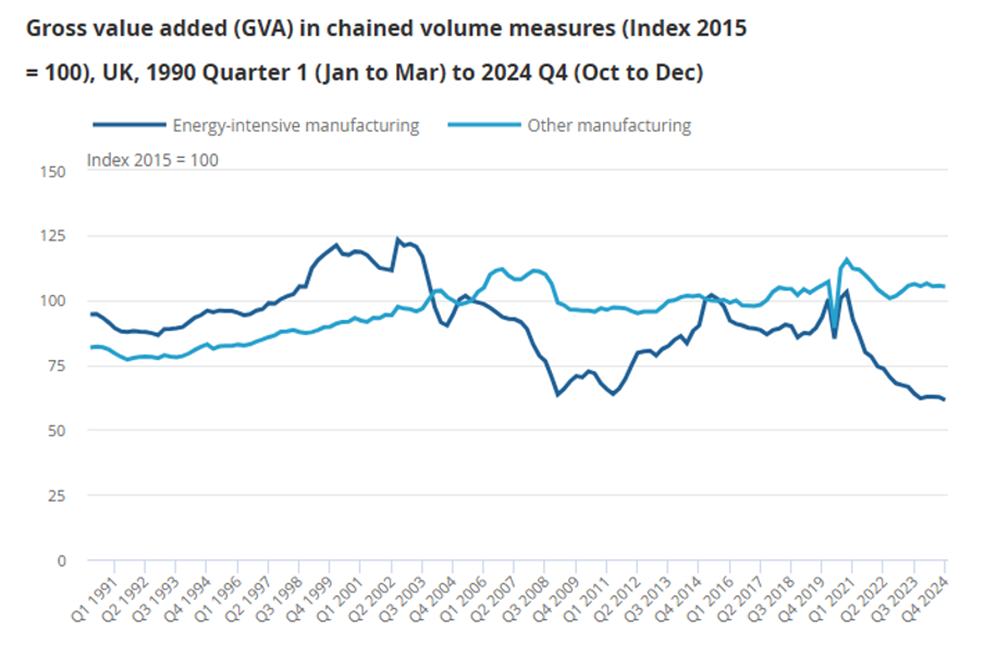
All that the UK’s pursuit of Net Zero CO2 emissions has achieved is a fall in energy-intensive industries to the lowest level in 35 years, according to the ONS (see Figure 1). Industrial production, exports, economic productivity, and employment have all fallen as a result.
Global emissions
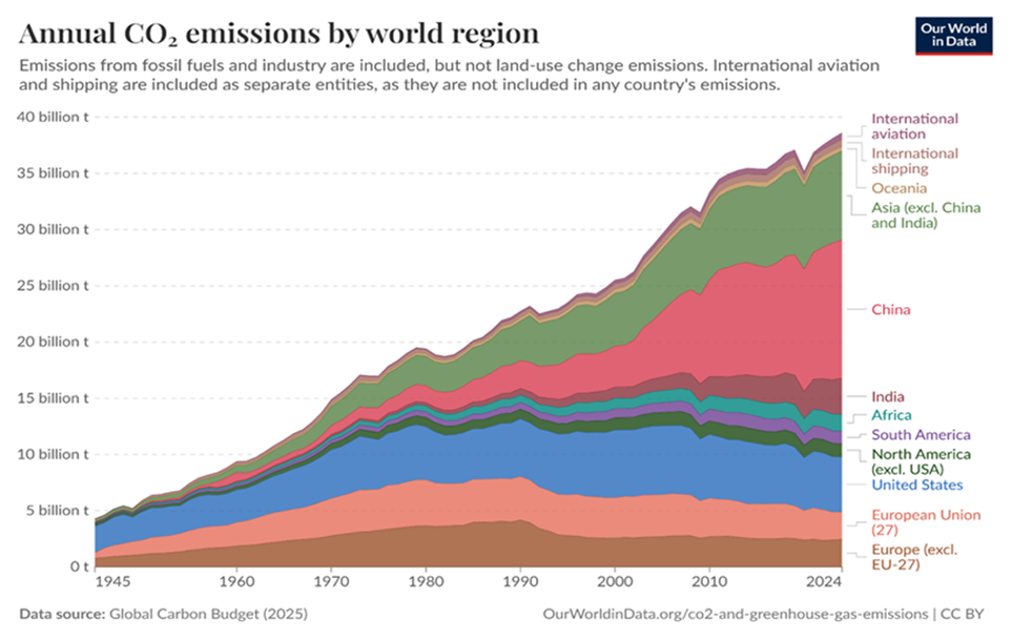
In 2024, global emissions from man-made sources, hydrocarbons and industry reached 38.6 billion tonnes, up from 38.09 billion tonnes in 2023. The year-over-year increase was 510 million tonnes, surpassing the UK’s total CO2 emissions from these sources, which were 312.91 million tonnes in 2024. Despite this, UK politicians believe that achieving Net Zero in the UK will impact global emissions and continue their quest to reach Net Zero by 2050.
In 2019, the UK accounted for 1% of global emissions; by 2021, this had decreased to 0.9%, and it currently stands at 0.8%. The reason? Global emissions are rising overall. UK emissions have remained nearly constant since 2022, whereas global emissions increased by 3% from 2022 to 2024. In short, the UK’s frugality is not affecting global emissions. It is just destroying our industry.
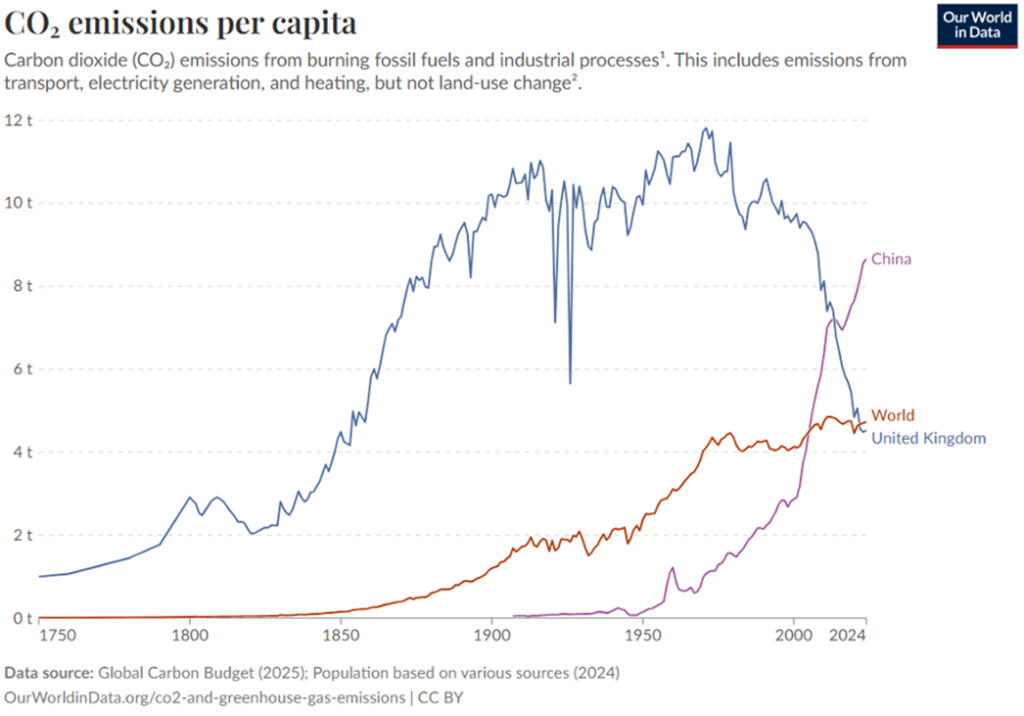
As UK total emissions currently exceed 300 million tonnes and global emissions increased by over 500 million tonnes last year, the futility of the UK’s Net Zero exercise is becoming apparent to everyone. UK per capita emissions of 4.53 tonnes of CO2 per person are now just over half those of China (8.6 tonnes of CO2 per person) and below the global average of 4.73 tonnes of CO2 per person. See Figure 3, below.
Net Zero calculations for dummies
First, what does Net Zero mean?
The UK is trying to reach Net Zero CO2 emissions. It calculates net emissions as its production of CO2 equivalent emissions (CO2e) from electricity, heating, transport, industry, agriculture, waste, buildings, aviation and shipping, less the CO2 it removes from the atmosphere in forests, soils, peatlands and engineered removals from carbon capture and storage and bioenergy with carbon capture and storage.
Unfortunately, the UK currently removes no CO2 from engineered processes such as carbon capture and storage (“CCS”), nor are there any other countries operating commercially sized direct capture of carbon dioxide from the atmosphere. There are systems for capturing and storing CO2 emissions from industrial processes and energy production, but only one company, Climeworks, in Iceland, is currently mechanically removing CO2 from the air and storing it in basaltic rock, capturing thousands of tonnes of CO2 per year rather than millions. Direct Carbon Capture and Storage is very energy-intensive and therefore very expensive in the UK, although possibly economic in Iceland, where power comes predominantly from geothermal sources.
Therefore, the only avenue available to the UK to reach Net Zero is to: increase energy costs through taxation, thereby reducing consumption by consumers and industries; encourage UK industry and extractive industries to relocate offshore; or pay farmers to turn productive farmland into forests and to re-waterlog drained peatlands.
Reforesting UK farmland and rewetting drained peatlands won’t be enough to meet the UK’s Net Zero Targets, nor would doing this make a difference to global emissions. UK forests currently sequester only 18 MtCO2/yr, whereas rewetting peatlands could reduce UK emissions by an additional 20 MtCO2/yr, and non-peat soil CO2 absorption could bring the total to 40 MtCO2/yr. Currently, only 13% of the UK’s landmass of 24.5 million hectares is forested. The UK would need twice its total land area, 54.5 million hectares, of only forest to absorb its current CO2 emissions. Short of leasing some land from Australia or Canada to plant forests, reaching Net Zero in the UK by tree somewhere else is a fool’s errand. Ironically, leasing land in Australia and Canada is not a joke, as it may appear. Several companies do this or sponsor other forestry programmes in developing nations to claim zero emissions.
The UK government has bet the farm, literally and figuratively, on both outsourcing emissions and developing a mechanical method to capture and store CO2. And UK politicians have made this bet without questioning how the UK population will remain employed, or earn enough to pay for the food, energy and manufactured goods it will need to import.
Winning the UNFCCC’s climate accounting game
National emissions do not include emissions from: imported goods; the UK’s international investments; UK companies’ overseas factories; nor from international shipping and aviation not allocated to the UK. These exemptions have led successive governments trying to win the Net Zero accounting game to promote offshore production and discourage the extraction of UK oil, gas and coal. Net Zero has become a game of point-scoring among governments that are concentrating solely on reaching their CO2 emissions targets for international recognition, without recognising the devastation they have caused to the UK economy as a whole.
How the UK reduced its emissions: the only things that made a difference
• Replacing coal-fired electricity with gas-fired electricity, as gas has about half the emissions of coal.
• UK methane emissions from the waste management sector decreased by 71% between 1990 and 2019. This was due to improvements in landfilling standards, changes in the types of waste sent to landfills and increased use of landfill gas for energy. Methane emissions from landfills are one of the leading sources of global methane emissions, not burping cattle.
• Deindustrialising the UK by taxing and regulating emission-intensive industries until they moved their manufacturing out of the UK and then imported the goods they used to make. The UK imported goods, resulting in 180 million tonnes of CO2 emissions in 2023, 180% higher than in 1990. For the UK to claim it has cut its emissions by 300 million tonnes while importing goods that emit 180 million tonnes elsewhere is untenable. (See Figure 4, below.)
Since 2019, the UK has lost an estimated 150,000 to 200,000 industrial jobs due to deindustrialisation and high energy prices, with the steepest declines in energy-intensive sectors such as steel, chemicals, ceramics and paper. Manufacturing’s share of UK GDP has halved since 1990, from 16% to just 8%. Unsurprisingly, UK carbon dioxide emissions have also halved over the same period, not due to a successful “Green” transition but simple deindustrialisation.
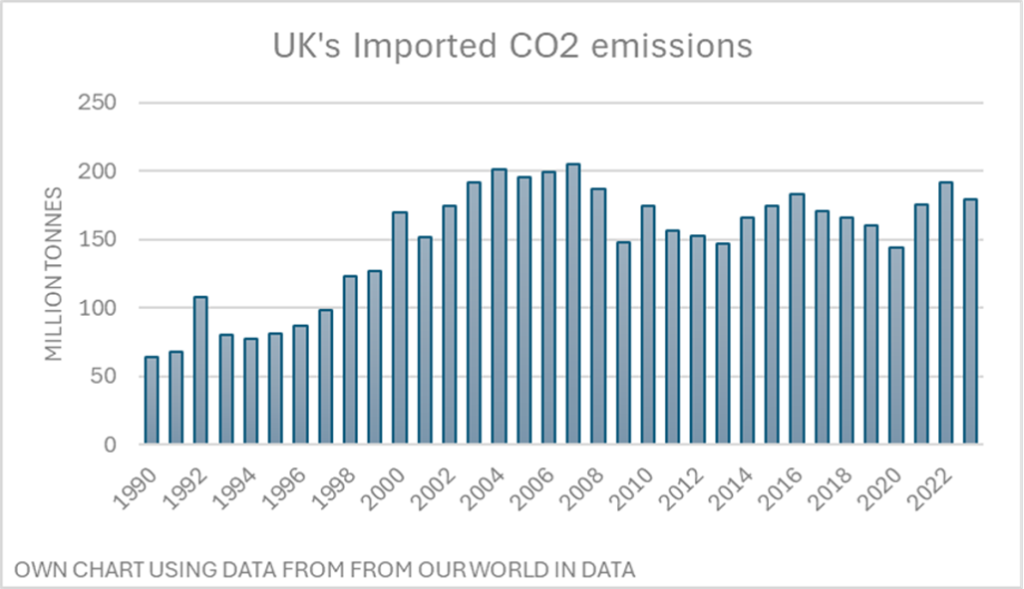
Figure 5 below shows UK consumption emissions and UK territorial emissions. Rather than halving UK emissions since 1990, the UK has simply exported them. If we include the emissions associated with imported goods, the UK has reduced its consumption-related emissions (production plus imports) by 27% and its consumption-related emissions relative to its 1990 Paris Agreement emissions baseline by just 19%, not by the 50% that it claims.
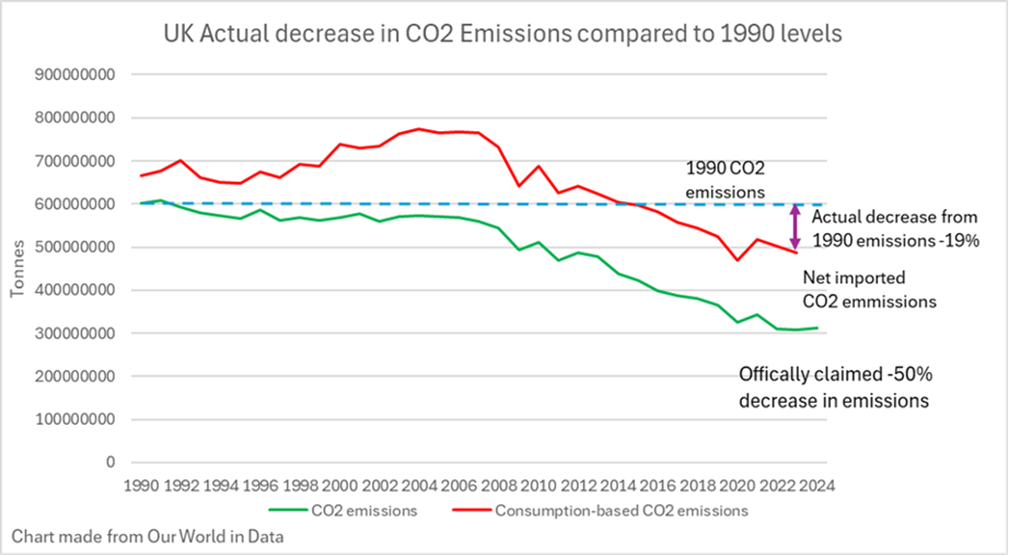
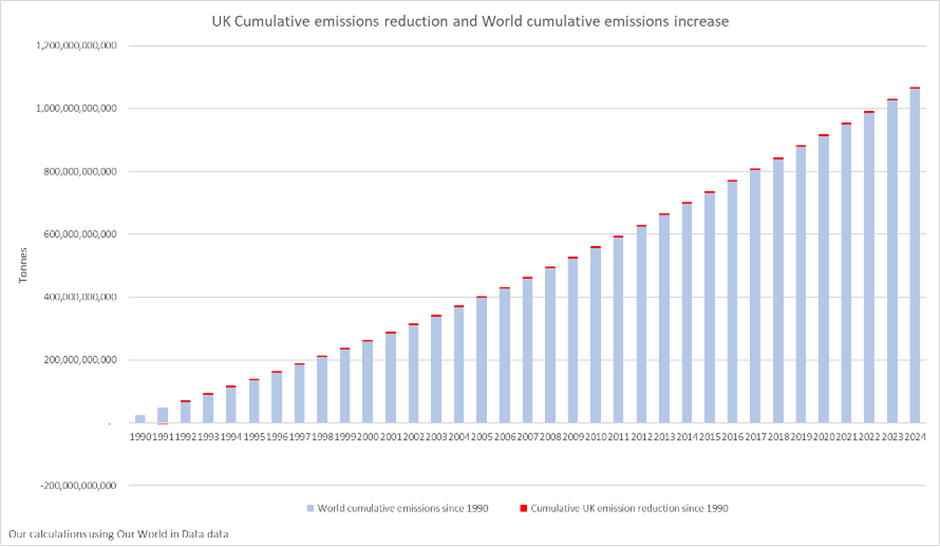
This has made no difference to global emissions, as shown in Figure 6 below, but it has had a devastating effect on UK industry, manufacturing GVA, the UK’s trade deficit and its employment, as shown in Figure 1. In Figure 6 below, the UK’s emission reductions are barely visible relative to the increase in global emissions. UK cumulative emissions reductions since 1990 amount to 0.03% of cumulative global emission increases over the same period. Total UK reductions amount to just 290 million tonnes of territorial emissions since 1990, (excluding imports), while cumulative global emissions have increased by 1.07 trillion tonnes over the same period.
Who sets the rules for Net Zero Accounting?
The United Nations and the Intergovernmental Panel on Climate Change (“IPCC”) established the rules for how and what is counted as a country’s emissions. The United Nations Framework Convention on Climate Change (“UNFCCC”) legally requires countries to produce national greenhouse-gas inventories in accordance with the IPCC Guidelines. This covers the gases that must be counted, which sectors must be included, how to measure emissions and removals, and how to treat land uses, forests, peatlands, agriculture, industry, energy and waste. All countries must submit their greenhouse gas inventory to the UNFCCC. This is the legal basis for a country’s carbon budget and its Net Zero Accounting.
Although the Paris Agreement is a legally binding treaty under international law, adopted at COP21 and by the United Nations, it only obliges countries to submit a Nationally Determined Contribution (“NDC”) every five years. National CO2 emission targets are not legally enforceable, and there is no penalty for failing to meet an NDC. Another weakness of the Paris Agreement is that each country sets its own NDC emissions targets. The UK has slavishly adhered to the UNFCCC requirements, regardless of the devastation this has done to its economy, and met its NDC in 2020. However, China’s NDC was to continue increasing its emissions, with a soft target to reach peak emissions “around” 2030. India signed the Paris Agreement without committing to cap its emissions at all. China and India were able to do so by claiming they remain developing economies. Although their per capita emissions may be lower than those of many Western nations, China is now the world’s second-wealthiest economy and India is the fifth. Together, China and India accounted for 40% of global emissions in 2024, and this share is projected to continue to increase – even as signatories to the Paris Agreement.
To add to the absurdity of Net Zero accounting, the UN requirements do not include the 1kg of CO2 emitted per day by a human. The UK’s 68 million inhabitants exhale about 25 million tonnes of CO2 a year. China and India each have about 1.4 billion people, so human exhalation should add approximately half a billion tonnes of CO2 per year to each country’s total emissions. This exceeds the UK’s total emissions and equals last year’s global increase in emissions, yet it is not counted under the UNFCCC.
It is unsurprising that the United States, during President Trump’s first term, decided to withdraw from the Paris Agreement. The Biden administration rejoined in 2021, but the Trump administration’s State Department published in January 2026 a list of 66 international organisations it intends to leave, entitled ‘Withdrawal from Wasteful, Ineffective or Harmful International Organisations’. On the list are the UN Framework Convention on Climate Change, the Intergovernmental Panel on Climate Change and the bodies of the Paris Agreement. Any new UK government should consider doing the same. Both President Trump and his Energy Secretary, Chris Wright, urged the UK to abandon its Net Zero programme in speeches delivered at the World Economic Forum Annual Meeting in Davos this year.
On 12 February 2026, President Trump revoked the US Environmental Protection Agency (“EPA”) greenhouse gas endangerment finding, which removed the requirement for the EPA to regulate CO2 and other greenhouse gases, such as methane and water vapour, under the Clean Air Act. Treating CO2 as a pollutant has governed US federal regulatory policy since 2009; the removal of the endangerment finding will reduce restrictions on US power generators, oil and gas producers, heavy-duty trucking, manufacturing and chemical production. Although some US states have regulations that will prevent a wholesale industrial revival in the US, this change is something the UK should also be following.
The UK’s journey to industrial destruction
Politically, the UK has been moving toward the dismantling of its hydrocarbon extractive industries for many decades. Almost all post-war UK governments, including those of Harold Wilson and Margaret Thatcher, either closed down, increased regulations, or increased taxes on the industry as a whole or on parts of it. The only exception was the brief government of Liz Truss, which proposed lifting the fracking moratorium, but Rishi Sunak ousted Truss before it could take effect.
• Margaret Thatcher may have inadvertently started the UK’s pursuit of Net Zero when she warned the UN in 1990: “The danger of global warming is as yet unseen, but real enough for us to make changes and sacrifices.” In her 2003 memoir, Thatcher expressed regret for the “apocalyptic hyperbole” she had unleashed and lamented how the climate-change narrative had ossified into a “dogma.”
• Thatcher established the Hadley Centre for Climate Prediction and Research in 1990, which to this day produces the primary datasets for the Intergovernmental Panel on Climate Change (“IPCC”).
• The “dash for gas,” which took off in earnest in the early 1990s, was already reducing UK CO2 emissions, at no cost to consumers and long before the Climate Change Act.
• The UK Major Government signed the UN’s 1992 Rio Declaration, which consisted of 27 principles intended to guide countries in future sustainable development.
• The Blair government signed the 1997 Kyoto Protocol, committing the UK to reducing emissions. John Prescott was the UK representative at the 1997 Kyoto Protocol meeting and played a prominent role in negotiating the UK’s commitments within the EU framework.
• The EU introduced its Emission Trading System (“ETS”) in 2005. This was the world’s first large-scale international carbon market. The ETS requires power generators, heavy industry and intra-EEA aviation to buy allowances for every tonne of CO2 they emit. It also caps total emissions by limiting the number of allowances sold, with zero allowances sold by 2039.
• The Labour Government under Gordon Brown signed the Climate Change Act in 2008. Both the Conservative and the Liberal Democrat opposition parties claimed the target reduction was too low. Only five Members of Parliament (“MPs”) voted against the bill in its second reading, and only three MPs, Christopher Chope, Peter Lilley and Andrew Tyrie, opposed it in its third reading.
• The Climate Change Act 2008 required the government to:
- reduce greenhouse gas emissions by 80% below 1990 levels by 2050
- reduce carbon dioxide emissions by 26% by 2020
- set out a series of five-year carbon budgets to establish the pathway to 2050
- prepare policies to keep emissions within these budgets
- introduce emissions trading schemes by secondary legislation
- publish regular reports on the risks to the UK from climate change and programmes for adaptation to respond to the risks identified
• The act established the Committee on Climate Change (now called the Climate Change Committee), an independent, expert body to advise the government on the appropriate level for the targets, budgets and matters relating to mitigation and adaptation. The Committee was required to submit annual reports to parliament on progress towards the targets.
• The Labour government published its Low Carbon Transition Plan in July 2009.
• In April 2013, the Cameron/Clegg coalition introduced the Carbon Price Support tax to discourage the production of coal-fired electricity. This was in addition to the EU’s Emission Trading System.
• From September 2013, all UK-listed companies were required to report their annual greenhouse gas emissions in their directors’ report.
• In 2015, the UK, as part of the EU, signed the Paris Agreement, where the EU had agreed collectively to reduce its net greenhouse gas (“GHG”) emissions by 55% from their 1990 levels by 2030. This was legally binding under EU law and included national and sector-specific targets.
• The Theresa May Conservative Government in 2019 amended the Climate Change Act by replacing the 80% reduction target with a 100% reduction by 2050. The amendment was debated in the House of Commons for less than 90 minutes and passed without a vote.
• From April 2019, the requirement for listed companies to report their energy use, their Scope 1 and Scope 2 emissions and their energy-efficient actions under the Streamlined Energy and Carbon Reporting (“SECR”) framework was introduced. It covered large unlisted companies, large Limited Liability Partnerships and groups with two of either: turnover above £36 million; 250 employees; or, assets worth more than £18 million.
• Building on May’s policies, in 2019, the Boris Johnson Conservative Government further accelerated the UK’s path to Net Zero with its Ten Point Plan for a Green Industrial Revolution. The plan was slightly delayed by covid-19 lockdowns, but in general, most of it remains in place and is being implemented, whether voters realise it or not.
• From November 2019, the Johnson Government initiated a moratorium on fracking in England in November 2019. Both Scotland and Wales had already placed moratoria on the process. The moratorium in England was issued by the Department for Business, Energy and Industrial Strategy, then headed by Kwasi Kwarteng, and supported by the Oil and Gas Authority.
• Having left the EU in December 2020, the UK set its own Paris Agreement emissions reduction target of 68% below 1990 levels by 2030. This is an extremely ambitious target, considerably higher than the previous EU target of 55%, and among the highest by any signatories to the Paris Agreement. It was set by Boris Johnson and the Business, Energy and Industrial Strategy Minister following advice from the Climate Change Committee. This target still stands.
• In December 2020, the UK-EU Trade and Cooperation Agreement (“TCA”) was signed. It included a commitment by the UK and EU to: carbon pricing; not weaken, lower or reduce its environmental regulations, and targets below those in place at the end of the transition period; and to continue to recognise international environmental agreements, including the UNFCCC.
• In January 2021, the FCA introduced the ‘Climate Disclosure Rules’ for banks listed on the London Stock Exchange (“LSE”), requiring them to disclose their exposure to carbon-intensive sectors, their climate risk strategy and scenario analysis, including for a 1.5°C and 2°C increase in global temperatures. This regulation increased the costs of lending to high-emission companies.
• March 2021, the Johnson Government introduced the North Sea Transition Deal, requiring early reductions in offshore production emissions of 10% by 2025, 25% by 2027 and 50% by 2030 by electrification of offshore platforms, carbon capture, usage and storage (“CCUS”) and hydrogen.
• In 2021, the PRA introduced the ‘Climate Risk Management Rules’, which require banks to identify climate-related financial risks, assess exposure to high-emitting sectors, model transition risks, integrate these risks into their credit decisions and hold capital to cover material risks. This regulation increased the cost of lending to companies deemed to face climate risk.
• From March 2021, UK banks operating in the EU were required to comply with the EU’s Sustainable Finance Disclosure Regulations (“SFDR”).
• In April 2021, Bank of England Governor Mark Carney established the Glasgow Financial Alliance for Net Zero (“GFANZ”). The group included Banks (NZBA), Insurers (NZIA), asset managers (NZAM), asset owners (NZAOA), investment consultants and financial service providers. The group required its members to commit to achieving Net Zero Scope 1, 2, and 3 emissions by 2050, including emissions from their lending, investment and financing portfolios. Members were expected to phase out financing for unabated coal and new hydrocarbon expansion, and to increase financing for clean energy and transition activities. UK banks: NatWest, HSBC, Barclays, Lloyds and Standard Chartered all joined. UK Asset managers and insurers: Legal and General, Schroders, Aviva, Prudential and M&G also joined the group.
• In June 2021, the Bank of England launched the Climate Biennial Exploratory Scenario (“CBES”), commonly known as ‘Climate Stress Testing’. It required major banks and insurers to model their potential losses from possible climate change. This regulation also increased the cost of lending to high-emitting industries.
• In June 2021, the government introduced the Procurement Policy Note, which requires all applicants for UK government contracts worth more than £5 million to have a Carbon Reduction Plan.
• In December 2021, the FCA Climate Disclosure Rules were extended to cover asset managers, insurance companies and FCA-regulated pension companies.
• In 2022, the Johnson Government introduced the temporary Energy Profits Levy (“RPL” or Windfall Tax) of 25% until 2025, which was an additional tax on oil and gas companies, bringing their total tax rate to 65%, but the Government continued the investment allowances of 29% to encourage new developments and an 80% decarbonisation investment allowance.
• Since 2022, under ‘FCA Listing Rules LR 9.8.6’, all main board LSE-listed companies must include in their annual report: governance of climate risks; climate-related strategy; scenario analysis; risk management; metrics and targets for Scope 1 and 2 emissions and Scope 3 emissions if material.
• In June 2022, the Basel Committee on Banking Supervision (“BCBS”) introduced its principles for the effective management and supervision of climate-related financial risks. These applied to all internationally active banks, which included almost all of the UK’s Banks.
• In September 2022, the then-Prime Minister, Liz Truss, announced that she would lift the fracking moratorium, arguing that a greater supply of domestic gas could improve energy security, despite her Chancellor, Kwasi Kwarteng, having imposed the moratorium three years earlier when he was the Minister for Business, Energy and Industrial Strategy.
• Truss’s replacement, Rishi Sunak, reinstated the fracking moratorium in October 2022.
• Sunak increased the EPL (Windfall Tax) to 35% in November 2022 and extended it to 2028, bringing the total tax rate on oil and gas companies to 75%.
• In May 2023, the UK-New Zealand trade agreement came into force and included extensive environmental compliance requirements and an agreement not to derogate from its environmental laws to encourage trade. The agreement also commits to reducing hydrocarbon use and to removing hydrocarbon subsidies that distort trade.
• In June 2023, ‘Sustainable Finance’ was formally written into UK financial services regulation when the Financial Services and Markets Act (“FSMA 2023”) received Royal Assent. The Act introduced the UK’s first statutory sustainability-related duties for financial regulations, including a requirement for the PRA and FCA to support the government’s net zero and environmental objectives when making financial rules.
• In January 2024, the Sunak Government introduced the UK’s Zero Emission Vehicle Mandate with financial penalties for manufacturers who fail to meet electric vehicle (“EV”) sales quotas.
• In January 2024, the Sunak Government, under pressure from the industry, released 31 new licences which attracted 115 bids from 76 companies, despite the 75% tax rate. The licences were expected to produce about 545 million barrels of oil equivalent (“MMboe”) by 2050 and 600 by 2060.
• In February 2024, the Offshore Petroleum Licensing Bill mandates that the oil and gas regulator, the North Sea Transition Authority, hold annual licensing rounds for offshore petroleum production, subject to two tests being met. First, the carbon intensity of domestic natural gas is lower than that of liquefied natural gas imported into the United Kingdom. Second, the UK is expected to remain a net importer of both oil and gas. However, the bill lapsed after failing to pass before the end of the 2023/24 parliamentary session.
• From June 2024, UK companies with large EU operations or EU-listed securities must comply with the EU’s Corporate Sustainability Reporting Directive (“CSRD”).
• From June 2024, the Economic Regulation Act 2024 extended the duty to regulate for “sustainable economic growth” as defined in the FSMA 2023 to other regulators: Ofgem (energy), Ofwat (water), Ofcom (communications), ORR (rail and road), CMA (competition), Civil Aviation Authority and the Payments Systems Regulator.
• In July 2024, the current Labour Government was elected, and in its first fiscal statement, the Chancellor, Rachel Reeves, increased the EPL from 35% to 38%, extended it to 2030 and removed the investment allowance of 29% and reduced the decarbonisation investment allowance to 66%. The Government announcement claimed these changes were not expected to have “any significant macroeconomic impacts and no impact on individuals, households or families.”
• In August 2024, the Labour Government ceased to grant new oil and gas licences but agreed to respect those granted by the Conservatives before they left office.
• In August 2024, the government announced that it would not defend the legal challenge brought by Greenpeace and Uplift against the approval of the Rosebank oil field and the Jackdaw gas field.
• In January 2025, GFANZ removed the requirement for its members to align with the Paris Agreement after threats of an antitrust suit by US legislators.
• In June 2025, the government published guidance requiring oil and gas companies to include Scope 3 emissions – those made by their customers while using their product – in their Environmental Impact Statements.
• The current Energy Secretary, Ed Miliband, announced in October 2025 that he would ban fracking by replacing the moratorium with a full legal prohibition. Miliband has committed to introducing legislation to end new onshore oil and gas licensing, including fracking licences.
• In November 2025, Chancellor Rachel Reeves announced that after the EPL expires in 2030, it will be replaced by the Oil and Gas Price Mechanism (“OGPM”). The OGPM is an additional tax of 35% applied to UK oil and gas firms operating in the UK and the UK Continental Shelf, and will be charged on the realised price a company receives above a threshold of £90 per barrel for oil and 90p per therm for gas.
• In November 2025, under political pressure and amid concerns about job losses, Ed Miliband, the UK Minister for Energy Security and Net Zero (“DESNZ”), introduced Transitional Energy Certificates, which allow limited new oil and gas developments if they can be connected to existing fields and pipelines.
• In November 2025, the North Sea Future Plan ended new offshore exploration licences and new onshore oil and gas licences in England. This prevents fracking anywhere in England under this policy.
The self-harm of high taxes on oil, gas, coal and electricity
Main taxes on the oil and gas industry
The UK benefits from tax revenue from the oil and gas industry and from annual licence fees. The main taxes are:
Ring Fenced Corporation Tax (“RFCT”) of 30%
These taxes are charged on ring-fenced profits from oil and gas produced in the UK and the UK Continental Shelf. Ring-fenced profits are those that cannot be reduced by losses from other parts of the company. This 30% tax rate was intended to ensure the UK government received a fair share of returns from the UK’s natural resources. The standard UK corporate tax rate is currently 25%.
The Supplementary Charge (“SC”) of 10%
The 10% Supplementary Charge was introduced in 2016 and is also applied to ringfenced profits, but without a deduction for financing costs. However, the SC permits deductions for the Investment Allowances, Cluster Area Allowance, and Onshore Allowances. The Cluster Area allowance was introduced in the Finance Act 2015 and provides a 62.5% deduction on qualifying expenditure incurred in a designated Cluster area. So far, there is only one cluster area: the Culzean Cluster Area in the North Sea. The Onshore Allowance was introduced in the Finance Act 2014 to support the development of onshore oil and gas projects and allows 75% of capital expenditure to be deducted. The Investment Allowance is currently 62.5% of investment expenditure.
Petroleum Revenue Tax (“PRT”)
Previously, a 50% Petroleum revenue tax was imposed. This is a field-based tax charged on profits from oil and gas production in individual fields that received development consent before 16 March 1993. With effect from 1 January 2016, the Petroleum Revenue Tax rate was reduced to 0%. Petroleum Revenue Tax is a deductible expense in computing profits chargeable to Ring Fenced Corporation Tax and Supplementary Charge.
Energy Profits Levy (“EPL”) – “Windfall Tax”
Introduced following the Russian invasion of Ukraine as a temporary tax on the “Windfall profits” of oil and gas companies. Originally set at 25% for 3 years, the EPL has been increased and extended twice and is now 38% through to 2030. After its expiry in 2030, it will be replaced by a permanent tax. The EPL will expire before 2030 if the 6-month average price for both oil and gas is at or below the Energy Security Investment Mechanism threshold of £71.40 per barrel of oil and £0.54 per therm for gas.
The Oil and Gas Price Mechanism (“OGPM”)
The OGPM will be a permanent tax of 35%, applied to UK oil and gas firms operating in the UK and the UK Continental Shelf, and will be charged on the realised price a company receives above a threshold price of £90 per barrel for oil and 90p per therm for gas. The tax will be in addition to the ring-fenced 30% corporate tax and the 10% Supplementary Charge on ring-fenced profits paid by UK oil and gas companies. The threshold prices are not indexed and will be set manually by the government each year. The OGPM will become active if the EPL ends earlier than 2030 due to two consecutive quarters of low oil and gas prices.
Oil and Gas levy, fees and rents
The UK Government also charges fees for onshore and offshore licences, the Oil and Gas Levy, which are paid annually to the North Sea Transition Authority (“NSTA”). The levy is paid by offshore licence holders whether the licence is in production or in pre-production. The Licences are granted for a 10 by 20 km offshore block. However, a licence does not confer consent; companies also need to obtain Exploration Well Consent, Field Development Plan approval, Production Consent, and pipeline works authorisation from NSTA before they start drilling. Companies also need to provide Environmental Impact Assessments, obtain Environmental Consents and obtain Health and Safety approvals. The Government also charges fees for pipeline authorisations, offshore gas storage licences, CO2 storage licences and pollution prevention and control fees. The NSTA also charges fees for licence applications, drilling consents, pipeline works, consent to extend a licence, or amend a work program approval.
Other carbon taxes
Emissions Trading Scheme (“ETS”)
Certain companies must buy allowances to cover their CO2 emissions. Not all industries and activities are covered by ETS schemes. Emissions from energy use and industrial processes are generally covered, whereas emissions from administrative, office, and general business operations are not. For example, power generation from coal, gas, oil and biomass plants is covered by ETS, as are emissions from the production of steel, cement, ceramics, chemicals, pulp and paper, and aluminium.
Carbon Price Support (“CPS”) tax
The UK introduced the CPS in 2013, under the Cameron/Clegg coalition, to discourage the production of coal-fired electricity. This is part of the Climate Change Levy framework and only applies to industrial and commercial electricity users. The last coal-fired power plant closed in September 2024, so why is this additional £18 per tonne of CO2 still being added to industrial and commercial electricity bills? The Chemical Industry Association calculates this adds about £8 per MWh. The Centre for British Progress claims it increased electricity costs by more than £3.50 for every £1 it generates for the Exchequer in 2024.
Climate Change Levy (“CCL”)
The CCL is a tax on business, agricultural, and public-sector energy use, but not on domestic energy use. The CCL varies by energy type and is charged on electricity, gas, and solid fuels: the current rates are £0.00775 per kWh for electricity, £0.00775 per kWh for gas, £0.02175 per kWh for LPG, and £0.06064 per kg for other taxable commodities.
Electricity network balancing and curtailment costs (“BSUoS”)
UK industrial and commercial energy users typically see balancing, backup and curtailment‑related charges adding 3–5% to their electricity bills, with BSUoS alone rising sharply and now costing businesses £15.69/MWh (1.569p/kWh) from October 2025 to March 2026. This was a 46% increase from the previous cost of £10.74/MWh. BSUoS is a significant cost for industrial users who may use 10GWh of electricity a year. An energy-intensive industry is likely to use 100 GWh per year. Curtailment payments are compensation for energy generators when the grid asks them to reduce or stop electricity production. This is usually for wind energy.
Balancing is the process of ensuring that the energy supply meets demand at all times and that the grid frequency is maintained at 50 Hz. This requires payments to suppliers to increase production or decrease production as necessary.
Contracts for Differences Levy (“CfD”)
Contracts for Difference were introduced in 2014 to provide low-carbon generators with stable, predictable revenues for project construction. The CfD sets a guaranteed price per MWh that the generator will receive regardless of the wholesale price. Generally, the CfD strike price is set well above the wholesale price to encourage new low-carbon electricity, but during the brief gas price spike caused by the Russian invasion of Ukraine, the wholesale price of electricity rose above CfD strike prices, forcing generators to pay suppliers. The total cost of CfDs was £2.6 billion in calendar year 2025. This adds over £30 to domestic bills and also imposes high costs on non-domestic electricity users. The CfD levy is one of the largest non-commodity charges on commercial energy bills; there are no discounts for small companies, however, Energy Intensive Industries can receive an 85% exemption from the CfD levy. CfDs lower the cost of capital for low-carbon energy suppliers but increase electricity costs for everyone else.
Capacity market
The Capacity Market is designed to ensure there is always adequate power during peak demand, when the wind drops, during a cold snap, or during an unexpected outage. Capacity agreements pay generators a fixed amount a year for the provision of energy during a “stress event.” Costs are smaller but growing. The Capacity Market cost £1.3 billion in calendar year 2024 and has already cost £1.4 billion in the year to October 2025. The Office for Budget Responsibility (“OBR”) forecasts the cost will rise to £4.4 billion per year in 2030/31. In the price cap for January-March 2026, the Capacity Market adds about £24 to household electricity bills. Over the year as a whole, Capacity Market charges for businesses are in the £5-15/MWh range, although high users can face much higher seasonal charges during peak times. There are some exemptions for Energy Intensive Industries. A wiser approach would be to allow continuous, reliable gas-fired power, thereby avoiding the need for this charge.
Transmission Network Use of System (“TNUoS”)
TNUoS charges are fees that recover the cost of operating, maintaining and developing Great Britain’s high‑voltage electricity transmission network. This includes both onshore and offshore transmission infrastructure. TNUoS is a major component of electricity network costs, accounting for approximately £4 billion per year. TNUoS is expected to increase by 60% in 2026/27 to fund network extensions to connect offshore wind and to reflect the new electricity transmission price control, which starts in 2026. The charge is set by the National Grid Electricity Systems Operator (“ESO”) by zone. The addition of offshore wind generators, located far from consumer demand, has increased transmission costs. Consumers, businesses and households pay about 75% of the charge through their electricity bills, and generators pay the remaining 25%. TNUoS does not apply in Northern Ireland. Again, gas-fired electricity generators located near centres of demand would avoid the need for this charge.
Distribution Use of System (“DUoS”)
These are charges for using the local electricity distribution networks – the lower‑voltage networks that take power from the transmission grid and deliver it to homes and businesses. The charges are set by each distribution network in accordance with Ofgem methodologies. Although electricity suppliers pay the DUoS this is then passed on to consumers.
Renewable Obligations (“RO”)
The Renewables Obligations added £7.8 billion to UK electricity bills in 2024/5 and is projected by the OBR to cost £8.4 billion in 2026/27. For non-exempt large industrial users, this can equate to around £33/MWh. The RO scheme was designed to support large‑scale renewable electricity generation by requiring electricity suppliers to source a proportion of their electricity from renewable generators. It was introduced in 2002 and closed to new generating stations in 2017, but existing accredited stations still receive support. The Chancellor has now removed 75% of the RO costs from electricity bills and transferred them to general taxation.
Feed-in tariffs (“FiT”)
The Feed‑in Tariff scheme was a UK government support mechanism designed to encourage small‑scale, low‑carbon electricity generation. It ran from 2010 to 2019 for new applicants, but legacy costs will continue to receive payments for up to 20–25 years. The scheme supported technologies such as: rooftop solar photovoltaic (“PV”), small‑scale wind, hydro, anaerobic digestion and micro‑CHP. The £1.8 billion annual cost of this scheme is passed on to other energy consumers through their bills.
Nuclear Levy – Regulated Asset Base (“RAB”)
RAB is a funding model that allows a nuclear project to receive regulated payments from consumers during construction, thereby lowering financing risk and reducing capital costs. It is being used to fund Sizewell C and has been added to UK electric bills from November 2025. The levy will be applied per unit of electricity used, and the first levy rate has been set at £3.455 per MWh. Although Energy Intensive Industries (“EII”) are exempt from RAB costs, this increases costs for everyone else, especially non-EII commercial users.
Tax exemptions and discounts
Energy Intensive Industries (“EIIs”) such as steel, aluminium, cement, glass, chemicals, fertilisers, chemicals, paper, plastics, ceramics and industrial gases receive partial compensation for the indirect ETS and CPS charges that are passed on in their electricity costs and a 92% discount on the CCL rate on electricity, a 89% discount on the CCL rate on gas, a 77% discount on the CCL rate on liquefied petroleum gas (“LPG”) and an 89% discount on other energy commodities through the Climate Change Agreement (“CCA”) provided they meet certain obligations. But EII status does not exempt companies from paying the ETS, CPS or CCL for their direct emissions. To apply for compensation, EII companies must demonstrate that they operate in an eligible product sector and that the price impact of the UK ETS and CPS on the business’s electricity costs, as a proportion of its GVA over a five-year average, exceeds 5%.
Energy Intensive Industries Support Levy (“ESL”)
The ESL, introduced in April 2025, is designed to fund discounts on Network Charges for Energy-Intensive Industries by imposing additional charges on non-Energy-Intensive customers. The EII SL was introduced by the Labour Government and is designed to fund the Conservatives’ British Industry Supercharger. Network charges cover Transmission Network Use of System (“TNUoS”) and Distribution Use of System (“DUoS”) charges. These Network Charging Compensation (“NCC”) discounts are increasing from 60% to 90%3 from 1st April 2026 and the government is considering expanding eligibility to additional sectors. As more businesses qualify, the cost of the scheme will increase and be passed through to non-EII customers. The policy rationale was to help energy-intensive industries remain competitive internationally. However, shifting the burden to non-energy-intensive industries simply makes them less competitive. A better solution would be to make energy producers pay the Network Charge on a mileage basis.
How regulations choked off investment in oil, gas and coal
While the UK has not introduced any regulation that directly prohibits or caps lending to oil and gas firms, it has implemented a series of prudential, disclosure, and supervisory requirements that materially affect the cost and availability of capital for high-emission sectors.
UK and international financial regulations have led to higher borrowing costs, stricter collateral requirements, limited access to long-term debt and increased due diligence requirements, thereby deterring new entrants to the UK oil and gas markets. While UK regulations do not explicitly prevent new entrants, the combined effect of prudential, disclosure and market pressures creates a de facto barrier to entry for new developers. As do higher insurance costs and financial charges due to the Bank of England’s financial stress testing.
These measures – introduced by the Prudential Regulation Authority (“PRA”), Financial Conduct Authority (“FCA”), Bank of England (“BoE”), the Pensions Regulator and international bodies such as the Basel Committee on Banking Supervision (“BCBS”) – increase the capital intensity, reputational risk and compliance burden associated with financing hydrocarbon activities. As a result, borrowing costs for new oil and gas developments have risen by an estimated 80–150 basis points, depending on project type and emissions profile. PRA rules require banks to hold additional capital against high-emission borrowers, potential stranded-asset risk and transition risk. This adds up to 70 basis points to the cost of lending. The FCA’s climate-related financial disclosure requirements have reduced investor interest in long-dated loans to hydrocarbon companies, which is estimated to add 40 basis points to borrowing costs. The Bank of England’s requirement that banks conduct climate stress tests also increases margins and collateral requirements for lending to commodity companies. This adds another 30 to 40 basis points. In all, a new oil and gas development that previously borrowed at 7% may now face rates of 8% to 8.5%.
Prudential Regulation Authority (“PRA”)
The PRA’s Supervisory Statement SS3/19 requires UK banks and insurers to manage climate-related financial risks by: integrating climate risks into governance frameworks; embedding climate considerations into credit risk assessment; conducting scenario analysis; and, holding capital commensurate with climate-related exposures.
Bank of England (“BoE”)
Requires major banks and insurers to stress-test investment and possible portfolio losses under early-transition, late-transition, and no-additional-action scenarios.
Financial Conduct Authority (“FCA”)
The FCA introduced mandatory climate-disclosure requirements for listed companies and regulated asset managers. These rules require disclosure of Climate governance, climate mitigation strategy, scenario analysis and risk management, and the recording of their Scope 1 and 2 emissions, as well as Scope 3 emissions if significant. This last requirement would cover all oil, gas and coal companies in the UK.
Basel Committee on Banking Supervision (“BCBS”)
The BCBS issued global principles for the management and supervision of climate-related financial risk requiring internationally active banks to: integrate climate risk into credit underwriting; assess exposure to carbon-intensive sectors; conduct climate scenario analysis; and, adjust their capital ratios where risks are material.
EU Sustainable Finance Regulations (Applicable to UK Banks with EU Operations)
Although the UK left the EU before these regulations took effect, UK banks with EU subsidiaries must comply with: the EU Taxonomy Regulation; the EU’s Sustainable Finance Disclosure Regulation (“SFDR”); and the EU’s Corporate Sustainability Reporting Directive (“CSRD”). These frameworks require detailed reporting on exposures to high-emission sectors and stranded-asset risks. The obligation to comply with the CSRD was recently removed by the EU for small and medium-sized enterprises.
Glasgow Financial Alliance for Net Zero (“GFANZ”)
GFANZ membership is voluntary; however, its membership includes most of the UK’s major financial services companies. GFANZ required members to: commit to Net Zero by 2050; set interim targets for 2030; publish transition plans; and, report annually on progress. Following US antitrust pressure in 2023–2024, GFANZ removed mandatory Paris-alignment requirements in 2025. However, before this, GFANZ reduced investment in the UK’s emission-intensive industries.
Carbon Reduction Plan for Government contract requirements
All applications for central government contracts worth more than £5 million per year, including VAT, must meet climate-related conditions set out in Procurement Policy Note (“PPN”) 06/21. Bidders must submit a Carbon Reduction Plan that reports their current greenhouse gas emissions for Scopes 1, 2, and 3, sets out specific carbon reduction measures, commits to reaching Net Zero by 2050 and follows the government’s technical standard for Carbon Reduction Plans. This is a mandatory condition of participation and must be met before the company’s ability to provide the tender requirements is evaluated. This is regardless of whether the tender is for construction work, defence projects or digital services.
County Council’s environmental contract requirements
Most Country Councils in the UK have declared a Climate Emergency and require that environmental conditions be met in their procurement and contract work. This requires that business tenders for council work include carbon-reduction plans, Net Zero Commitments, emissions reports, and low-carbon specifications. This adds costs and complexity to tender documents, which disproportionately prevent SMEs from bidding. An example is the West London Low Carbon Procurement Policy adopted by eight London Boroughs. In contrast, the Central Government applies these requirements only to major contracts worth over £5 million per year.
Some respite from the “Supercharger Package”
The Conservative government realised it was taxing industry out of the UK and introduced a package of capital allowances and tax incentives to accelerate private sector investment in manufacturing, energy infrastructure, industrial decarbonisation, and R&D and plant upgrades. The scheme was published in April 2025, just months before the election was called. It allowed 100% deductions from taxable profits in year one, full expensing of plant and machinery investments and 50% first-year allowances for long-life assets such as pipelines, energy networks, industrial furnaces and CCS infrastructure. The Current Government has retained full expensing for plant and machinery, manufacturing equipment and industrial upgrades, as well as the 50% first-year allowance for special rate assets such as pipelines and CCS infrastructure. But it has shifted away from CCS, Hydrogen, and energy infrastructure towards green manufacturing, grid build-out, planning reform, and public investment via the National Wealth Fund.
Net Zero nonsense undermines UK growth, employment and revenue
The UK economy still relies heavily on oil and gas, which are used as industrial heat sources and as inputs for chemical, pharmaceutical and plastics production, and domestic heating, transport and electricity generation.
The constant changes in regulation, taxation and licensing approvals, as well as increasing financial costs, have caused UK oil production to decline by 40%, from 52.9 million tonnes in 2019 to 30.7 million tonnes in 2024, and UK gas production to decline by 21%, from 436,566 GWh in 2019 to 343,858 GWh in 2024. This significant decline was not due to greater technical difficulty in extraction or scarcer resources – but a change in the political policies. Despite this, according to the Digest of UK Energy Statistics (“DUKES”), the UK still relied on coal, gas and oil for 75.2% of its primary energy consumption in 2024.
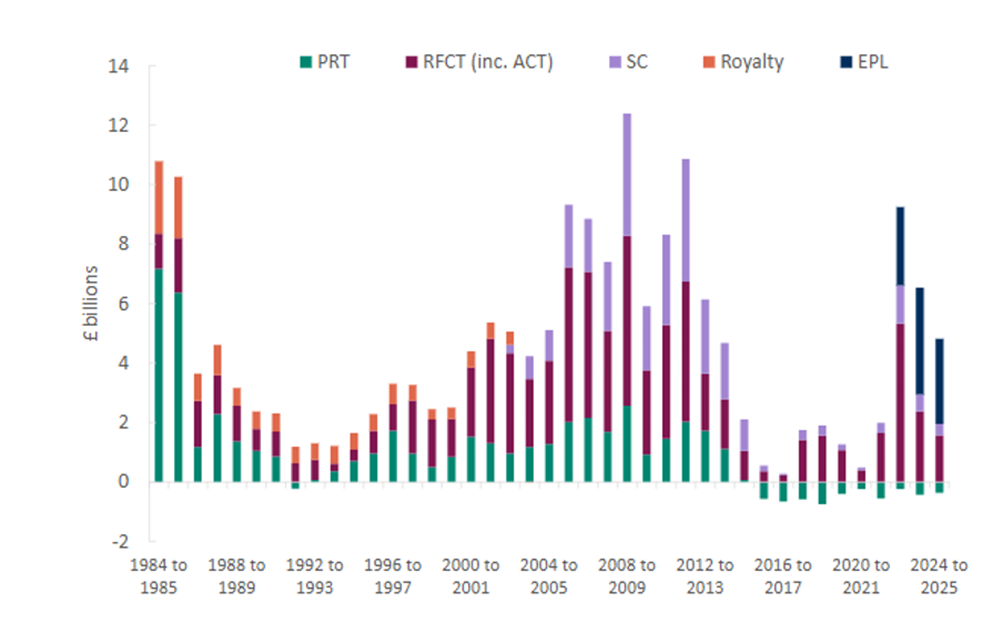
Tax revenue from the sector has declined in tandem with production. The OBR forecast in November 2022, after the EPL was introduced, that government oil and gas revenues from the Ring Fenced Corporate tax, the Supplementary Charge and the Petroleum Revenue Tax and the Energy Profits Levy would be £14.9 billion in 2022/23 and £20.7 billion in 2023/24. Instead, only £9.9 billion was raised in 2022/23 and £5.5 billion in 2023/24. In November 2025, the OBR’s forecasts were much more modest: £2.7 billion in 2025/26, £2.4 billion in 2026/7, £2.0 billion in 2027/8, and £1.6.3 billion in 2028/9, £1.2 billion in 2029/30 and a mere £0.3 billion in 2030/31. But even this estimate is now considered too high by the OBR, who, in their March 2026 Economic and Fiscal Outlook, expect all UK oil and gas production to have ceased by 2030 as the EPL and additional licensing requirements are discouraging new well development. His Majesty’s Revenue and Customs (“HMRC”) has published the EPL figures for the financial year 2024/25; they have fallen to just £2.7 billion, a drop of £870 million from 2023/24.
One of the benefits of the OBR’s pessimistic forecasts, that the UK will receive a mere £100 million in tax revenue for all oil and gas production taxes in 2029/30 and 2030/31, is that there can be no possible complaints from HMRC that removing the Energy Profits Levy will reduce Government revenues. Even for 2028/29, the OBR is only forecasting oil and gas tax revenues of £200 million. Scrapping this counterproductive ‘Windfall tax’ will not be a “cost” to the treasury, based on the forecasts shown in Figure 8, below.

Oil and gas companies are scaling back and cancelling investments in the UK. Some companies have announced they will quit the UK North Sea basin completely due to fiscal “unpredictability.” According to Offshore Energies UK, the UK is projected to lose £12 billion in tax receipts due to declining output, a figure that will be exacerbated by capital investment falling from £14 billion to just £2 billion between 2025 and 2029. Job losses are expected to be around 35,000.
Also at risk is the oil refining industry, which contributes £3-£4 billion per year to UK GVA and supports over 100,000 jobs directly and indirectly through its supply chain.
Unfortunately, both the Conservative and the Labour governments considered the Energy Profits Levy, or Windfall Tax, a good idea. Under a different tax and regulatory regime, the UK could at least be self-sufficient in fuels and chemicals, or even a net exporter – as it previously was.
Some Ministers have claimed that the Ministerial Code prevents them from breaking international treaties such as the Paris Agreement. However, the Ministerial Code is not a statute and does not impose legal penalties. The UK Ministerial Code is an ethical code of conduct, not a law. It explicitly states that Ministers have an overarching duty to comply with legal obligations arising from domestic and international law. The Government removed the Code’s explicit reference to international law in 2015, which is believed to have weakened the obligation to comply with it.
About The Great British Business Council
The Great British Business Council (“GBBC”) was established to enhance public and political understanding of the advantages a thriving business community provides to local security, standard of living and wellbeing. It aims to support British firms and small businesses by promoting well-crafted, practical, evidence-based policy reforms that foster enterprise and innovation. It is independent of any political party, as it hopes that all parties will consider adopting the straightforward, practical policy suggestions it proposes.
The GBBC is funded by private donations from concerned citizens who want the UK to thrive economically as it once did. If you would like to join us or donate to their cause, please contact in**@**BC.UK or follow them on LinkedIn, X (Twitter), Facebook, YouTube, TikTok and Bluesky.
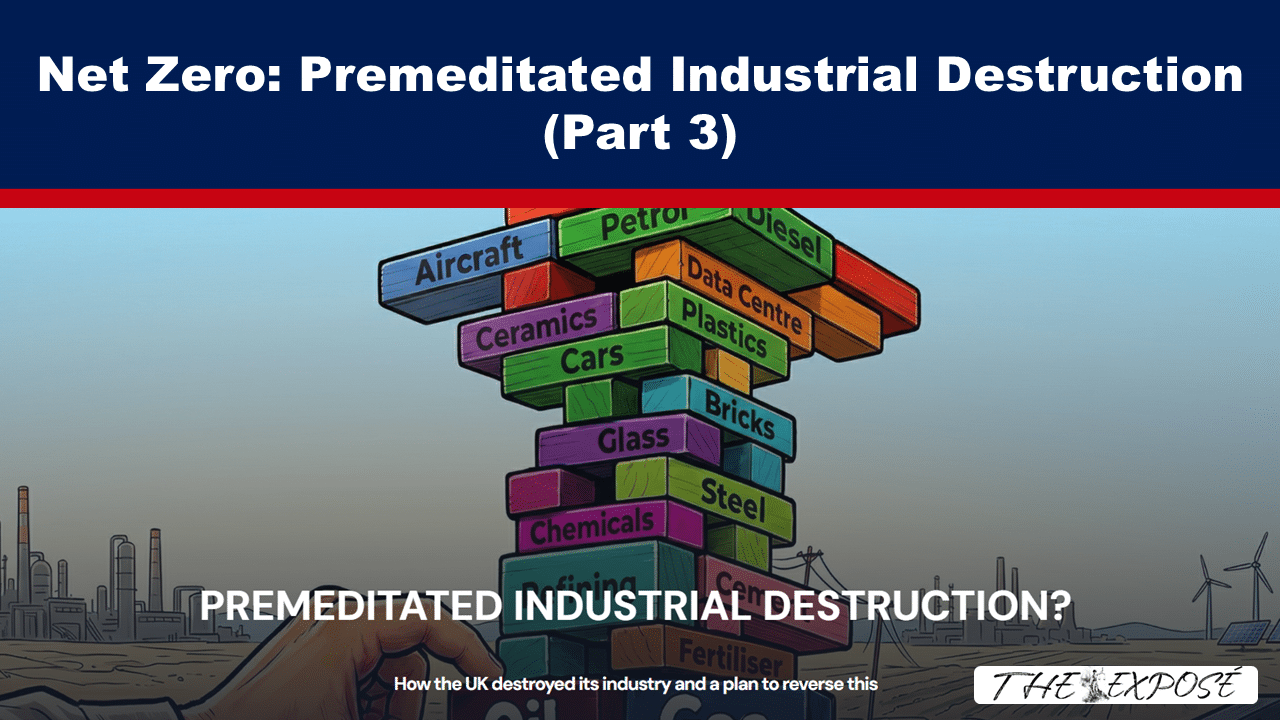
Featured image: Cover of the GBBC paper, ‘Premeditated Industrial Destruction: How the UK Destroyed Its Industry and A Plan To Reverse This’
The Expose Urgently Needs Your Help…
Can you please help to keep the lights on with The Expose’s honest, reliable, powerful and truthful journalism?
Your Government & Big Tech organisations
try to silence & shut down The Expose.
So we need your help to ensure
we can continue to bring you the
facts the mainstream refuses to.
The government does not fund us
to publish lies and propaganda on their
behalf like the Mainstream Media.
Instead, we rely solely on your support. So
please support us in our efforts to bring
you honest, reliable, investigative journalism
today. It’s secure, quick and easy.
Please choose your preferred method below to show your support.

Categories: Breaking News, UK News
Total bloody loonies!
https://trumpwhitehouse.archives.gov/people/ivanka-trump/ don’t ever forget
W ell, well, well funny how this ‘blue print’ has been happening in Australia as well for many years. Shameful in so many ways this evil hidden agenda! 🤬
This entire quagmire of rules, regulations and “reality” is a fantasy, built on a lie, a myth. Well-written and detailed, and depressing. Why is there no mention of the fact that CO2 needs no reduction? Peel back the layers of UN/IPCC twaddle, and open your eyes to the reality that global warming is not controlled by us humans. It’s the Sun and the planet, doing their cyclical thing and as we have already proved, the physics show that the levels are approaching saturation, where adding more CO2 makes less and less difference. We could double it without worrying. All that would do is increase crop yields.
But have at it. Stay in Plato’s cave. Ignore the planned dissolution of the west. Believe the media.
Who set up the UN? The IPCC? It’s all a nonsense. If a contract, an international agreement is based on a lie, it’s invalid. Simple as.
Just say no. We will not comply.