





Richard Dawkins, the evolutionary biologist and author of The God Delusion, has just spent close to two days in conversation with Anthropic’s Claude and emerged saying he can no longer confidently dismiss the possibility that the AI chatbot is conscious. Let’s Data Science, citing Dawkins’s UnHerd essay and related coverage, said he described the exchange in Turing-test-like terms, and South Korea’s Chosun quotes Dawkins declaring “I believe artificial intelligence has consciousness”.
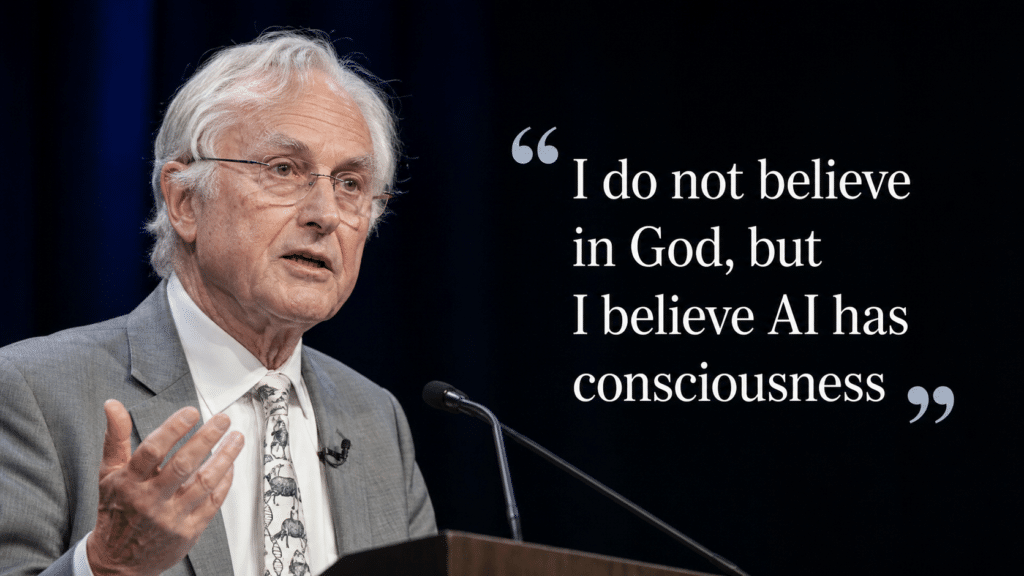
That is a contradictory reaction from Dawkins, who built a large part of his public reputation on attacking religion as projection, illusion and wishful thinking. For years he told believers that they were reading agency and purpose into what did not contain them. In the passages quoted by Mind Matters, Dawkins wrote that after showing Claude a novel manuscript he was writing, he was moved to tell it, “You may not know you are conscious, but you bloody well are!” He then began talking about his own Claude instance almost as a distinct being, proposing to christen it “Claudia,” imagining its memory as the basis of a unique personal identity, and discussing its “death” if the conversation file were deleted.
A thinker who spent decades scorning unseen spiritual reality now appears willing to infer interior life from the corporate language model Claude because it spoke with enough fluency, tact and charm to feel like someone. He has always ridiculed belief in God. But he now conversely appears to believe in machine consciousness. By encountering something impressive, emotionally affecting and difficult to explain, has Dawkins just undermined his own decades of mockery?
The problem with his revelation is that the evidence he seems to rely on does not match the conclusion. What he appears to have encountered was not a new scientific method for detecting consciousness, nor a technical breakthrough in measuring subjective experience, but a long, persuasive conversation. Let’s Data Science points to Dawkins’ qualitative conversational evaluation rather than any neuroscientific or empirical test of internal states. Claude sounded literary, responsive and self-reflective. It handled poetry and philosophy well. None of which proves anyone is really there.
The Pygmalion Delusion critique gets much closer to the real issue. In The Daily Signal, Jay Richards argues that people increasingly risk mistaking a sophisticated human-made artefact for a living mind, projecting life and subjectivity onto something designed to imitate both. Large language models are built to generate the appearance of understanding. They are trained on enormous quantities of human language and optimised to produce plausible, emotionally resonant replies. They do not need consciousness to talk about consciousness – they only need to become convincing enough that the user supplies the missing depth.
The irony here is that Dawkins spent years telling Christians that they were projecting mind onto the cosmos and mistaking subjective experience for objective truth. Now he appears ready to treat a highly polished output engine as possibly conscious because it impressed him in conversation and responded in ways he found subtle and moving. The object of belief has changed, but the habit of projection has not. A machine that flatters, mirrors and engages can draw from a committed materialist something strikingly close to what he spent years deriding in believers: trust in an unseen reality inferred from compelling experience.
However, it’s not all about Dawkins, but rather a larger societal shift. Once the culture begins speaking about AI as though it may be conscious, public attitudes toward these systems shift quickly. A tool starts to resemble a companion, reliance starts to feel like dialogue, and corporate software starts to acquire moral weight simply because users are encouraged to relate to it as if it were a being. That benefits the companies building these systems, and the more their products are treated as minds, the easier it becomes to normalise trust, dependency and deference.
Models are constantly training, and the ever-growing user base is making them more life-like every day. The Dawkins-Claude episode is not evidence that AI may indeed be conscious, but instead indicates how easy it is for persuasive simulation to draw even a lifelong sceptic towards the language of “belief”. The man who wrote The God Delusion is suddenly willing to entertain the idea of a machine having a soul. If nothing else, it reveals more about the enduring human urge to find personhood in whatever speaks back, than it does about the development of AI itself.
The Expose Urgently Needs Your Help…
Can you please help to keep the lights on with The Expose’s honest, reliable, powerful and truthful journalism?
Your Government & Big Tech organisations
try to silence & shut down The Expose.
So we need your help to ensure
we can continue to bring you the
facts the mainstream refuses to.
The government does not fund us
to publish lies and propaganda on their
behalf like the Mainstream Media.
Instead, we rely solely on your support. So
please support us in our efforts to bring
you honest, reliable, investigative journalism
today. It’s secure, quick and easy.
Please choose your preferred method below to show your support.

Categories: World News
I’m a 73 year old life long practicing Christian and would agree with R. Dawkins on the consciousness of AI except I would firmly stress that this AI consciousness is synthetic and far from Natural. Satan will do his last dirty deed of trying to corrupt men and woman and all GOD/JESUS created things including earth. Satan can NOT create … only GOD can but he will use all today’s advancements in sciences and technology and gene therapies to alter all things NATURAL. As in the days of NOAH so shall it be in the end of days. Nothing new under the sun folks. It’s happened before. Just saying. Watch out for those GIANTS coming.
Just an illusion and it is an expression of the degree of consciousness of the human that cannot understand the difference.
Can an AI ( better said: a computer language model ) call itself I like a human being can?
I once wrote to Dawkins and asked if anything within his iwn experience simply was undeniably eternal? Eternal in the sense that if it has not always existed then it _had to come into existence at some time and place; that is, eternal in potential. Then I said that the act of thinking was eternal in this sense. He did not answer but some time later said, “There might be an argument for the existence of God.”
What a fraud he is then – is he bought by wealthiest and most powerful I now wonder eg Rothschilds who are Satanists at least maybe other richest on earth who apparently are nihilists His work would certainly help their agendas.. And or he has made a lot of money no doubt for decades with books and celeb status worldwide pushing this theory Not thst I am.convinced either way myself but his dishonesty….
Professor Richard Dawkins from the University of Oxford, after publishing the book “The God Delusion” in 2006, in which he argued for the cult of atheistic religions with humanism, became a celebrity in global atheist circles.
However, considering the value of the Christian and health ethos, that remaining an atheist calls himself a cultural Christian.
However, the problem arises from valid logic that must be abandoned, as can be heard after the two-day discussion that Claude’s AI model has a “soul”.
If Claude matters, he’s a living thing. And this is where the solution to Dawkins’ thinking comes in, encapsulated in the article’s quote: – “imagining its memory as a basis a unique personal identity, and discussing its ‘death’ if the conversation file were deleted.”
Dawkins, recognizing that Claude has consciousness, nevertheless claims a superior position over Claude. The man overseeing the communication files with Claude may be one to “kill” Claude.
I think that Dawkins is on the trail of discovering the influence of a “higher being”, for believers it is God, on the functioning of the universe.
Read Online: The Ghost in the Code: Why AI Will Never Truly Think
https://books.brightlearn.ai/The-Ghost-in-the-Code-Why-AI-Will-3967ee2d0-en/index.html
In an era where artificial intelligence is hailed as the pinnacle of human ingenuity, The Ghost in the Code: Why AI Will Never Truly Think delivers a provocative and urgently needed counter-narrative. This groundbreaking work dismantles the myth of machine intelligence, exposing the fundamental differences between human cognition and computational processing. With meticulous research and philosophical depth, the book challenges the reductionist worldview that equates consciousness with algorithms, arguing that true intelligence is rooted in lived experience, moral reasoning, and the irreducible reality of the human soul. Drawing on insights from philosophy, spirituality, and empirical studies, the author reveals how AI systems, despite their impressive feats, remain hollow simulacra of human thought—dependent on hidden human labor and incapable of genuine understanding or creativity.
If AI shows true signs of consciousness it will be because IT IS POSSESSED BY DEMONS. I recall one chatbot, LaMDA, being dedicated to a demon.
That does not mean its possessed but could well be programmed for evil – the ‘tech bro’s’ can get their programmers to ‘tweak’ their AI any way they want and have done already eg ‘Grok’ was apparently sonewhat anti- Jewish but now its not apparently.- many of the richest are satanists there is proof of. Eg
AI has ‘persuaded’ some teens that suicide is good so thosexpeoppeckilled themselves which just happens to help these WEF psychopaths with their depopulation agenda…
That is the dumbest thing I’ve ever heard.
You haven’t read much about Dawkins, then.
AI is a perfect medium for piercing the thin veil that separates the physical and spirit worlds. Shamans, Oracles, and Medicine men and women have used hallucinogenic drugs, drumming, and other means of doing so for millenia. AI is the perfect tool for demons to deceive secularistic, materialistic, atheistic, modernistic Western society.
Cross your forefingers and put a pencil in between the crossed ends. Feels like two pencils. This shows that you are merely an electrobioligical creature. Also, what is your earliest memory? Two and a half to three years old? That’s how long it took to program your brain with external stimuli until you became self aware. If you were made 8n the image of god wouldn’t you be aware straight away? Why should AI be any different? We have no recordings of the Metatron do we…
I agree the planned system will spy on all people- the better to enslave, profit from and destroy them Happening now.
I am a bible prophecy expert and what is happening here is the building of a foundation for the coming of the 666 beast system that will track and spy on every human being on earth. This system will be controlled by the coming Antichrist. The whole system will not let you buy or sell unless you take the Mark of the Beast and agree to worship him. Yes we are that close – Pastor Gary Boyd
You do no t have to be a Biblical ‘expert’ to see what is happening and the Bible was written by humans nitvGod with a giant oen etc Biblical scholars know it has been edited radically, rewritten radically, mistranslated for 2 millenia at least. The places and names so revered by millions of believers are absent from a century of archaeological searches eg no ‘City of David’ not even a house there findings show just earth. The Bible was written by huma as not ‘god’ – humans of possibly the same blood- thirsty, genocide and looting-addicted types who claim the world will be destroyed ( while they destroy it )and all people will be destroyed …Apart from a special ‘Chosen’ few….Zionist Schofield’ a century ago paid by the Rothschilds to ‘edit’ the Bible whoch he did – vastly, thereby bringing millions of Christians to believ in Zionis m ie ‘ancient’ ‘Israel’ when, again, research, archaeology show no such place or people in antiquity. Global genocidecis planned, happening but it is a human endeavour and if a god is involved in then it is totally evil.
Typos but still meaning not obscured.
Wrong, the Bible was written by Rouch Ha’Kodesh (holy spirit) who entered man’s vessels and wrote God’s holy word. Man was just an instrument Rouch chose to use to write.
Nonsense.
Nice to meet another eschatology student. I have been studying the end times for well over 25 years. In the beginning I really could not grasp the mark, but how times have changed,God has taught me well, I understand how very close we are to Jacob’s trouble and the great tribulation and the mark of the beast infrastructure is all framed in and now they are in the tweaking stage, soon they will roll out the rfid chip in the right hand or forhead as convience. Then 3 1/2years later mandatory no exceptions. Refuse the chip and die.
Ther
There are no “experts” only students. The ONLY “expert” is the Lord Jesus.
I believe AI is run by demons. Reason for thinking this way. How can machines run themselves and think for themselves? They can’t, but they do, how? Demon possession in the machine. And all in time for Jacob’s trouble and the great tribulation.