




Before Rome became an empire, mystery cults infiltrated the Roman political class.
Rome and Carthage, former allies, became enemies in the Punic Wars, with Rome emerging victorious and taking control of Carthage’s territories, leading to Carthage’s downfall and Rome’s moral decay into an expansionist empire, Matthew Ehret explains.
The mystery cults, including the Cult of Cybele, Isis and Mithra, migrated to Rome, influencing its culture and values, and contributing to its transformation into an empire.
The Cult of Mithra originated in Persia. It was a seven-degree initiatory male-only cult, catered to a warrior class and worshipped in underground grottos. It gained significant influence in the Roman Empire, with several Roman emperors being part of the cult, and it played a role in the expansion of the Roman Empire.
Can history reveal something about the world today?
Let’s not lose touch…Your Government and Big Tech are actively trying to censor the information reported by The Exposé to serve their own needs. Subscribe to our emails now to make sure you receive the latest uncensored news in your inbox…
Below is an article by Matthew Ehret about how the Roman Empire became a host for mystery cults. While reading his article, we’d like you to consider three things.
Firstly, the name “Palestine” has neither Arabic nor Hebrew origins. The English term derives from the Latin Palaestina, which comes from the Ancient Greek Palaistinê.
The Greeks used this term to describe the region, possibly adapting it from the Egyptian Peleset and Assyrian Palastu, which referred to the Philistine people. According to Britannica, the Hebrew Bible later used a similar term, Peleshet, to refer to the Philistines. The Philistines, who constantly warred with the Israelites, were not native to the land, and by the 6th century BC had disappeared from history.
The Roman Empire resurrected and officially adopted the name in the 2nd century AD, 800 years after the Philistines had disappeared, as the provincial name Syria Palaestina. The Romans renamed the region from Judea in an attempt to strip Jews of identifying with their land.
“Palestine” is, therefore, strongly associated with both Roman occupation and the Philistines. It has no association with, for example, modern-day Gazans or Jordanians living in the West Bank. Yet, in recent years, the name has been resurrected once again to describe an as-yet-to-be-identified region that will no doubt include Judea and the entire State of Israel. Why are the Roman Empire and the Philistines being invoked thousands of years later?
Secondly, consider the Biblical prophecy about seven kings: “This calls for a mind with wisdom. The seven heads are seven hills on which the woman sits. They are also seven kings. Five have fallen, one is, the other has not yet come; but when he does come, he must remain for only a little while. The beast who once was, and now is not, is an eighth king. He belongs to the seven and is going to his destruction.” Revelation 17:9–11 (NIV).
Thirdly, consider what is happening today, keeping in mind: “What has been will be again, what has been done will be done again; there is nothing new under the sun.” Ecclesiastes 1:9 (NIV).
Is the past warning us about the present day and our future?
The Origins of the Roman Empire: The Mystery Cults Migrate to a New Host
In the previous instalment of this series, you were introduced to the story of Rome’s moral decay from a republic into an evil empire, and the battle which St. Augustine of Hippo engaged in during the last phases of the western Roman Empire’s meltdown.
That exploration took us into the rise of Alexander the Great, the clash between Platonists and Aristotelian influences over Alexander, the defeat of the Persian Empire, and the assassination of Alexander the Great.
We will here pick up the story with the rise of the Silk Road in 200 BC, and the infiltration of mystery cults into the heart of Rome.
Table of Contents
The Silk Road Connection to Hellenic Civilisation
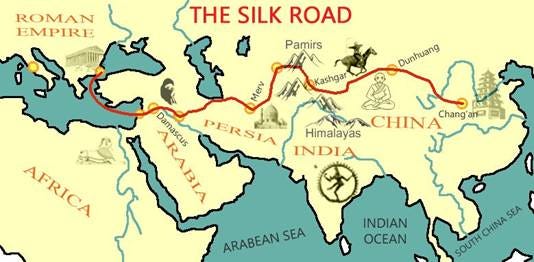
The Silk Road that united Chinese culture with Persian, Arab, Greek, Roman and African cultures would first emerge with the Han Dynasty about a century after Alexander’s death.
Despite the fact that many modern historians attempt to treat the events of Alexander’s west-to-east expansion and China’s east-to-west programme as two separate events, the connection of both programmes is most certainly connected in the study of universal history. Were it not for Alexander’s Hellenizing efforts, it is unlikely that the Silk Road would have ever arisen.
With Alexander’s untimely assassination within the gates of Babylon, the great potential to create a city of justice, love and goodness, which treated all human beings as divine, reasonable and self-perfectible, the way Plato had put forth in his Republic, or Solon had dreamed of much earlier … fell to pieces.
Just outside of the chaos of the regions formerly known as Alexander’s Empire, the small state of Rome could be seen across from its southern neighbour across the Mediterranean, Carthage. Many people know of the term “Carthage delenda est”, i.e., “Carthage must be destroyed,” as the battle cry of Rome during its destructive battles against its nemesis … but few understand how this war happened, why these former allies became enemies in the first place, or how this helps us to understand the origins of the Roman Empire.
Rome’s Moral Downfall: The Carthaginian Wars
What is often overlooked by experts of the Carthaginian Wars is that these two neighbours had much in common for centuries.
In fact, they were established around the same period in 800 BC. During most of their existence, Carthage and Rome maintained a strong alliance, which had been renewed in the form of four formal treaties spread out across the years 509 BC to 279 BC.
It was an important division of labour and talent.
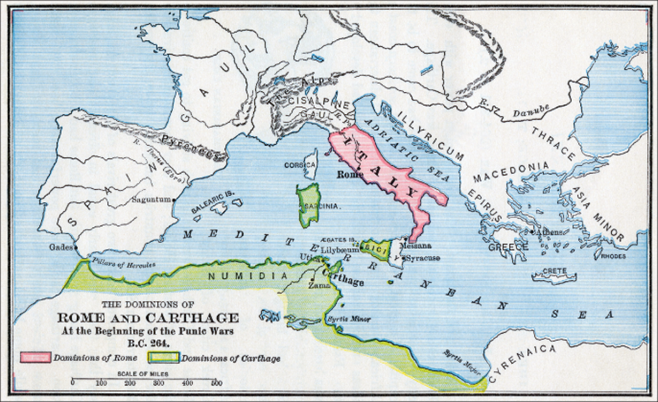
Rome was known as a great land-power, with an extremely competent and disciplined standing army. Through its military power and reputation, Rome had built an important array of strategic alliances over the centuries, since they were so often forced to defend themselves from invading forces from the north, attacking from the Alps.
Due to Rome’s lack of a strong maritime capability, they also lacked a strong commercial centre or robust trade policy.
Carthage, on the other hand, had a very strong focus on commerce and trade, sharing much from their Phoenician forebears. But they did not have a very strong army and, as such, were forced to often use mercenaries or call upon their Roman allies to defend themselves during enemy invasions.
Overall, there was a win-win synergy between Rome and Carthage that worked quite well for centuries, and which allowed them to avoid being conquered.
But during the early 3rd century BC, something changes, and the alliances began to crumble. It is uncertain what invisible forces had been working behind the scenes to sever the alliance, but in the year 264 BC, the first Punic War was launched by Rome. Several Carthaginian territories were invaded, and the first of three bloody wars began. When the war ended in 241 BC, Rome had come out victorious and took control of Carthage’s former territory of Sicily.
Carthage also had to start paying large annual tributes to Rome, resulting in growing resentment and a sense of betrayal.
You must now put yourself in the position of the high priesthood of the mystery cults floating above the stage of this theatre of universal history.
The powerful Babylonian high priesthood of Marduk had still suffered the sting of their Persian “Marcher Lord” being defeated, and their Macedonian eastern empire plans crumbled due to Alexander’s Platonic conspirators.
But this priesthood had learned a valuable lesson. The Cult needed a new seat of power to accomplish what the Achaemenid Empire had failed to achieve. With Alexander’s former empire divided into warring factions, the viability of using any of Alexander’s former generals to become the new “Marcher Lord” was likely deemed unwise. And so, the Marduk priesthood would have been looking further westward toward the region of Rome and Carthage.
I suspect this factor, despite being neglected by academia, is likely a driving force orchestrating the Punic Wars from behind the scenes.
The question posed by those heirs of Babylon was: Will this new seat of power be Carthage or Rome?
Who was going to host the parasite and become the new Marcher Lord?
There were two more Punic Wars which resolved this question.
In the Second Punic War, which occurred from 218 to 201 BC (also instigated by Rome), Carthage did quite well under the leadership of the brilliant general Hannibal. But with Hannibal’s defeat at the Battle of Zama in 201 BC, the tides of fortune turned against Carthage and the nation was beaten again.
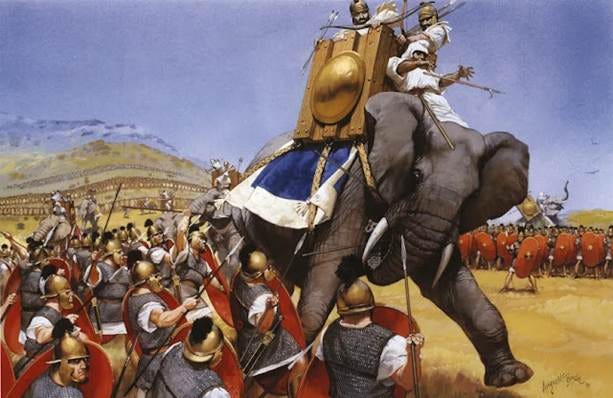
During this time, Rome was technically still a republic, but like the similar case of Athens during the Peloponnesian War of 434-404 BC, Rome had also embraced a new moral descent into an expansionist empire, betraying its allies, its former values and demanding total obedience to those new territories it brutally conquered.
Despite its slide into empire, Roman citizens during the early to mid-Republic still had a strong sense of morality, duty and honour, which was not easy to destroy. Although there was a belief in various gods imported from Greece,[1] the dominant culture of Rome was still ethics-driven and featured a spiritual life more premised on the deification of heroes. The Romans, not unlike the Confucians, believed in treating war heroes like the great Roman general-turned farmer-turned Dictator-turned farmer Cincinnatus in religious-like reverence, which had a much greater influence over the minds of Romans than any of the pagan gods.
After the Second Punic War, one of the new insidious foreign cults that came into Rome was the cult of Cybele, which spearheaded the overthrow of Rome’s ethical order. This earth-mother cult had various names within various parts of the ancient world, such as Inanna to the Babylonians, to the Greeks she was Demeter, to the Minoans she was Rhea, but she was most popularly known as the cult of Gaia.
The Cult of Cybele’s entry into Rome was entirely tied to the Second Punic War.
Mystery Migrate to Rome
Within Rome, a powerful institution existed in the form of the Committee of 15. This elite committee of priests was sanctioned to interpret the Sibylline Oracles, which had been brought into Rome under King Lucius Tarquinius Superbus, who ruled as king of Rome from 534-509 BC, and remained a dominant subversive institution throughout the entire lifespan of Rome.
Very few important decisions were made without consulting with the Committee of 15 who would in turn, interpret the transcribed allegorical streams of consciousness that were the Sibylline Oracles … these oracles were composed in three large tomes which contained the allegorical sayings of the Pythian Oracle of Apollo at Delphi in Greece, and were sold to Tarquin by the Cumaean Sibyl before his downfall.
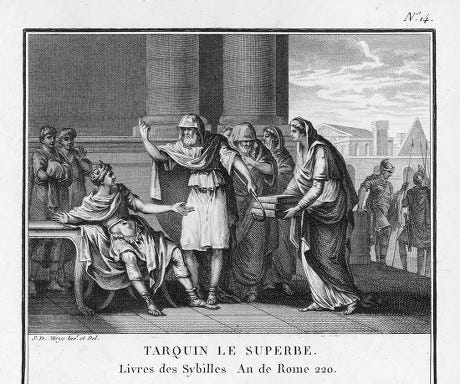
During the Second Punic War, the Roman Senate asked the Committee of 15 how they might defeat Carthage. After consulting the Sibylline Oracles, the committee stated: “Rome would be victorious over Carthage IF an official invitation were extended to the Cult of Cybele to become an officially sanctioned Roman cult.” Cybele’s cult was then firmly entrenched, its stronghold in Anatolia and the Mithraic Kingdom of Pontus.
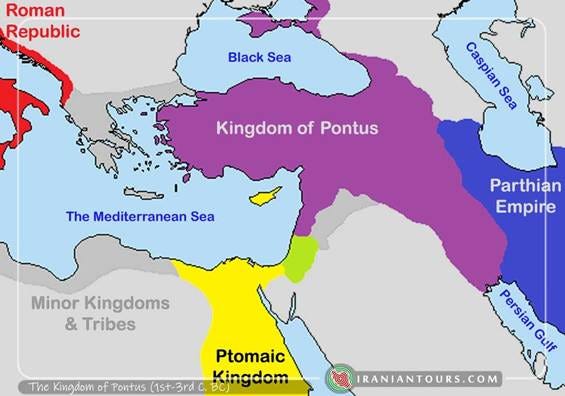
In 204 BC, the Roman Senate agreed and invited the cult into the capital, which immediately built temples across Rome, including on Palatine Hill which housed the infamous Sibylline books. Whether it was due to the “favour of Cybele” or darker political intrigue, by 201 BC, Carthage was defeated and Rome expanded ever further into former Carthaginian territory, enslaving many of their citizens and increasing Carthage’s tribute.
However, unbeknownst to the Roman population, the Cult of Cybele proved to be a much more corrupting influence as its rites included widespread orgies, ecstatic drug-induced frenzies and an initiatory system that required all male priests (dubbed “Galli”) to be castrated (see image on next page), dress as women and speak with a falsetto voice.
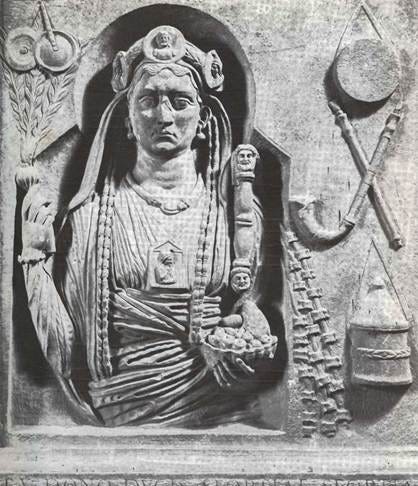
The Stoic Roman values of the day, which prized masculinity, temperance and family, were deeply offended as thousands of young men became fanatical Galli eunuchs, and at least for a century, public backlash resulted in the Cybele cult going underground. It would only re-emerge into the open through Government protection under the Empire.
By the Third Punic War (149-146 BC), Rome had fully embraced its new imperial identity. Despite Carthage’s offer to surrender to the Romans, the edict ‘Carthage Delenda Est’ called forth by Senator Cato the Elder won the day. Carthage’s requests for peace were ignored, and the last remnants of the state were destroyed, its male population massacred and its women and children taken into slavery.
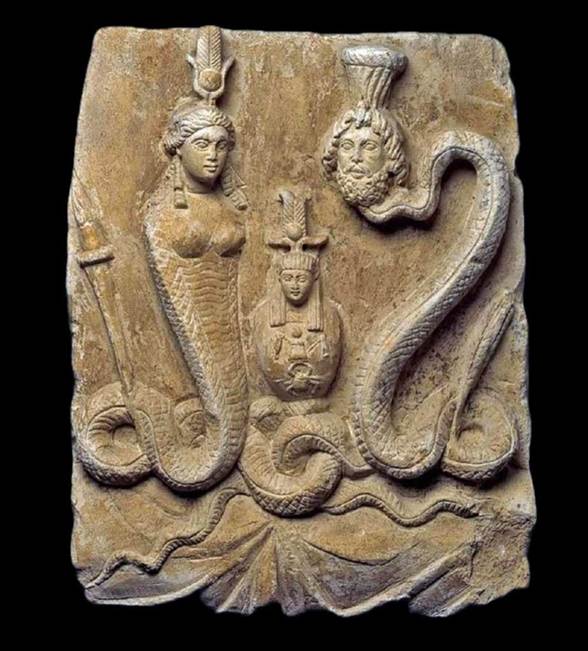
Through it all, the mystery cults continued to rise in influence. The cult of Isis began to spread in Rome in the mid-second century BC under a Romanised branding dubbed “Isis-Serapis,” practising sexual rites and various forms of sacrifice.
The Isis cult’s importation into Rome was also steered by the Sibylline Oracles and began in 201 BC with the figure of Osiris (Isis’ male counterpart) being replaced by the figure of Serapis – a Romanesque lord of the dead.
Mithra: Sol Invictus
By 64 BC, the Roman General Pompey introduced the Cult of Mithra covertly into Rome. This Cult originated in Persia and, for a period, dominated the Kingdom of Pontus, in Northern Turkey, alongside its female-dominated sister cult, Cybele, whose temples were often featured next to Mithraeum (underground crypts that served as temples to Mithra). The Kingdom of Pontus existed from 268-63 BC and was led by a dynasty of Kings each named Mithradates I-VI.
The Cult of Mithra was a seven-degree initiatory male-only cult, which catered to a warrior class and worshipped in underground grottos called “Mithraea” of which over 500 have been discovered across Europe, North Africa, England and the Middle East in modern times.
Soon after the Roman Civil Wars, which ended in 33 BC, the Cult of Mithra became the leading cult of the Roman Legion, elite Praetorian Guard and a dozen Roman emperors, including Marcus Aurelius, Diocletian, Constantine, Commodus, Valerian, Galerius, Licinius and Julian the Apostate.
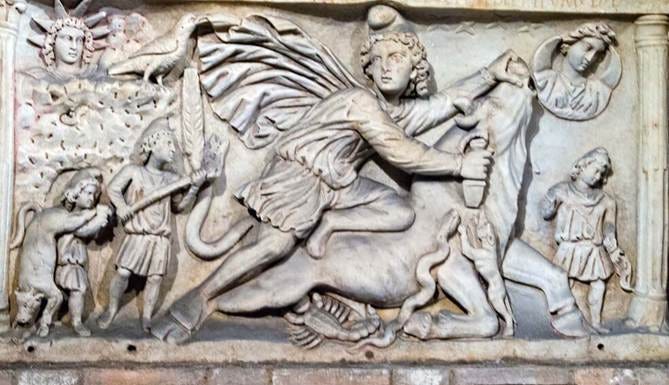
General Pompey had likely first encountered the Cult of Mithra during his battle against Mithradates VI Eupator – the ruler of Pontus during the Mithridatic Wars, which were waged from 88 BC to 63 BC. The Mithridatic dynasty was itself established by the bloodline of the Emperor Darius (of the Persian Achaemenid Empire) and acted as the last bastion of direct Achaemenid influence after the Empire’s downfall, whose state religion was Mithra worship, with each hereditary king adopting the name “Mithradates” and elevated to God status as Sol Invictus in the flesh.
King Mithradates VI waged numerous attacks on Rome until his death in 63 BC, during which time, General Pompey (a rival to Julius Caesar) had led battles against the determined Mithraic King Mithradates VI and it is likely that his failure to conquer Rome had something to do with an agreement reached out between General Pompey and the high priests of Mithra who saw in Rome a more attractive host with much more room for growth than the small Kingdom of Pontus.
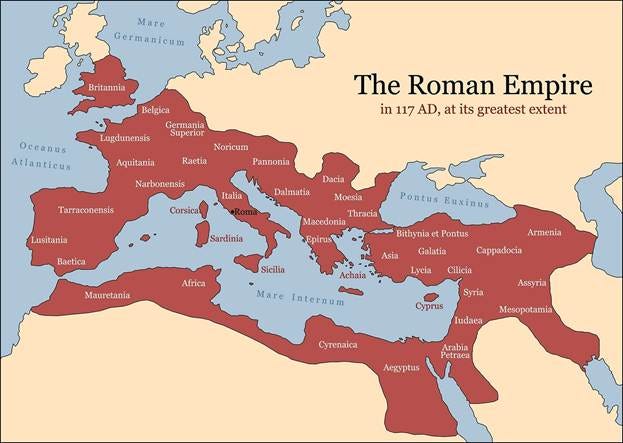
Rome continued to expand, carrying its new cults as a new Marcher Lord from 63 BC onward, and by 117 AD, the Roman Empire reached its apex of size and power.
The Rise of Pax Romana
Between the death of Mithradates VI and the high point of Roman expansionism, a number of very important things happened.
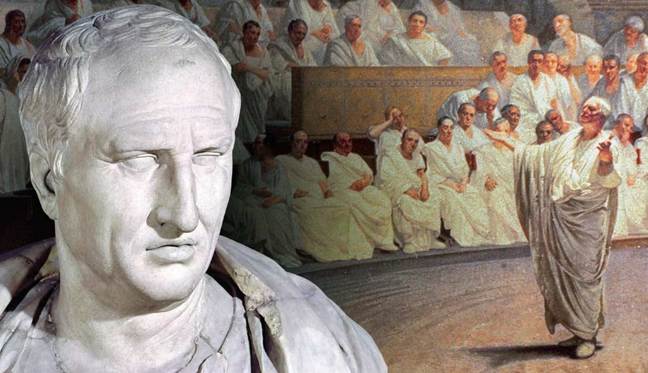
We had Cicero’s many battles to revive the better spirit of Rome and restore the healthier traditions of the republic.[2]
But just like Socrates earlier, Cicero, who defined himself not as an Epicurean or Stoic but as a Platonist, was assassinated by Mark Antony in 43 BC who demanded the great orator’s head to be cut off.
Just like Socrates, Cicero also had a chance to escape Rome and keep his life, but following the teachings of his beloved Plato,[3] Cicero decided that it would be better for posterity and better for the health of his soul to remain in the land that he had fought so hard to defend his entire life.
Sadly, unlike Socrates, Cicero had not trained a Plato to continue his work. He had not built an Academy and no one was left on the stage of history to pick up his torch after he died.
After a protracted series of civil wars, Octavius Augustus, the nephew of Julius Caesar, emerged victorious, having successfully defeated Mark Antony and Cleopatra in 32 BC. Octavius Augustus wasted no time in declaring himself Emperor, establishing a new form of God-man (Pontifex Maximus) which would lead the Roman Empire into a promised new “Golden Age.” Whatever residues of the old Roman Republic that existed in 32 BC were largely purged by this time.
The late philosopher Lyndon LaRouche took note of a particular meeting between priests from the mystery cults and emperor Octavian Augustus held on the Isle of Capri, which was a central command for the Cult of Mithra:
“The first century BC was a time of great troubles throughout the Mediterranean littoral. The priesthoods of the various forms of Great-Mother worship, the Syrian-Canaanite Magi, the Ptolemaic cult of Isis and of the cult of Apollo, were engaged in the effort to combine the conquests of Rome, Egypt and Syria into a single world-empire. The bloody issue was, what would be chosen as the capital of this new empire? The leading contenders were Alexandria and the city of Rome. The decision was settled on the battlefield against Mark Antony and Cleopatra; Rome’s victory had been negotiated earlier, at a meeting on the Isle of Capri.”[4]
In the next instalment, we will be introduced to the rise of Christianity onto the stage of history, 33 years into Rome’s takeover by the mystery cults of Babylon and Persia.
Footnotes
- [1] Some examples of Roman gods imported from Greece include: Jupiter (Zeus): Sky god, head of the pantheon, Juno (Hera): Queen of the gods, associated with marriage. Neptune (Poseidon): God of the sea. Venus (Aphrodite): Goddess of love and beauty. Minerva (Athena): Goddess of wisdom and strategy. Apollo (Apollo): Imported early as a deity of prophecy. Bacchus (Dionysus): God of wine and ecstasy. Mercury (Hermes): Messenger god. Diana (Artemis): Goddess of the hunt. Vulcan (Hephaestus): God of fire and forge. Hercules (Heracles): A hero/god adopted directly.
- [2] See Cynthia Chung’s “How to Conquer Tyranny and Defeat Tragedy” essay included in the Spring RTF Anthology
- [3] As outlined in the Crito and Phaedo dialogues showcasing the final days in the life of Socrates
- [4] Cited in Executive Intelligence Review, vol 15, no. 44, Nov 4, 1988
About the Author
Matthew Ehret is the editor-in-chief of The Canadian Patriot Review, Senior Fellow of the American University in Moscow and Director of the Rising Tide Foundation. He’s written the four-volume ‘Untold History of Canada’ series, four volume ‘Clash of the Two Americas’ series, the ‘Revenge of the Mystery Cult Trilogy’ and ‘Science Unshackled: Restoring Causality to a World in Chaos’. He is also the host of the weekly ‘Breaking Free of Psyops’ on Badlands Media and host of ‘Pluralia Dialogos’ (which airs every second Sunday at 11 am ET HERE).
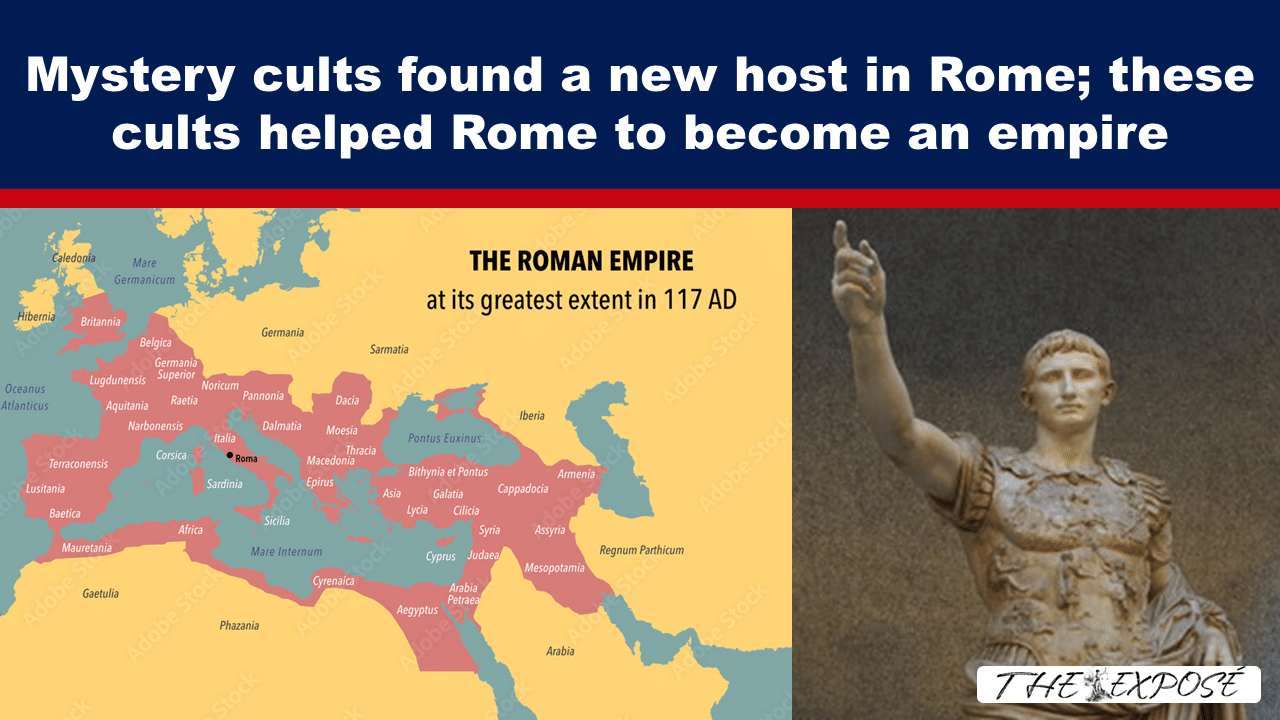
Featured image: Map of Roman Empire territory at its peak (left). Frontal close-up of a marble statue depicting the ancient Roman emperor Augustus giving a salute (right). Source: Adobe
The Expose Urgently Needs Your Help…
Can you please help to keep the lights on with The Expose’s honest, reliable, powerful and truthful journalism?
Your Government & Big Tech organisations
try to silence & shut down The Expose.
So we need your help to ensure
we can continue to bring you the
facts the mainstream refuses to.
The government does not fund us
to publish lies and propaganda on their
behalf like the Mainstream Media.
Instead, we rely solely on your support. So
please support us in our efforts to bring
you honest, reliable, investigative journalism
today. It’s secure, quick and easy.
Please choose your preferred method below to show your support.

Categories: Breaking News, World News
How can this author be a fellow of the American University in Moscow (promoter of American propaganda) and also the host of ‘Breaking Free of Psyops’ on Badlands Media (opposer of American propaganda)?
https://www.youtube-nocookie.com/embed/YCyPeTjmZA4 canakastans C U L T
Sir.
You are still deliberately confusing your readers. Just one example.
Inanna was Sumerian not Babylonian. And was NOT the goddess of planet Earth but representing Venus. The same goddess of beauty and fertility was named Ishtar by the Akkadians and used later the same way by the Babylonians. This is the whore of Babylon.
Every planet has two power. Good and bad. Venus is the same. Giving, kind and beautiful. Or be a prostitute. Inanna was the good rep of Venus Ishtar was the bad.
The Sumerians were not Semite. The Akkadians were. When Akkad of Sargon von against the Sumerians new laws were written by Hammurabi. Where the temple priestesses of Inanna had to be turned to be the priestesses of Ishtar. And perform prostitutions. Plus the Sumerian women had to serve as prostitutes for certain time
in the temple. Who did refused her head was shaven. This was also a show of their
morality in the oppressed Sumerians.
This is the reason today’s the orthodox Jewish women still shave their heads.
The history of mankind is the history of two different race.
There are many reasons for what you surmise – I like to look anthropologically at the roots – and this canadian too ,by the looks of it .
If you can provide better primary sources – archeologically ,I’d be delighted to hear them .
Brilliant portrayal of the range of issues to be debated ,!
Palantir permitting !
I do agree that the Gazan holocaust is trialed first in Bosnia ,having had some varied experience there .
I think Karadic & Arkan were linked to mystery cults ,not least from the amount of sniper fire I received from their supporters ,who I concluded ,2008 must have been Israeli ,judging from the invites I had to move to Israel (I ,until recent events,was a former staunch supporter)- a very short time thereafter .
Also a retired psychadelic NATO interrogator took a painstaking 2 hours convincing me Arkan was walking ,alive round many eu borders ,2 decades AFTER the Belgrade hotel driver security switch -killed the driver . The refugee numbers for EU destabilisation, especially of UK is Putin working through Arkan .
I had followed ,with some disdain ,a very angry head of Police ,comissioner of Harlemermeer – who wrote in a painstakingly researched report of Arkan’s 1981 escape from max security NL Bijlmer prison .Clearly AVID (NLss) based escape ,Concluding that Shell wanted no South Stream ,only 43% futures on crimean peninsula on what went from 4 billion cube metres gas at seabed depths no less than 2500m (ie unextractable with ‘safe’ technology) – to 14 trillion around 2014 .
So ‘by their fruits you will know them’ leads me back to a senior Iranian commando – who at 53 ,cold night end of barbecue – in autumn – jumped up no warm up – higher than me – >2metres – perfect splits ,sidesaddled ,sailed gently to the ground knicked toe & heel at 180 degrees ,zero injury ,impact on concrete tiles .
I was so curious why even the best chinese acrobats dont use this technique .Nureyev & ALL dancers would never dare ,especially not ukranian .
Getting to know this azeri – pashto speaker was a delight .
Mithras was not even in his vocabulary .
It was genetic .
Firstly, our history shaped by influence and by corrupt leaders. The cycle of this history repeats over & over from ancient times until today. People with notorious popularity will influence the masses. The corrupt human always aimed to be a leaders so that in power to control everything especially money & riches.
Whoever in power, will annihilate the old history and create a new history according to own narratives by destroying/burned all written existing documents then create new written documents to fit the narratives.
A new history was re-written accordingly to fit the narratives was created by mixing 50% fact with 50% fabricated history just like our current history book used by school as textbooks. Textbook was half-lie to control the mind of young people to believe false narratives.
Every ‘story or history’ written or documented was half-true because 50% was fabricated story mixed with true story. Everything must be take with tons of salt and always trust all history as half-true.
What I’m trying to convey here is, every knowledge we have today about past history was every single of it only HALF-TRUE. This is because every real evidence of past civilization was erased & replaced by a new fabricated history. Some of the truth may surface once a while but quickly ridicule by so-called ‘paid’ experts/professor to discredit those new evidences.
People may argue or debates on this articles but the truth about Rome, Pompeii, Egypt, Sodom & Gomorrah was the same story of Sin city of Las Vegas today. Every single of these places was place of male prostitution. The practice of same sex (LGBTQ+++++++) annihilate current civilization because population was decimated without new born baby to replace ageing population. This trend already in motion in our current society.
Summary, always takes every sing;e ‘story’ about ‘history’ as half-true. Everyone was trying to prove half-true knowledge.
Very confusing series of comments here. This outstanding essay seems to be out of their league.
Interesting article but could do with a lot more references to back up some of the claims.
Also, to Rhoda: Why preface the article with a comment about Palestine not existing ? What is the relevance to this article which does not mention it ?
You know a lot of people referred (and still do refer) to the natives of north American as “Indians”, does that negate their human rights because they are not really Indians ?
Hi John, to understand the reference to “Palestine,” a Roman Empire term, you need to also understand the second consideration I highlighted, the prophecy about the seven kings.
There is more than one interpretation of this prophecy but it is commonly interpreted as the kings represent empires. The empire described as “one is” is the Roman Empire, which will die out and then return as the seventh king/empire in the future, “the other has not yet come” as the Bible states. “The future” in this context is a future time as relating to the time when Revelations was written.
I included a link to an interpretation of the prophecy in the words “Biblical prophecy about seven kings” in the article in case people were interested to find out more.
“Palestine” invokes the Roman Empire. Near the top of the structure of the hidden world government orchestrating events to their advantage is 300 families (aka the Committee of 300) that some researchers believe are descendants of Roman Empire emperors and doges. The Venetian Nobles (also sometimes referred to as the Black Nobles) were doges etc in the Roman Empire who moved to and set up shop in Venice when the Roman Empire fell. It was from there that they began plotting their next bid to dominate the world. They have been plotting and trying to take over the world ever since. The latest of those plots we are living through today. It is these 300 families, mainly consisting of descendants of these Venetian Nobles, that are orchestrating world events to further their plan.
If you understand who the Philistines were, why the Romans invoked them in naming the region “Palestine,” then you will discover another link to history, both before and during the Roman Empire era, and another prophecy for the end of days in Revelations about the anti-Christ.
It is not a coincidence that they have chosen to push out the name “Palestine” now. The deliberate use of this word links the people behind the Palestinian agenda back to the One World Government under a one world religion plot. It is not a Jewish plot. Nor is it a Muslim plot. The plot is anti-Jewish, anti-Muslim and anti-Christian because at its core it is anti-God. People who do not worship God (YHWH), pose no existential threat to them. It is people who follow God (YHWH) that pose an existential threat to the Committee of 300 and their helpers imposing their satanic plot on the world.
I don’t want to get into the prophesy discussion because it is ALL conjecture. One of the current interpretations may be correct or none of them may be correct, nobody knows, and in the past other interpretations were believed strongly by many, only to be discarded when the course of events showed them to be quite wrong.
So sticking to the issue of the name Palestine, It was used in the Rothschild-inspired draughting of the British Mandate over a hundred years ago, before the current Palestine “problem” arose. So, for me, it’s a Zionist revival of the word and not such a recent one, and certainly not by the people we are led by the media to call Palestinians. Prior to the time of the British mandate, I don’t know if the inhabitants of the area would have called themsleves Palestinians but it’s quite irrelevant, they existed and are not obliged to have a name in any way whatsoever for their humanity to be real.
The British Mandate was the beginning of the physical “fulfillment” of prophesies of the return of the exiled but I would ask anyone who sees that as proof of a prophesy coming true, as I did years ago, to just entertain the possibility that it was powerful people who were able to enact the British Mandate and from there, the declaration of the State of Israel. It was not necessarily the work of God.These extremely powerful people would also have their own interpretations of other prophesies not yet come to pass, so be careful, they are powerful and they have read the prohesies too. I fear that they are currently in the process of engineering a “last battle” that culminates around Israel to “fulfill” such prophesies as they see could be to their worldly advantage.
The “Palestianians” like us, and anyone else not in the club, will be cannon-fodder and colateral damage if we don’t stop the globalists.
Hi John Hubbard, there is sufficient proof (without using the wisdom that the Bible speaks of) that the Palestinian agenda is the Globalists’ agenda. But to see it, it requires you to come out of the “Palestinian” bubble and see the world for what it is, rather than what you think you want it to be.
Consider this for a moment: “Palestinian,” translated into English from Latin, is another word for Philistine. Are you calling yourself a Philistine? If so, why? What do you have in common with the Philistines?
Sorry for the confusion; I think I missed a comma in my comment above. I’m was saying the Palestinians are cannon-fodder, just like us.
But anyway, I am not in any bubble. I see violence and killing as violence and killing. I think anyone who sees it as God’s work is seeing the world as “they think they want it to be”.
I agree that the globalists are using everything they can to further their aims, and a common theme is to arm both sides, “support” both sides, set them at each other’s throats. Making excuses for the killers is furthering the globalists agenda.
Hi John Hubbard, thank you for the clarification.
Everyone is cannon fodder – they view us all as “useless eaters.” At the root of all of this is the love the money. When someone who has made it their life’s ambition to amass the most money in the world and over generations they achieve that ambition, they then want to own the world and determine its destiny. They view themselves as above human, like gods who are untouchable and unaccountable to no-one except those (or the entity) above them. It is these same global mafia who are behind the Palestinian cause/agenda, just as they are behind the covid agenda and the climate change agenda. They are, for example, directing governments and big business using organisations they control such as the United Nations and the World Economic Forum. The top of their hierarchy is represented by the all seeing eye – lucifer.
When you realise “Palestine” and “Palestinians” are terms to push a global political agenda, you realise that people living in Gaza and the West Bank are in far greater danger than the “Palestinian cause” would have you believe, but not for the reasons they have portrayed.
Here’s some things worth thinking about:
1.The founding Charter of the Board of Peace is advertised as Donald Trump’s plan – yet Tony Blair was a key architect of the plan (Officially Blair began crafting the proposal in late 2023, but his plans for “peace” go back as far as 2007 so how long had he, or his institute (which is a Globalist front), actually been working on it?).
2. It proposed that a technocratic government be installed.
3. Blair was the only person, aside from Trump, initially named to the “Board of Peace” intended to oversee the plan’s implementation.
4. The 20-point Gaza peace plan, does not mention Gaza or “Palestinian” self-determination. In fact the plan mentions neither by name at all.
5. Instead, the Charter defines the Board as a broad, nimble multilateral institution for global conflict resolution, with the ambition to potentially rival the United Nations.
To me it seems pretty obvious but what do you think has happened in the name of “free Palestine”?
We shouldn’t be fooled: this was not Trump’s plan – this is a Globalist plan. All they had to do was to create the (idea of horrifying) conditions in so-called “Palestine” and convince the “useless eaters,” particularly in the West, that this Globalist “peace” plan was a good idea – hence the “Palestinian cause” was invented and highly publicised. Its the Hegelian Dialectic: Problem – reaction – solution.
I agree with pretty much everything that you say there but to compare the “Palestinian cause” to covid and climate change agendas would suggest that the Arab, or whatever they are, people of Gaza and the West Bank are not really suffering under Israeli occupation, or at least domination, if you don’t like the word “occupation”. I mean are you saying that the “Palestinians” are not being slaughtered and that it’s all a hoax ?
Hi John Hubbard, there is no evidence of a genocide in Gaza. Has there been trouble? Yes. Has it been grossly exaggerated? Yes. Is it one sided? No.
Here’s why I spoke about getting out of the “Palestinian” bubble, the narrative they have created and are continuously trying to focus people’s entire attention on.
Hamas is an Islamist group operating in Gaza. Hamas is not Gaza. Islamist does not equate to Muslim, and Islamism is not the religion of Islam. Gazans who oppose Hamas are jailed or publicly executed by so-called “Hamas freedom fighters.” Children are indoctrinated into Islamism from an early age, at UN run schools in Gaza. The UN has been the de facto government in Gaza for a very long time. As a “legitimate” government in Gaza (Hamas conned their way into “government” at the first election they participated in and has refused to hold elections ever since), Hamas has effectively been a front for a UN-controlled state. The UN has funded, aided and abetted Hamas’s terrorist activities. The UN, the Globalists’ organisation that is planned to be their vehicle for a One World Government, is complicit in the atrocities Hamas has committed both within Gaza and in Israel for well over a decade.
Who are the oligarchs behind the UN, who are using the UN to issue diktats to governments and now pushing for the recognition of a “Palestinian State” – even though no borders/boundaries are recognised or defined for such a state? This is where we come back to the Venetian Nobles, who are descendants of the emperors and doges of the Roman Empire.
Why do you believe the information you receive about Hamas committing atrocities, being a dictatorship etc. but not information that suggests Israel has committed atrocities ?
You say there is no evidence for a genocide; well I haven’t used that term but many others do use that term, some of whom I would think do not have an axe to grind. The photos of the utter destruction, at least of the buildings, in Gaza look genuine. Maybe the photos are faked, or the people have all been kept at a safe distance while their homes and everything else has been destroyed but I am not convinced. I would basically just say count the bodies over the last few decades to see who you should be giving your support to, who is the victim here.
The UN, like the medical establishment and other institutions, although rotten, are not a great big conspiracy where everyone is working off the same script. There are many genuine people in there who are following orders, blindly, unknowingly, but not maliciously. The people who make policy are no doubt as rotten as can be, but those on the ground are probably relatively half-decent and they report something like a one-sided war with the Israelis absolutely dominating, without mercy.
The argument that Hamas are “terrorists” and therefore any colateral damage is absolutely o.k. is just luciferian.
Evening Rhoda,
There is NO such thing as a Palestinian people today (as you well know).
To the best of my knowledge and belief, the 1611 KJV Bible is the ONLY version that renders the ancient Philistine nation (the five lords thereof occupying Gath, Gaza, Ekron, Ashdod & Ashkelon) as Palestina (Exodus 15:14, Isaiah 14:29 & 14:30), all the modern versions render the word as Philistia; this being true even of Joel 3:4 wherein the 1611 KJV renders it as Palestine – this name being too loosely bandied around, just as are Zion/Zionism.
It is not too hard to see how back in the days leading up to the Balfour Declaration that Palestine became the default name for the whole nation/land of Israel, especially since she wasn’t officially recognised as a nation until 1948. Back in the Victorian age the 1611KJV was then the Bible that was widely used- the Johnny come latelys not appearing until the turn of the century.
Regarding prophecy, as Christians, we should never forget that Jesus is the Spirit of prophecy. Revelation 19:10.
Lies are plural, Truth is singular
The Holy Spirit will guide you into all truth..He will shew you things to come. John 16:13.
Islander: why this great issue over their name and why does that matter with regard to their humanity ?
You mention Jesus; do you seriously think he would mistreat them because of a name ?
Hi Islander, good to see you.
Your point about the KJV being the only version of the Bible that mentions the name Palestine is interesting. I didn’t know that until I read your comment, so thank you for for telling me.
An AI response to a query confirmed that the KJV is the only version of the Bible to use the word “Palestine” and states, “The KJV translators used ‘Palestine’ or ‘Palestina’ in four different verses (Exodus 15:14; Isaiah 14:29, 31; Joel 3:4) to refer to the coastal territory of the Philistines.”
I was curious to know why the KJV used “Palestine.” An AI summary said:
Using different translations of the same word (Peleshet) in the same Bible (KJV) raises some questions. But on the face of it, in English we have four words associated with the ancient Rephaim tribe that at one time lived in the northern part of what is now called the Gaza Strip: Palestine, Palestina, Philistia and Philistines.
And yes, as you said in your opening remark, the Philistines or Palestinians no longer exist. They disappeared from history after the Babylonians attacked them, killing most if not all of them, and destroyed their cities thousands of years ago.
You point out, “The Holy Spirit will guide you into all truth.He will shew you things to come.” This is the wisdom the Bible speaks of, and I know both of us are seeking it. Amen.
Good afternoon Rhoda,
To come to my conclusion regarding Palestine/Palestina I did it the hard way by trawling through all the major modern versions on Bible Gateway-you did it the easy way by using AI!
Even then, I could only say “to the best of my knowledge and belief”, but I would think AI to be 100% correct on this. AI is a good tool, but only if used with much discernment. Thanks for confirming this.
I don’t understand John Hubbard saying “why this great issue over their name..”, names are of the utmost importance-especially in Holy Writ!!!
A couple of other things’
I did NOT like that comment by Sam.
Are there not two L’s in parallel in PARALLEL?
Every blessing.
Hi Islander, there’s a few things to comment on, so here goes …
You are right about AI. It is only about 70-80% accurate at the best of times, so everything AI produces should be checked to sources. Because of this, when I use it, I will always say so. I used it due to time limits, just to get an idea.
My guess is John Hubbard isn’t thinking too deeply about what is happening, nor does he/she want to. My guess is John Hubbard is an activist rather than someone who is wanting to find out what is going on. When we think of the Globalists and how they communicate with each other, we should realise they often do so on public platforms – call it Globalese if you like. It’s a question of trying to work out when they are doing it and what their code words mean. We can suspect they are using Globalese when a word or phrase looks out of place or the meaning has been changed/misused (double speak). This is why I believe, the use of the word “Palestine” is very revealing.
I can see more information than is publicly visible about a user profile if I choose. In the case of Sam’s threat I checked before I challenged him. The threat by Sam, is the same Sam that has published articles either through or under the name Patricia Harrity, and has also posted perhaps hundreds of comments over the years pushing the “no virus” dogma. I usually delete his derogatory/abusive comments (which to be fair were less numerous in the last couple of years), but this time I’ve left it up because he did something similar before (about 4 years ago) which he denies and then asks for proof – so now the proof can stay public lest he “forgets” again.
My question about ls in parallel was a test to see if the commentator was an AI program. The user didn’t seem to be applying much human logic, so I wanted to rule that possibility out. You are right, there are not two ls in parallel, there are more than two.
I hope you are feeling better …