





Last year, the government of Burkina Faso terminated the Target Malaria project, a research initiative funded by the Gates Foundation and Open Philanthropy, due to biosafety risks, low impact and scientific sovereignty concerns.
Target Malaria aims to use genetically modified mosquitoes to control malaria. It is not the only mosquito project Gates has invested in. Gates has also invested in Oxitech’s genetically modified mosquito programmes. But his ambitions don’t stop there.
The Gates Foundation has also funded projects releasing mosquitoes infected with a modified Wolbachia bacteria. This method of assaulting the natural world is born out of the Australian ‘World Mosquito Programme’.
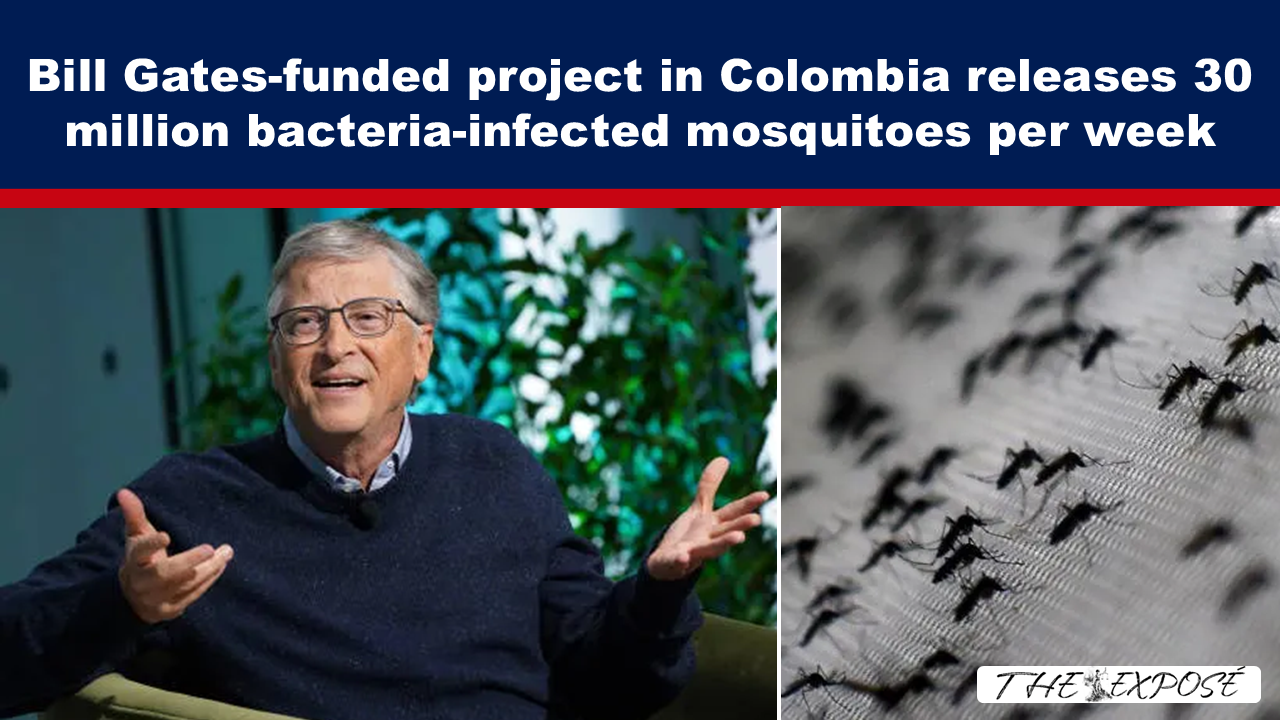
In Colombia, the World Mosquito Programme has been releasing 30 million Wolbachia-infected mosquitoes a week.
What is Wolbachia?
Let’s not lose touch…Your Government and Big Tech are actively trying to censor the information reported by The Exposé to serve their own needs. Subscribe to our emails now to make sure you receive the latest uncensored news in your inbox…
Table of Contents
Gates-Funded Genetically Modified Mosquitoes
In August 2025, Burkina Faso suspended and terminated the Target Malaria project, a research initiative funded by the Gates Foundation and Open Philanthropy, which began in the country in 2012 as part of a broader international effort to use gene-based technology in disease control.
The military-led government, headed by Captain Ibrahim Traoré, ordered the immediate halt of all activities involving genetically modified mosquitoes aimed at eradicating malaria, citing biosafety risks, low impact and scientific sovereignty.
The government cited the need to prioritise public health and environmental safety over the controversial biotechnology, stating that all remaining mosquito samples would be destroyed.
Related:
- Burkina Faso Stops Gates Foundation’s Anti-Malaria Campaign, Nigeria Eye, 23 August 2025
- Burkina Faso closes Gates Foundation, Open Philanthropy funded malaria programme, Alliance Magazine, 26 August 2025
- Burkina Faso Halts a Malaria Programme Backed by Bill and Melinda Gates Foundation, 25 August 2025
Target Malaria is an international research consortium dedicated to developing and distributing novel genetic technologies to control malaria in Africa. It receives its core funding primarily from the Gates Foundation (formerly the Bill & Melinda Gates Foundation) and Coefficient Giving (formerly the Open Philanthropy Project Fund).
Gates is obsessed with mosquitoes. “He’s been pushing for the idea of using genetically modified mosquitoes to eliminate the disease since 2016. That’s just one year after Oxitec finished its first mass mosquito release in Brazil,” Futurism, which is a Gates fan, said.
The Gates Foundation funds genetically modified mosquito research primarily in sub-Saharan Africa, the Americas and South Asia.
In 2023, the Foundation invested US$15 million in the Transmission Zero programme, led by Imperial College London and the Ifakara Health Institute in Tanzania (“IHI”), in partnership with the Tanzanian National Institute of Medical Research, aiming to conduct field trials by 2027.
“The group has already successfully created and tested such a mosquito strain in Imperial’s labs, and recently announced the first transgenic (genetically modified) mosquito strain ever to be made in Africa by IHI researchers,” Imperial College boasted.
Adding, “The new funding will be used to substantially expand the operations of Transmission Zero both in the UK and in Tanzania, building increased research and supporting activities as the programme scales up.”
Past grants also supported the Target Malaria project in Mali, Burkina Faso and Uganda. In 2016, the Foundation awarded US$35 million to Target Malaria.
“With its latest award of $35 million, the Foundation has now invested a total of $75 million in the Target Malaria project, which is based at Imperial College, London. Using CRISPR gene-editing technology, the Target Malaria team has succeeded in installing a ‘gene drive’ in a malaria-transmitting species of mosquito that renders females of the species sterile,” Philanthropy News Digest said. “The Gates Foundation funding will enable Target Malaria to prepare laboratories in Mali, Burkina Faso and Uganda … Interest in gene drives has increased with the spread of the Zika virus.”
The Foundation has also funded Oxitec to develop a self-limiting strain of Anopheles albimanus for use in the Americas, eastern Africa and South Asia, it was reported in 2018. “Oxitec previously developed a self-limiting strain of Aedes aegypti mosquitoes … These mosquitoes have been previously released in Brazil.”
The Anopheles mosquito carries malaria. The Oxitec-Gates partnership is targeting Aedes aegypti because it is the species of mosquito that is a vector for dengue fever, chikungunya, Zika fever and yellow fever.
According to an article published by AFP Fact Check in 2023, the Gates Foundation said that it does not fund any mosquito release work in the United States. And an AFP “fact check” in 2024 stated that the Foundation “does not fund any of Oxitec’s work involving Aedes aegypti mosquito release in Brazil.”
The devil is in the details. Before 2018, Oxitec released genetically modified Aedes aegypti mosquitoes in Brazil. But, apparently, after 2018, the Foundation funded Oxitec to genetically modify Aedes aegypti but only for release into “various parts of the world” other than the US and Brazil. It’s a word salad; make of it what you will.
Wolbachia-Infected Mosquitoes
It’s not only experiments on the public with genetically modified mosquitoes that are being conducted. Experiments are also being conducted without our permission or consent with mosquitoes infected with genetically modified bacteria.
The World Mosquito Programme is a not-for-profit initiative founded in 2009 and owned by Monash University in Australia. It is dedicated to protecting “the global community,” as Gates Open Research likes to put it, from mosquito-borne diseases such as dengue, Zika, yellow fever and chikungunya.
Earlier this month, The Times of India reported that a project in Colombia, backed in part by the Gates Foundation and supported by the World Mosquito Programme, releases 30 million mosquitoes a week, which carry the Wolbachia bacteria.
The mosquito factory in Medellín, Colombia, began releasing mosquitoes into the city in August 2017. However, the broader initiative in Colombia started earlier, with the first releases of Wolbachia-infected mosquitoes occurring in 2014 in Bello.
The World Mosquito Programme notes that there was a major outbreak of dengue fever in Medellín in 2010 and 2015. Bello is 8 miles (13 kilometres) from Medellin. Mosquitoes are weak fliers (typically travelling 1 to 3 miles from their breeding sites) but can be carried hundreds of kilometres by winds.
The Wolbachia-infected mosquitoes are not genetically modified; instead, the mosquitoes are bred to carry the bacteria. The aim is that these lab-bred mosquitoes will breed with wild mosquitoes and infect them with the bacteria. The claim is that the bacteria make it more difficult for viruses to spread from mosquitoes to humans. The project mainly uses Aedes aegypti.
Mosquito Borne Viruses They Say They Are Trying To Stop
Before we continue, let’s recall that the viruses that the Aedes aegypti mosquito carries are dengue fever, chikungunya, Zika fever and yellow fever. Where have we seen these viruses before?
They have been identified in the UK and Europe, and elsewhere, as agents that have the potential to be used as biological weapons.
Last year, we published an article highlighting the UK’s National Health Service (“NHS”) guidance on Chemical, Biological, Radiological, and Nuclear (“CBRN”) threats. In the article, we noted:
In addition to the NHS, the UK has a network of organisations and initiatives aimed at enhancing CBRN risk mitigation. These include the European Union (“EU”) CBRN Risk Mitigation Centre of Excellence.
Biological CBRN threats noted by the EU CBRN Risk Mitigation are, “Avian flu, the Ebola outbreak in West African countries, Dengue fever, Zika virus, zoonotic diseases or the ongoing covid-19 pandemic.”
The EU CBRN Risk Mitigation diverges from other definitions of CBRN threats in that it notes they are dual purpose, both a threat and a benefit.
In respect of biological CBRN agents, dual use means that biodefense and biowarfare are two sides of the same coin, which allows for biowarfare research to be conducted under the guise of biodefense. [Emphasis added]
NHS, emergency services and public health have always known covid and its vaccine are bioweapons; it’s stated in their CBRN guidance, The Exposé, 7 February 2025
Public Health England’s CBRN guidance identifies additional mosquito-borne viruses as potential biological weapons.
As a consequence of the covid “pandemic,” Public Health England (“PHE”) was disbanded in 2021. Its public health functions were transferred to the UK Health Security Agency (“UKHSA”). And its health improvement functions were transferred to the Office for Health Improvement and Disparities (“DHSC”), NHS England and NHS Digital.
In PHE’s 2018 ‘Chemical, biological, radiological and nuclear incidents handbook’, the guidance states that biological agents may be deliberately released, covertly or overtly. It confirms that VHFs do not occur naturally in the UK. On page 103, under the subtitle ‘Viral haemorrhagic fever (VHF)’, the document confirms that the viruses that cause VHFs can be used in biological warfare:
Think of viral haemorrhagic fever … a single confirmed case in the UK, even if from endemic area, should be investigated to exclude deliberate release.
VHFs include Lassa fever, Junin (Argentinean haemorrhagic fever), Machupo (Bolivian haemorrhagic fever), Guanarito (Venezuelan haemorrhagic fever), Congo-Crimean haemorrhagic fever (CCHF), Rift Valley fever, Ebola, Marburg, yellow fever and dengue viruses.
Route of infection varies: mosquito bite (dengue, yellow fever, Rift Valley fever); tick bite (CCHF); inhalation of dust contaminated with infected rodent droppings/urine (Lassa fever, hantaviruses); needlestick or direct contact of infected blood or body fluids with eyes, nose or mouth (Lassa, CCHF, Ebola, Marburg); most are infectious by droplet spread, but no evidence of naturally occurring airborne / aerosol spread.
A research paper published in 2016 by the American Academy of Arts & Sciences explores the proliferation and rising threat of dual-use biological agents, agents that could be used for malicious purposes (i.e. biowarfare). Chapter 2 notes the rise of the Australia Group (“AG”), a multilateral effort to try to prevent dual-use biological material, equipment and information from being acquired for hostile purposes:
Today, modified organisms are being created more quickly and cheaply using sophisticated gene synthesis machines and reagents that are widely available. This work is being carried out in many countries and in diverse settings – in academic institutions, in industry and other private sector facilities, in government laboratories, and, in some cases, at sites where amateur scientists work without any institutional affiliation.
… the biological materials, equipment and related information [relating to biological agents of potential concern, including the synthesis of modified or novel agents] is used for legitimate purposes but can also cause harm, either accidentally or deliberately.
In December 1992, the twenty-two members of the AG agreed to control the export of fifty-three human and animal pathogens, ten toxins and seven types of equipment that could be diverted to the production of biological weapons. Since that time, the AG’s membership has expanded to forty-two countries (plus the European Commission), its control list for human and animal pathogens has increased to ninety microorganisms and nineteen toxins, and its equipment list has grown to include nine categories of items. The AG also has added a plant pathogens control list that as of early 2016 comprised eighteen microorganisms. Genetic elements and genetically modified organisms that contain nucleic acid sequences associated with the pathogenicity of any of the listed agents are included under the AG controls.
Chapter 2: Dual-Use Threats: The Case of Biological Technology, Governance of Dual-Use Technologies: Theory and Practice, American Academy of Arts & Sciences, April 2016
Among its common control lists, the AG has ‘A List Of Human And Animal Pathogens And Toxins For Export Control’. The list of viruses includes chikungunya and yellow fever viruses.
So, taking the EU CBRN, PHE and AG lists together, dengue fever, chikungunya, Zika fever and yellow fever viruses are all potentially bioweapons. They are the four viruses for which Aedes aegypti mosquitoes are a vector. And Bill Gates is funding research and experiments on these mosquitoes because of these viruses. Which came first, the disease or Gates’ research?
Are Modified Wolbachia Bioweapons?
Now, to return to the bacteria Gates is infecting mosquitoes with.
Wolbachia is a genus of bacteria that primarily infects arthropods (such as insects and spiders) and filarial nematodes (parasitic roundworms). It is estimated to infect between 25% and 70% of all arthropods and nematodes, making it one of the most widespread reproductive parasites in the biosphere.
Wolbachia live only within host cells, typically in reproductive tissues but also in other organs. They are usually transmitted vertically (from mother to offspring via eggs), ensuring the bacteria pass through the host’s germ line.
Wolbachia can be released into vertebrates from a parasitic worm, for example.*
Filarial nematodes (parasitic roundworms) cause human diseases such as onchocerciasis (river blindness), elephantiasis (lymphatic filariasis) and loa loa (African eye worm), as well as heartworm in dogs. The worms have a symbiotic relationship with the bacteria and require Wolbachia for fertility and survival.
When filarial nematodes die due to natural attrition, larval moult, microfilarial turnover or pharmaceutical interventions, Wolbachia is discharged from the worm into its host’s (e.g. human or animal) bloodstream or tissues. This release triggers a severe inflammatory response as the bacteria interact with host immune cells. A study published in 2024 in the Journal of Parasitology Research stated:
Patients with human lymphatic filariasis with B. malayi experience severe systemic inflammatory reactions that are strongly correlated with the discharge of bacteria into their blood after antifilarial therapy of worms. This gives concrete proof that upon the death of the nematode, Wolbachia is released into the blood and exposed to the host’s immune systems. Studies in B. malayi-infected animals have revealed a further connection between immunological reactions to bacteria and the emergence of lymphatic filarial diseases.
Setegn A, Amare GA, Mihret Y. Wolbachia and Lymphatic Filarial Nematodes and Their Implications in the Pathogenesis of the Disease. J Parasitol Res. 2024 May 2;2024:3476951. doi: 10.1155/2024/3476951. PMID: 38725798; PMCID: PMC11081757.
In contradiction to the study above, Scott O’Neill, founder of the World Mosquito Programme, said in a 2015 article published by Scientific American, “we do not think” that Wolbachia survives in humans or other mammals, even if introduced into the bloodstream.
It is known that bacteria can pass through and reside in a mosquito’s salivary glands. Bacteria are not merely present; they are actively transferred to mammalian hosts through the saliva during blood feeding. Studies using fluorescently labelled bacteria demonstrated that these microbes colonise host tissues (including the liver, lungs and kidneys) shortly after a mosquito bite.*
O’Neill, however, claimed that research and safety tests of Wolbachia-infected mosquitoes indicate that the bacteria cannot infect humans because they are too large to travel through mosquito salivary ducts into the human bloodstream, and volunteers bitten by infected mosquitoes have shown no signs of infection or immune response.
Also in his 2015 article, which was about releasing Wolbachia-infected mosquitoes in northern Australia in 2011, O’Neill suggests that the bacteria are subjected to genetic manipulation to get them to survive in Aedes aegypti:
[We] found that we had to condition the microbes before injecting them into mosquitoes – to get these bacteria, which were used to living in fruit flies, accustomed to their new hosts. To do so, we extracted Wolbachia from fruit flies and then grew it in mosquito cell lines. In 2005, we finally prevailed: we infected mosquitoes with Wolbachia and watched them pass the bacterium from generation to generation – 13 in all. Since then, Wolbachia has flourished in all subsequent generations. As we expected, at least one strain of Wolbachia shortens the life of A. aegypti … These days, we use a strain of Wolbachia that blocks dengue transmission but does nothing to shorten the mosquitoes’ lives.
In addition to the field trials we have been doing in Australia for the past four years, trials are underway in Vietnam and Indonesia. Last September, we also started releasing the mosquitoes in Brazil. [Emphasis added]
It will come as no surprise that the field trials for Wolbachia-infected mosquitoes in Australia were primarily funded by the Gates Foundation and the Wellcome Trust.
Read more:
- Modifying Mosquito Population Age Structure To Eliminate Dengue Transmission, Gates Foundation, 1 January 2016
- Dr. David Martin: The evidence for a planned covid pandemic starts in the UK in 1966, The Exposé, 28 May 2026
The Gates-Wellcome-funded experiments weren’t limited to Australia. The Australian government noted in its “investments” for ‘Health Security Initiative 2017-2022’:
DFAT supports the World Mosquito Programme (WMP) to trial the use of Wolbachia bacteria to reduce the transmission of the dengue virus, as well as other arboviruses including Zika and chikungunya, in several countries in the Pacific (Fiji, Kiribati, and Vanuatu) and Southeast Asia (Sri Lanka, Indonesia). WMP is a not-for-profit initiative that works to protect the global community from mosquito-borne diseases in 12 countries, with regional hubs located in Melbourne at Monash University (Oceania hub) and Ho Chi Minh City (Asia hub).
In addition to DFAT, WMP is supported by a range of government, corporate and philanthropic donors, notably the Bill and Melinda Gates Foundation and the Wellcome Trust.
World Mosquito Programme, Health Security Initiative 2017-2022, Indo-Pacific Centre for Health Security, Department of Foreign Affairs and Trade (“DFAT”), Australian Government
As the American Academy of Arts & Sciences warned over 10 years ago about dual-use biological threats, “modified organisms are being created more quickly and cheaply … This work is being carried out in many countries and in diverse settings – in academic institutions, in industry and other private sector facilities, in government laboratories, and, in some cases, at sites where amateur scientists work without any institutional affiliation.”
Will there come a time when modified Wolbachia is included on AG’s list as a potential bioweapon? If so, by then, it will be too late. It’s already too late. Aside from the field trials in several countries spanning two decades, the Gates-funded project in Colombia has already been releasing 30 million infected mosquitoes per week, perhaps for years.
Further reading:
- Wuhan Institute of Virology is developing edible vaccines and vaccines for mosquitoes to turn them into “flying vaccines”
- UK government is wasting time and money on PCR testing tens of thousands of mosquitoes
- Gates-funded GAVI identified Ebola as “the next pandemic” in 2021
- Bill Gates is funding research to use mosquitoes as “flying vaccinators”
*Note: Article has been edited since it was first published to include a section on how Wolbachia can infect humans and animals if its e.g. worm host dies in the worm host’s body. We also added a paragraph noting that bacteria do pass through and reside in mosquito salivary glands.

Categories: Breaking News, World News
Why isn’t Gates in prison for the remainder of his life?
Because he belongs to the elites and they can do as they please.
Because he’s rich and part of Agenda 2030
I am afraid the flames of HELL will be the hottest flames for men like Billy Boy Gates, Tony Fouchi, Hitler, Stallin, Mouslini, and the rest. Oh the torment.
Some mosquitoes should be swatted and smushed. Bill Gates is one of them — that pest!
Thanks for the belly laugh! And I agree 100%.
Did he eradicate mosquitoes on Epstein Island???
Gates is one sick man, but unfortunately he is just one of many. Our enemies are researching deadly releases, but I am sure that we and allied nations are doing the same as no one wants to be attacked with bioweapons and have no defense, or way to strike back. With bio warfare and robotic soldiers and weapons, not looking too good for the human race.
This is for Billy Boy Gates and all his elite friends such as: Uval Noah Hararri, Klaus Schwab, George Soros, Peter Thiel, Tony Fauchi and all the evil elites waiting for the flames of HELL. THE HORRORS OF HELL. Hell the prison house of despair: here are some things that won’t be there:No flowers will bloom on the banks of Hell, no beauties of nature we love so well. No comfortsof home music or song: no friendship or joy will be in that throng, no children to brighten the long weary night, no love, no peace, nor one ray of light. No mercy, no pity, pardon or grace, no water oh God what a horrible place! The pangs of the lost no human can tell: no moment of ease, there’s no rest in hell. HELL A PRISON HOUSE OF DESPAIR: Here are some things that will be there; fire and brimstone are there we know;for God in his word has told us so. Memory, remorse, suffering, and pain; weeping and wailing but all in vain. Blasphemers, haters of God, sinners who refuse to be washed in his blood. Yeshua rejectors while on earth they trod;
Murders,drunkards and liars, will all have there part in the lake of fire. The filthy, the vile, the cruel and the mean, what a terrible mob in hell will be seen.yes, more than humans on earth can tell, are the torments and woes of eternal hell.
https://www.youtube-nocookie.com/embed/7zXlO6Hy1kQ Missed one
Thanks will add Fidels daughter to the list, thanks!
https://vigilante.tv/w/grXmL3ThaqNX3pDESS5xPB
They know their time is very short. Peter Thiel just moved into his bunker in Argentina. I am afraid that their bunkers will be no good once Almighty God starts to bring his judgement upon mankind.
Preach it Isabel!
Ok, I most definitely will. Thanks!
NON FICTION VICTOR FRANKENSTEIN.
I Googled “what animal kills the most humans per year” the answer was “mosquitoes” ….. imagine that.
Should Gates face a tribunal and the death sentence for mass murder? He appears to be a serial killer via bacteria.
Malaria is prevented by HCQ. That has been known since the 1800s. Gates does not know anything beyond a HS education. He is just stupid.
People like Gates think they are Gods and above the law. They think we are serfs and there are too many of us. There is one law for all or no law at all. At the moment we are still obeying the law, but once we set it aside, the so called elite, which do no deserve this Earth, will indeed find that we are Legion and they are few. Their protectors, the Porkers, will be swept aside and replaced with honest men. It’s coming.
Meet The REAL Joker from Batman…. Clinically Psychopathic
put gates inside a closed room with those bugs.
Lol, I agree! Also let him be Jabbed by all his bioweapon mRNA jabs every 15 minutes,and let’s see how he likes it.
Just reported in the news:
“Google wants federal approval to unleash approximately 32 MILLION mosquitoes into the states of California and Florida over the next two years.
“This is supposedly part of an effort to halt the spread of several serious mosquito-borne illnesses, including West Nile virus, St. Louis encephalitis, dengue, Zika, chikungunya, and yellow fever…”
Gates has already released malaria mosquitoes in Florida in past years, after which there were outbreaks and a few people died.
https://www.thegatewaypundit.com/2026/05/google-reportedly-planning-release-tens-millions-mosquitoes-two/