




The UK government’s introduction of a windfall tax on the oil and gas industry has led to decreased production and increased reliance on imports.
And then, tropical cyclone Narelle damaged Australia’s main LNG production and, at the same time, there is the conflict in the Persian Gulf, leading to increased competition for LNG on the global market, affecting gas prices in the UK.
Adding to the UK’s reluctance to produce its own gas is anti-fracking activism. Anti-fracking scare stories are highly likely due to Russian disinformation. Why? Russia benefits from an energy-dependent UK.
The UK must consider its energy independence, including fracking, to mitigate reliance on imported gas.
Let’s not lose touch…Your Government and Big Tech are actively trying to censor the information reported by The Exposé to serve their own needs. Subscribe to our emails now to make sure you receive the latest uncensored news in your inbox…
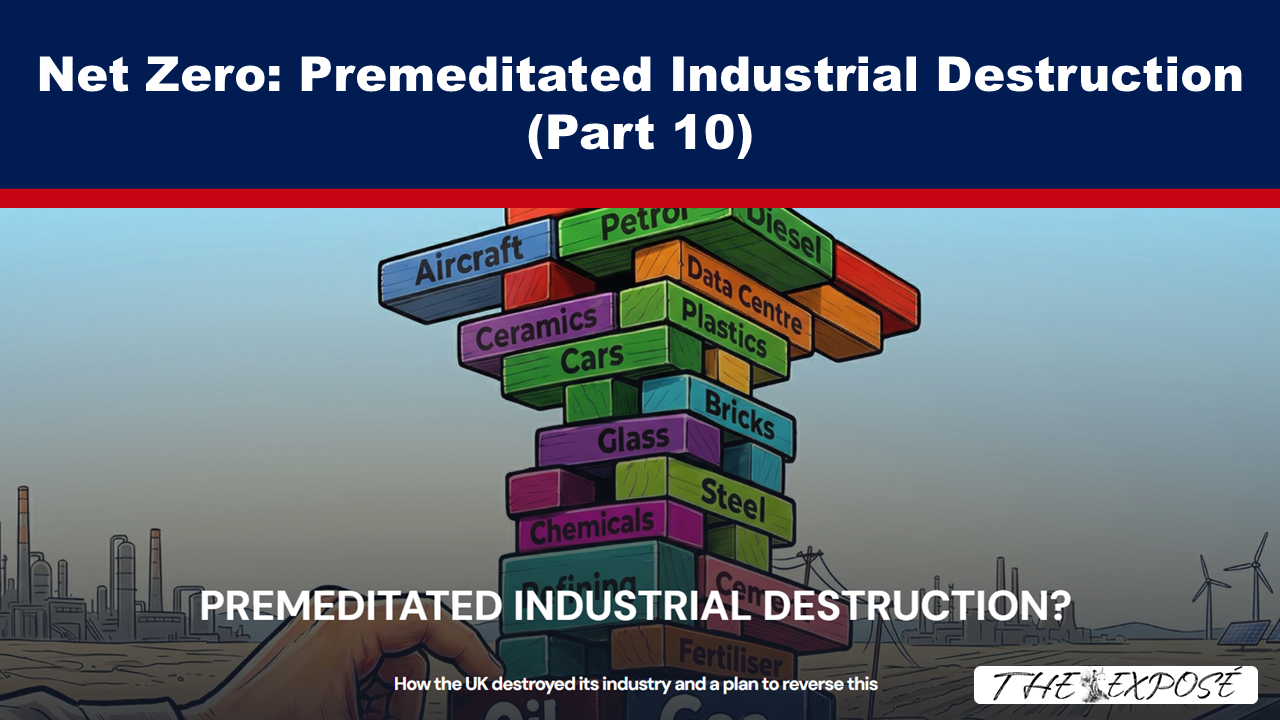
On 1 April, the Great British Business Council (“GBBC”), a newly formed think tank, published a paper titled ‘Premeditated Industrial Destruction: How the UK Destroyed Its Industry and A Plan To Reverse This’.
The paper is authored by economist Catherine McBride, retired engineer and consultant David Turver and public relations consultant Brian Monteith. It demonstrates how the Government’s Net Zero policies are destroying the foundations of the UK economy and provides recommendations on how Net Zero could be reversed.
Because this paper is important in revealing some home truths, we are reproducing it in a series of articles, more manageable chunks if you will, so that, hopefully, more will read it, or at least read part of it. We have made some minor edits for readability purposes. For those who choose to read the paper in one sitting, you can do so HERE.
Let’s not lose touch…Your Government and Big Tech are actively trying to censor the information reported by The Exposé to serve their own needs. Subscribe to our emails now to make sure you receive the latest uncensored news in your inbox…
Chapter 9: Geostrategic security from domestic oil, gas and coal
By Great British Business Council, 1 April 2026
Table of Contents
Introduction
Overall, UK oil and gas trade volumes in 2024 were broadly stable compared with 2023, with imports rising 2 per cent and exports falling 6 per cent, though this masks some variation by fuel. UK Import dependency increased to 43.8% in 2024, up from 40.3% in 2023. (DUKES published 31 July 2025). However, energy security has emerged as a central theme for the UK’s oil and gas industry, particularly in light of Russia’s invasion of Ukraine, its impact on European gas supplies and political upheaval in Norway, as domestic energy prices have increased due to additional EU demand.
Some commentators – such as Professor John Underhill at the University of Aberdeen – correctly argue that dependence on imports exposes the UK to excessive geopolitical and economic risks, and have called on the government to adopt a policy approach that balances energy security with environmental sustainability and climate concerns. This is now more important than ever.
Now, the US and Israel’s conflict with Iran has again made energy security front-page news. Iranian attacks have damaged Qatari liquified natural gas (“LNG”) production at Ras Laffan, the world’s largest LNG complex, which exports between 77 and 81 Mtpa, equal to about 20% of global LNG supplies. The Iranians also damaged Bahrain’s Bapco refinery, which produced between 260,000 and 380,000 barrels per day. This is Bahrain’s most important energy asset. Saudi Arabia’s Petroline (East West pipeline) is able to reroute crude export to Yanbu on the Red Sea to avoid Iranian attacks on tankers in the Straits of Hormuz. But the pipeline currently transports 5 million barrels per day, while Saudi Arabia’s historical seaborne crude exports ranged from 6.1 to 7.5 million bpd. Abu Dhabi National Oil Company’s Hashan-Fujairah oil pipeline can funnel another 1.5 million bpd to the Gulf of Oman, also avoiding the Strait of Hormuz.
Economic theory versus reality
International economic theory assumes that imports will always be available, and so it is economically rational to replace domestic production with cheaper imports, but this theory falls apart when the price of imported products is driven above domestic prices due to an international supply squeeze or when imported products are not available at all due to war damage or foreign governments banning exports to ensure their own domestic supplies.
Supply squeezes due to war damage have increased oil and gas prices, as well as other hydrocarbons and petrochemicals that UK manufacturers have become accustomed to importing. And although the UK imported about 33.6 million tonnes of ‘HS2711 Gaseous hydrocarbons’ in 2025, 70% of them came from Norway and 22% from the US, which technically do not have a supply problem, but countries that were reliant on Qatari LNG will now be trying to move their purchases to US and Norwegian supplies by bidding up their price. This will also be true of countries that rely on crude oil supplies from Iran or Bahrain. Iran exported 67 million tonnes of Crude in 2023 (the most recent figures); one-third was bought by China, with the rest going to unspecified Asian countries.
Qatar supplied less than 2% of the UK’s gas imports in 2025, well below the 12% it supplied in 2022. In 2024 (the most recent trade data), Qatar exported just over 100 million tonnes of gas, with China and India each buying about 20%, South Korea buying 15% and Pakistan and Taiwan each buying about 6%, followed by Singapore, Japan, Bangladesh and Thailand. The scramble for other suppliers will push up prices for US, Australian and Malaysian LNG, and potentially for Norwegian natural gas if countries are connected by pipeline.
During the 2022 hydrocarbon price spike, caused by panic buying by UK and German gas companies fearing immediate sanctions on Russian gas supplies. This pushed up the price of UK and EU gas to 10 times the US Henry Hub price. The Conservative government’s response was to add an additional 25% Energy Profits Levy (“EPL,” the windfall tax) on the UK oil and gas industry. This was precisely the wrong response. The government claimed the levy would raise £15 billion to subsidise UK gas consumers; however, this was entirely the wrong response. The only effective cure for high prices is to let prices encourage increased supply and lower demand. Subsidising demand by taxing supply led to the opposite: people continued to use gas while suppliers produced less to avoid the extra tax. UK production has continued to fall since the EPL has been in place, and both the Conservative and Labour governments have responded to the lower production by increasing the rate from 25% to 35% and then 38% and extending the period over which the levy would be applied to 2030.
To add to the absurdity of the UK’s windfall tax, the EU’s sanctions on Russian oil and gas never fully materialised; only some of the supply chains shifted. Russia continues to produce oil and gas, and the EU continues to import it. In 2024, the EU imported 54 billion cubic metres of Russian gas and 13 million tonnes of Russian oil directly, as well as refined oil from India, most likely refined from Russian crude. In 2024, India imported 240 million tonnes of crude oil, of which 37% came from Russia. The main result of the price squeeze was that Russian producers were getting higher prices for their oil and gas, which helped Putin pay for his invasion of Ukraine. The current war with Iran will also increase Russia’s oil and gas revenues.
There would have been a massive geostrategic benefit if the UK had done the exact opposite of the Windfall Tax and instead lowered its taxes on UK oil and gas producers, encouraging them to increase production for domestic use or for export to the EU. The EU could not walk away from its Russian oil, gas and coal supplies because it had no alternative suppliers. Most EU countries have very little or no domestic oil and gas resources. Germany did not even have an LNG terminal in 2022. It had to build some so that it could import LNG from the US, while the UK, which is connected to the EU’s gas pipelines, acted as a land bridge for US LNG rather than selling UK gas to the EU.
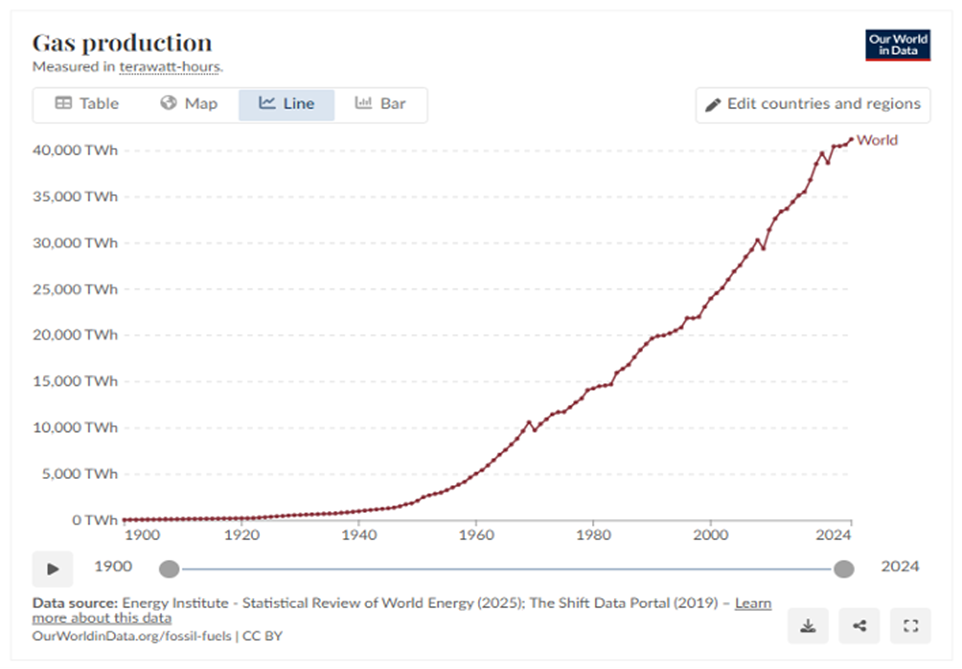
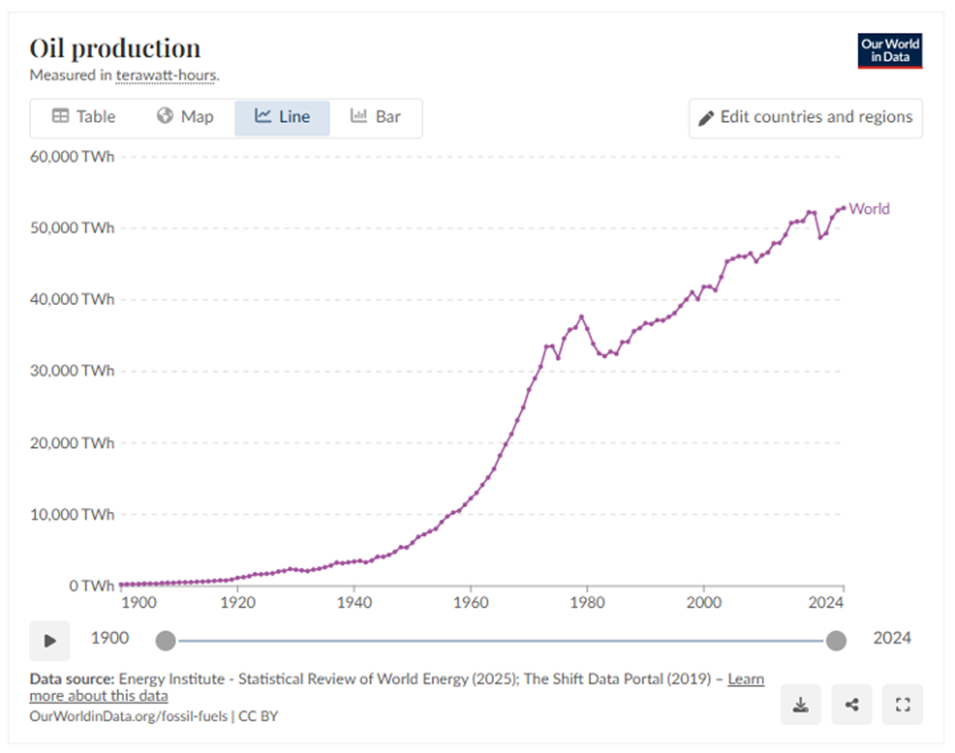
The sanctions against Russia had a minimal impact on Russian or global oil and gas production. In Figures 23 and 24 below on international oil and gas production, the drop in production during covid is noticeable, while Russia’s invasion of Ukraine, EU sanctions and the destruction of the Nord Stream pipelines are not. Global supplies of both oil and gas have increased, despite sanctions on Russia, the world’s second-largest hydrocarbon exporter in 2024, after the US and ahead of Saudi Arabia.
For the benefit of Ed Miliband and other UK politicians: There is no such thing as a global price for oil or gas; the prices are determined by supply and demand at the source of the oil and gas, the grade of oil, the composition of the gas and the ability and the cost of transporting and insuring the oil and gas to the place that demands it. Right now, on Monday, 9th March, a week after the US and Israel attacked Iran and Iran responded by attacking the production facilities of other Gulf oil and gas producers: the UK natural gas and the EU TTF gas prices are up by 5%, while the US Henry Hub price is down by 2.5%. The three prices are quoted in different units and currencies, but, converted, the UK and TTF prices are roughly the same, but they are over six times the US price. Similarly, US West Texas Intermediate (“WTI”) and UK Brent Crude are both light sweet crudes, but Brent is currently $99.57/barrel (+6.70) while WTI is only $94.05 (+3.47).
Transport and insurance costs add to the cost of imported oil and gas in peacetime but increase considerably during wars, terrorist attacks and blockades. Not only have oil prices increased by between 35% and 135% since Iran blocked the Strait of Hormuz, but Very Large Crude Carrier (“VLCC”) rates have quadrupled to $800,000 per day and war-risk insurance premiums have increased by almost 7 times. Pipeline prices that avoid the Strait of Hormuz by crossing Saudi Arabia, Oman and Turkey have also increased as demand for them has grown.
Pipelines help to reduce these costs by avoiding chokepoints and there are various transnational pipelines as well as pipelines linking inland wells and fields to export terminals. Russia has pipelines connecting its oil to Belarus, Poland, Germany, Slovakia, Hungary, the Czech Republic and China. Azerbaijan has pipelines connecting it to Georgia and Turkey; Kazakhstan has pipelines connecting it to China and the Black Sea; Iraq has a pipeline to Turkey; and, Canada has two pipelines taking its oil to the US.
Pipelines reduce transport costs, secure supply lines for landlocked producers, and unsurprisingly, enforce geopolitical dependencies. For example, the EU remains dependent on Russian oil and gas four years after its invasion of Ukraine. Pipelines can be the cheapest way to transport oil if volumes are steady, the terrain is not extreme and if the pipeline is already built and amortised.
Pipelines connecting the North Sea gas to the UK and the UK’s lack of gas storage also ensure that North Sea gas cannot be “sold to the highest bidder” and transported “elsewhere,” as many commentators claim. The UK does not have an LNG plant and can only supply gas to countries connected to it by pipeline: Ireland, Denmark and the Netherlands.
Weather and maintenance disruption can be as devastating as warfare
Tropical Cyclone Narelle hit north-western Australia on 26 March, damaging Australia’s main LNG production and closing ports. This is incredibly badly timed, coinciding with the conflict in the Persian Gulf. Australia produces 20% of global LNG and is the 3rd-largest LNG exporter after the US and Qatar. Qatar and Australia together provide about 40% of global LNG, and like Qatar, most of Australia’s LNG exports go to Asia: predominantly Japan, China, South Korea and Taiwan.
Most of the disruption has affected Chevron’s Gorgon and Wheatstone plants and Woodside’s North West Shelf Karratha plant, which together provide 8% of global LNG supply. This will lead to intensive competition for flexible cargoes as Asian buyers bid against the UK and the EU for non-Australian and non-Qatari LNG. While this may not disrupt UK supplies, it has definitely increased the price the UK will have to pay for the 20% of its gas that it imports from the US as LNG.
Maintenance by international suppliers
To add to the UK’s energy insecurity, Norway is due to reduce its gas exports by a third during the summer of 2026 while it carries out major maintenance work on its pipeline and processing facility. Norway will cut exports by 50 million m3/day from April to June and 75 million m3/day from August to September. These cuts will be spread across exports to both the EU and the UK; however, the UK should expect about a third of the reductions, as a third of Norway’s combined UK and EU gas exports go to the UK. Norway supplies about three-quarters of UK gas imports.
Fracking and Russian disinformation campaign
It is highly likely that all of the anti-fracking scare stories are either simply basic human fear of innovation (surprisingly common throughout history) or stories spread by vested interests who have the most to lose from an energy-independent UK. The Centre for European Studies found that the Russian government has invested €82 million in non-governmental organisations (“NGOs”) campaigning against shale gas. The former Secretary General of NATO, Anders Fogh Rasmussen, said the Russians, as part of a sophisticated disinformation operation, “engaged actively with so-called non-governmental organisations – environmental organisations working against shale gas – to maintain Europe’s dependence on imported Russian gas.”
The UK must also take seriously the problems that would be created if Russia decides to stop selling its hydrocarbons to its enemies – aka the West. Russia has supplied about 10% of the UK’s total oil and gas product imports (5-year average by value). Norway, our largest supplier, provides about 37% and the US supplies just over 10%.
Russia was also the UK’s largest supplier of refined petroleum. In 2021, we imported 5.7 million tonnes of product code ‘HS 2710, Petroleum oils and oils obtained from bituminous minerals (excluding crude)’, from Russia. Over the 5 years before its invasion of Ukraine, Russia has supplied between 15% and 26% of the UK’s refined petroleum imports.
So, what happens if they embargo sales to the UK – petrol rationing? Probably not for the UK, but for poorer nations, as the UK will be able to outbid poorer countries on international markets. But other Western nations, such as Germany, the Netherlands, Poland and South Korea, are much more reliant on Russia for their oil, coal and gas. Shortages in these countries will push up prices for everyone.
UK Steel Production and Geopolitics
[Note from The Exposé: For context, see Chapter 5, HERE.]
The only valid reason for the UK to continue producing virgin steel may be to ensure the security of supply for the UK’s defence industry, its construction industry and its most valuable exports: machinery and transport goods. With rebels able to prevent cargo ships from passing through the Suez Canal using a handful of cheap drones and Russia unlikely to rest on its laurels if it defeats Ukraine, this is not a hypothetical threat. Closing the Suez Canal disrupts the supply of finished steel from China and India, as well as the supply of iron ore and coking coal from Australia. A permanent closure of the Suez Canal would raise the cost of supplies from North America and Brazil, as all European buyers would divert their purchases to the Americas. To avoid this choke point, the UK must reopen its metallurgical coal mines.
Additionally, recycling steel in the UK is not viable while UK industrial electricity is so expensive. This will be made worse by adding more wind turbines to the grid, as explained in the first chapter. The substantial installation costs of renewable energy are recouped through subsidies (paid for by consumers), high generation fees, higher network fees and greater grid backup power fees.
Switching from cheap basic oxygen steelmaking (“BOS”) production to expensive electric arc furnaces (“EAF”) will not bode well for UK steelmaking. We must address the price of our industrial electricity. Adding more gas-fired power stations will help, while we increase conventional nuclear production and deploy Small Modular Reactors or Thorium Molten Salt Reactors. However, these latter options will take time to develop, so we should begin this process now. If there is a silver lining to the closure of the blast furnaces at Port Talbot, it must be the wake-up call to lower the price of UK industrial electricity.
About The Great British Business Council
The Great British Business Council (“GBBC”) was established to enhance public and political understanding of the advantages a thriving business community provides to local security, standard of living and wellbeing. It aims to support British firms and small businesses by promoting well-crafted, practical, evidence-based policy reforms that foster enterprise and innovation. It is independent of any political party, as it hopes that all parties will consider adopting the straightforward, practical policy suggestions it proposes.
The GBBC is funded by private donations from concerned citizens who want the UK to thrive economically as it once did. If you would like to join us or donate to their cause, please contact in**@**BC.UK or follow them on LinkedIn, X (Twitter), Facebook, YouTube, TikTok and Bluesky.
Featured image: Cover of the GBBC paper, ‘Premeditated Industrial Destruction: How the UK Destroyed Its Industry and A Plan To Reverse This’
The Expose Urgently Needs Your Help…
Can you please help to keep the lights on with The Expose’s honest, reliable, powerful and truthful journalism?
Your Government & Big Tech organisations
try to silence & shut down The Expose.
So we need your help to ensure
we can continue to bring you the
facts the mainstream refuses to.
The government does not fund us
to publish lies and propaganda on their
behalf like the Mainstream Media.
Instead, we rely solely on your support. So
please support us in our efforts to bring
you honest, reliable, investigative journalism
today. It’s secure, quick and easy.
Please choose your preferred method below to show your support.

Categories: Uncategorised
https://uncutnews.ch/live-vor-15-minuten-wer-kontrolliert-wirklich-die-strasse-von-hormus-larry-johnson-mit-brisanter-analyse/
Hi Rhoda,
I do not think Fracking is a good idea, it uses too much drinking water. As well as creating mild quakes.
Years ago, I can still remember Gas tanks, around the country.
In those days, gas was created by turning coal into coke.
Which was later burned to provide steel and aluminium.
The coal is still there underground waiting to be used.