





Fear is one of the most powerful drugs ever invented, Dr. Robert Malone and Dr. Jill Glasspool Malone say. And when it is weaponised, it is psychological bioterrorism.
The latest example of psychological bioterrorism is the current media frenzy surrounding Hantavirus.
To protect yourself, learn to recognise when fear has become the product that is being marketed.
Let’s not lose touch…Your Government and Big Tech are actively trying to censor the information reported by The Exposé to serve their own needs. Subscribe to our emails now to make sure you receive the latest uncensored news in your inbox…
Hantavirus and Psychological Bioterrorism
By Dr. Robert W. Malone and Dr. Jill Glasspool Malone, 11 May 2026
Fear is one of the most powerful drugs ever invented.
Unlike antibiotics or antivirals, it requires no FDA approval, no manufacturing plant, and no cold-chain shipping. Fear spreads itself. All it takes is a headline, a few experts on television, ominous music behind a news segment, and suddenly millions of people begin scanning their bodies for symptoms they did not know they had ten minutes earlier.
Psychological Bioterrorism is the weaponisation of fear about disease in order to manipulate individuals, populations, markets and governments. Sometimes the objective is political. Sometimes financial. Sometimes bureaucratic. Often, it is all three at once.
This is not a conspiracy theory. It is a recognised form of psychological warfare. We have written about it extensively in our book ‘Psywar’.
In that book, we write about Dr. Alexander Kouzminov, a former Soviet-Russian intelligence officer with deep experience in biological espionage and biosecurity operations, who in 2017, described how fear of infectious disease can be strategically amplified to shape public behaviour, influence governments, and create opportunities for those positioned to benefit from the panic. That process is called psychological bioterrorism.
Once you understand the framework, you start seeing the pattern everywhere.
A virus or some other pathogen emerges somewhere in the world. The media shifts into apocalyptic mode. Experts appear to be predicting catastrophe. Computer models project millions dead, if the right circumstances coalesce. Politicians declare emergencies. Pharmaceutical companies announce new products. Social media turns into a digital panic attack. And ordinary people, who just wanted to buy eggs and walk the dog, suddenly feel like civilisation is one cough away from collapse.
Wash. Rinse. Repeat.
The latest example is the current media frenzy surrounding Hantavirus.
Now, to be clear, Hantavirus is a real disease. It can be serious. It deserves appropriate medical attention and surveillance. Rodent control around homes and barns matters, particularly in areas where the virus is endemic. Nobody sensible is arguing otherwise.
But if you watched the recent media cycle unfold, you would think half the country was moments away from dying in a cloud of mouse droppings drifting through the HVAC system at Tractor Supply.
The reality is far less cinematic.
Hantavirus infections in the United States remain extremely rare. Most cases occur in very specific geographic regions and involve clear exposure risks, typically in enclosed areas contaminated with rodent waste. Yet suddenly, every media outlet behaves as though sweeping out your old feed room or poking around your basement is equivalent to starring in a Hollywood outbreak movie.
This is how psychological bioterrorism works. The pathogen itself matters less than the emotional payload attached to it.
Fear scales faster than facts.
The reason these campaigns work so well is simple. Human beings are biologically wired to fear invisible threats. A wolf outside the cave is frightening. But an invisible virus floating through the air? That activates something much deeper in the human nervous system. You cannot see it. You cannot smell it. You cannot negotiate with it. Every stranger becomes a potential threat. Every cough becomes suspicious.
That loss of control is the point.
Psychological bioterrorism succeeds because it simultaneously creates four powerful emotional conditions.
• First, speed. Modern communications allow fear to spread globally in real time. One dramatic headline in New York can trigger anxiety in Nebraska before breakfast.
• Second, vulnerability. Most people feel helpless against infectious diseases. They do not know what is true, what is exaggerated or what actually works. That uncertainty creates dependency on authorities.
• Third, confusion. During outbreaks, conflicting information floods the public sphere. Models change. Predictions fail. Definitions shift. Recommendations reverse. In the fog of uncertainty, populations become easier to steer.
• And fourth, social pressure. Once fear takes hold, compliance becomes a kind of tribal ritual. Masks, distancing, endless boosters, disinfecting groceries, standing on little floor stickers six feet apart like contestants in a strange game show. Many of these behaviours become symbols of belonging as much as they do of actual disease mitigation.
Humans are social creatures. We want to belong to the protected group. That instinct can be manipulated.
Suddenly, every dusty shed becomes a potential death trap. Sweep out the feed room and, apparently, you now require the courage of a Navy SEAL entering Fallujah.
This is where the psychology becomes more important than the pathogen itself. The actual risk matters less than the emotional framing. Invisible threats produce a unique type of anxiety because people cannot easily assess danger with their own senses. You can see smoke from a fire. You can hear a tornado siren. But you cannot see a virus particle. That uncertainty creates fertile ground for fear amplification.
And once fear takes hold socially, it becomes self-reinforcing. People constantly scan for danger signals. Every cough becomes suspicious. Every news alert feels urgent. Social media feeds become giant feedback loops of anxiety. One frightened person shares alarming information with ten others, who then amplify it further. Before long, the emotional reaction has become detached from the actual statistical risk.
We watched this dynamic unfold repeatedly during covid. We are now seeing smaller replay versions with avian influenza, Hantavirus, measles outbreaks and whatever pathogen dominates the next media cycle. The script rarely changes. First comes the alarming headline. Then come the predictive models. Then the expert panels. Then the declarations that “we must act now.” Soon, politicians, bureaucracies, corporations, and media organisations all become economically and institutionally invested in maintaining public attention on the threat.
Fear becomes infrastructure.
One of the more fascinating aspects of these cycles is how often speculative language is transformed into emotional certainty. Watch closely, and you will notice the repeated use of phrases like “could spread,” “may mutate,” “might become severe,” or “has pandemic potential.” Scientifically, these statements may be technically true. Almost anything in biology is possible. But psychologically, the public often processes those phrases as though catastrophe is inevitable. That shift in language matters enormously.
Most people do not have the time, scientific background or emotional distance to continuously evaluate evolving risk claims. They rely instead on emotional tone and institutional trust. If every headline sounds urgent, the brain assumes there must be urgency. This is one reason why psychological bioterrorism is so effective. The campaign does not require outright fabrication. It only requires selective amplification, strategic framing, repetition and emotional saturation.
Historically, governments and institutions have always understood the political utility of fear. Fear justifies emergency powers. Fear accelerates funding streams. Fear increases media consumption. Fear also creates social cohesion around compliance behaviours. During covid, entire rituals emerged around masking, distancing, sanitising groceries, vaccination and public displays of “doing the right thing.” Some interventions may have had a partial benefit. Others bordered on theatre. But all served an additional social purpose by signalling membership in the morally protected group.
Humans desperately want to belong to a protected group. That instinct is ancient. And it is easily manipulated.
None of this means infectious diseases are imaginary, nor does it mean all public health officials are malicious actors. Real outbreaks happen. Surveillance matters. Preparedness matters. Basic hygiene matters. But proportionality matters too. A society permanently trapped in hypervigilance eventually loses the ability to distinguish genuine emergencies from manufactured panic.
And that may be the greatest long-term danger of all.
When populations are conditioned to exist in a constant state of biological anxiety, they become psychologically exhausted. Trust erodes. Critical thinking deteriorates. Some people become permanently fearful. Others swing toward reflexive cynicism and stop believing anything at all, including legitimate warnings. Both outcomes are destructive.
An even bigger danger is the use of prolonged national health emergencies by those in charge to seize power. Election processes are manipulated or deferred. Medical practitioners who don’t comply or speak out lose their licenses permanently. Small businesses are shuttered, while large transnational corporations with ties to the government grow ever bigger. More “safety” regulations that benefit big ag are incorporated. Rules tighten, and freedoms become more restrictive.
The challenge moving forward is not to become fearless. The challenge and opportunity is to become harder to manipulate.
That requires perspective, resilience and the willingness to ask calm questions during moments of manufactured urgency. Who benefits from the panic? What evidence actually exists? What is known versus speculative? Are we responding proportionally to the actual level of risk?
Most importantly, we must learn to recognise when fear itself has become the product being marketed.
Because once societies accept perpetual emergency as normal, freedom begins to erode one anxious headline at a time.
About the Authors
Jill Glasspool Malone, PhD, is a specialist in preclinical, regulatory, and clinical project management, with special expertise in public policy and Federal regulatory issues. She has been a co-founder of several biotech companies and has held positions in the biotechnology industry and academia. She has an extensive publication record in gene therapy, immunology and public policy for infectious disease outbreaks. She is married to Dr. Robert W. Malone.
Robert W. Malone is a scientist and physician, and the original inventor of mRNA vaccination as a technology, DNA vaccination and multiple non-viral DNA and RNA/mRNA platform delivery technologies.
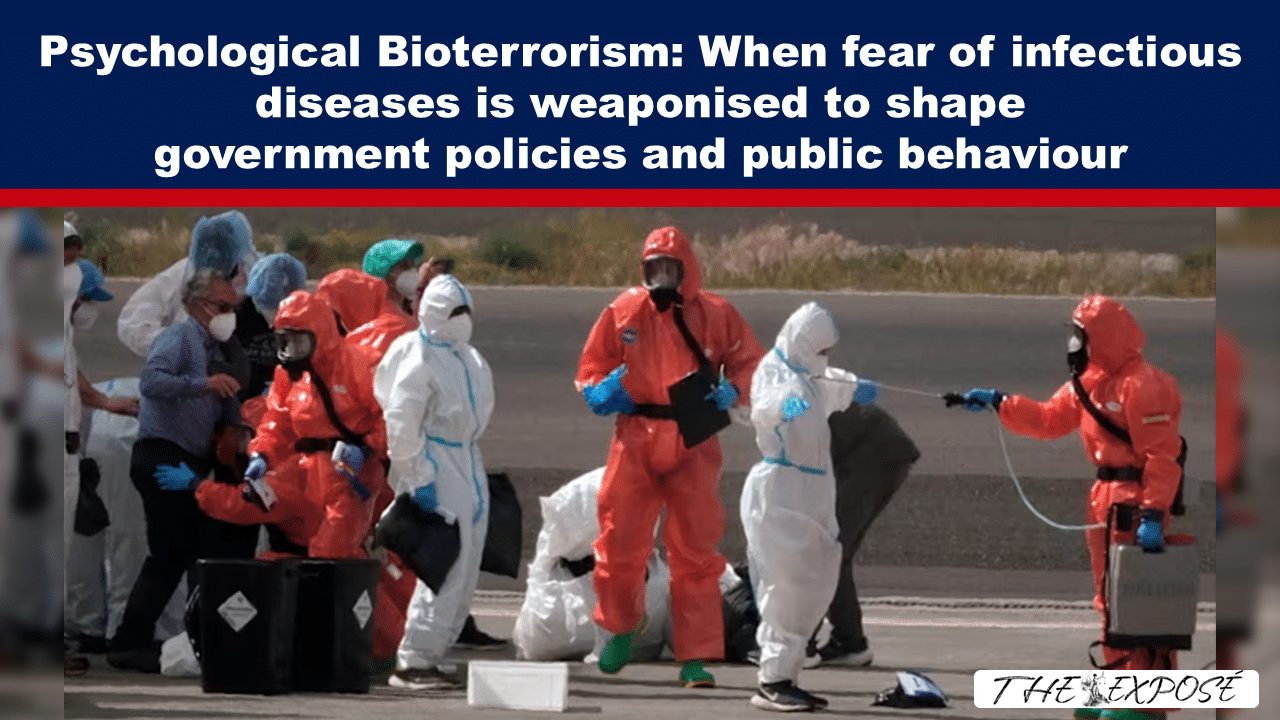
Featured image taken from a scaremongering Financial Times article, ‘Two cruise ship evacuees test positive for hantavirus’
The Expose Urgently Needs Your Help…
Can you please help to keep the lights on with The Expose’s honest, reliable, powerful and truthful journalism?
Your Government & Big Tech organisations
try to silence & shut down The Expose.
So we need your help to ensure
we can continue to bring you the
facts the mainstream refuses to.
The government does not fund us
to publish lies and propaganda on their
behalf like the Mainstream Media.
Instead, we rely solely on your support. So
please support us in our efforts to bring
you honest, reliable, investigative journalism
today. It’s secure, quick and easy.
Please choose your preferred method below to show your support.

Categories: Breaking News, US News
“When fear of infectious diseases is weaponised to shape government policies and public behaviour”Problem reaction solution. Business as usuals by the criminals in politics.
I’m just reading the ‘Contagion Myth’ and it just blows all of this virus BS out of the water!…
Right on the MYTH consensus. Deadly contagion does not exit because nature always maintain equilibrium for survival and depends on each other to sustain symbiosis life.
Nature NEVER goes berserk UNLESS biological engineered by human hands.
We lived in constants fear because only FEAR can be emotionally weaponized against humanity by so called ‘elected govern-ment’.
Want to know the real problem? It’s unsupported statements like this:
“Now, to be clear, Hantavirus is a real disease.”
Except, it isn’t. The only way to stop all this BS is to challenge the existence of pathogenic viruses using the scientific method and logic.
Already challenged & already proven scientifically virus does not exist.
Virus = engineered Venom = Neurotoxin smart protein (not a living creature nor alive)
The problem with society, refuse to accept the facts presented. Still believe a pseudo-science is a real science.
Believe fairy tale is real and this way not much will ever changed to be a better person except gullible sheeples.
Virus = engineered Venom
Engineered Venom = Neurotoxin smart protein
Venom (virus) not a living creature nor alive or able to replicate or reproduce. Snake venom is produced in specialized glands that are modifications of salivary glands. These glands secrete a complex mixture of proteins, enzymes, and other substances that serve various function.
Hence, virus could multiply and cause contagion is absurd lie, even scientifically impossible.
The missing & disappearing scientists have to do a lot with this FEAR propaganda.
Why no article by EXPOSE on this matter because those scientist are related to all the psychological bio-terrorism lies. They are been silenced to stop the TRUTH from coming out.
NASA’s related scientists are silenced because asking too much question on science facts & logic of SPACE exploration. The coming sun eclipse on 2nd August 2027 was one of the discussed topic to make sense of how Eclipse path could travel half of the globe in 6 hours on SPINNING globe… Somebody woke from all lies..!!
I’ve been trying to expose as much as possible about our screwed world leaders around the world that corrupted beyond repair because already ‘indoctrinated’ to refuse facts & logic.
Too much truth bombarded at one go would stressed out most readers. So, please watch the following video that covered as much as 74% (11) of the what’s already done and what’s coming soon…
The BANNED Interview That Warned Us All:
https://www.youtube.com/watch?v=L3j1aoo2tdQ
Nothing new – just basic common sense. Social engineering has been safe and effective – critical thinking amongst the vast majority almost programmed out.
Exposure to rodent faeces and urine can cause disease because it is toxic. This has nothing to do with an imaginary virus.
Particles that look identical to “hantavirus” can be seen in cells that are breaking down due to poisoning and starvation without the addition of a “virus”. Jamie Andrews has clearly demonstrated this experimentally.
The “hantavirus” PCR test has been shown to detect human genetic sequences NOT “viral” genetic sequences. This is publicly available information and can easily be checked by anybody.
Dr Malone is notorious for his pseudoscientific belief in “an invisible virus floating through the air”. The virus challenge is open to him and to anyone else who can prove the existence of viruses using the scientific method. Big cash prize up for grabs. Still no takers.
“You cannot see it. You cannot smell it. You cannot negotiate with it”…because it does not exist. It is all pure psychological bioterrorism and Dr Malone is part of the problem.
Virology does “require outright fabrication” unlike bacteriology because bacteria actually exist. Viruses are fictional computer models that do not exist in the real world.
I would be very curious to know which covid interventions Dr Malone thinks “may have had a partial benefit” since i cannot think of a single one that was not completely disastrous by design.
Dr Malone fraudulently claims to have invented many things but in any case he will surely make lots of money from his “platform delivery technologies” by keeping the virus hoax alive.
“It is difficult to get a man to understand something, when his salary depends on his not understanding it.”
Upton Sinclair
You quoted: “It is difficult to get a man to understand something, when his salary depends on his not understanding it.”
What does your “understanding” depend on?
For those who are not aware of Sam’s “understanding” about viruses: Here he is boasting that he could create a synthetic virus in 10 mins if he was let loose on Moderna’s platform: https://expose-news.com/2025/05/30/us-gov-cancels-funding-to-moderna/#comment-168217
Nobody is paying me. This is the third time that you have misrepresented that comment of mine. I was pointing out that the mRNA vaccine platform sequence can easily be changed. I was not talking about creating “a synthetic virus”. You do realise that people can read and understand what i actually said right?
Hi Sam. I have no medical background but I completely understood your comment and at no time did you mention creating or manipulating an actual virus!
Rhoda is too set in her ways and for a ‘truther’, that doesn’t bode well….
It is bizarre. Twice in that comment i refer to the fact that viruses are fake and yet some how this is presented as evidence that i believe in viruses!
True!
Dr Malone can’t be trusted because involved directly in virus scam, PCR test & vaccine lies.
Rhoda seem still ‘attacking’ (have bone to pick) on your term of synthetic virus thing. She’s not a virology specialist. Hence, her opinion or view based of what she want to believe unless she could provide concrete evidence of virus existence.
Synthetic term refers to engineered or modified from original or completely alternative similar substance of VENOM/TOXIN using computer sequence to embedded (inject) simple instruction (micro-electric command) to travel, find & attack certain living organs that transmit micro-electric.
Proof: Nano-technology. Self assembly according to coding embedded.
There is nothing to fear but fear itself. (JFK) And he is right, we who belong to creator God fear nothing because we know who has our backs. And when a person is in right standing with our creator nothing in Hell or on earth can prevail against us.
That should sat FDR not JFK, sorry about the hugh typo.
Typo in above post it should read FDR, not JFK. So sorry.
The Malones’ reprise of the dystopian govt darkness through which we all lived a few years ago is not welcome. Rather than reminding us of our helplessness, they should be agitating for Nuremberg-like trials to prosecute the perpetrators. The entire episode was a crime against humanity.
Having totally failed to understand the malignancy of his own co-invention (mRNA), Dr. Malone allowed himself to be injected with the “not-a-vaccine” and persuaded others to poison themselves similarly. Late in the game he changed his tune…too late.
The Malones should find an isolated corner on their palatial Virginia horse ranch, remain there and shut up.
He’s a wolf in sheep clothing. Period.
Great article. Stay strong everyone!
“Trust in the Lord with all your heart and lean not on your own understanding.”
“For I have not given you a spirit of fear but of power, love and of sound mind.”