



A major international study, published on Monday 1 June, revealed that 55,000 expected cancer cases went undiagnosed across seven high-income countries during the first nine months of the Covid pandemic. The study offers one of the clearest measures yet of the hidden cost of suspended screening, reduced access to doctors, and public reluctance to enter medical settings amid Covid fears in 2020. Along with another 2026 study which estimated 17,390 excess cancer-related deaths due to the interruption, these new findings offer an official glimpse into the scale of what was sacrificed six years ago.
The study, published in the Lancet Oncology on 1 June 2026, examine data from 2.6 million cancer patients across 18 jurisdictions in Australia, Canada, Denmark, Ireland, New Zealand, Norway, and the UK. Researchers compared observed cancer diagnoses between April and December 2020 with expected diagnoses based on pre-pandemic trends from 2015 to 2019. Of 347,666 expected cases, 55,713 were predicted to be missing, representing 16% of expected cases.
Those missing diagnoses were not evenly distributed across cancer types. The largest deficits were found in prostate cancer, female breast cancer, and melanoma – all conditions where screening, primary care access, and early investigation can play a major role in detection. Lung and ovarian cancers were less affected, likely because many cases are diagnosed through symptomatic or urgent pathways rather than routine screening.
The headline figures revealed:
- 55,713 expected cancer cases were predicted to be missing
- 16 percent of expected diagnoses were absent between April and December 2020
- Prostate cancer diagnoses fell 24 percent compared to expected levels
- Female breast cancer diagnoses fell 18 percent
- Melanoma diagnoses fell 18 percent
- Ovarian cancer diagnoses fell 4 percent
- Lung cancer fell 8 percent
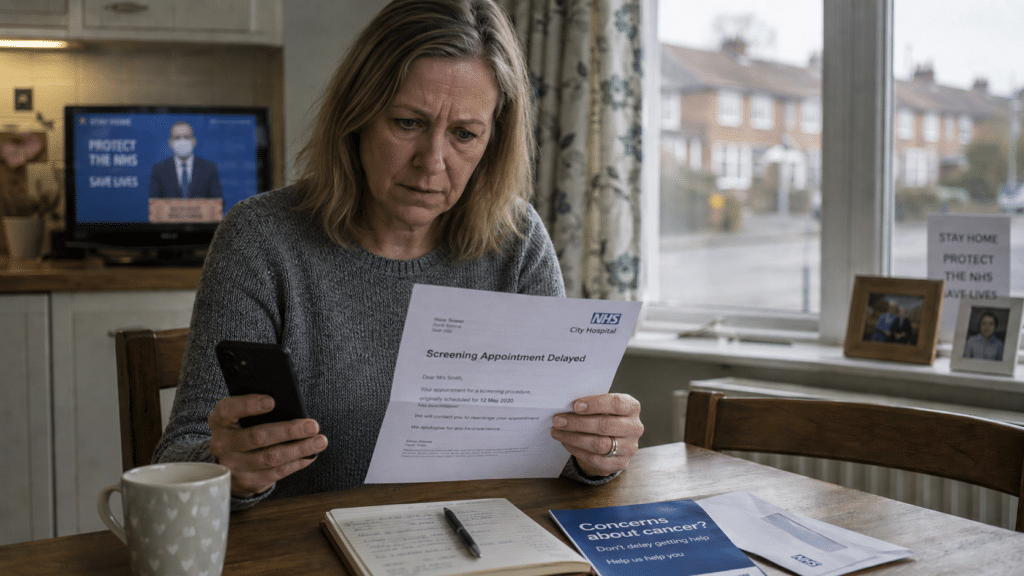
Cancer, of course, did not temporarily become less common during 2020. These figures represent the stark impact Covid pandemic measures had on people scared away from seeking medical assistance. Screening programmes were suspended, primary care appointments became harder to access, hospitals were reorganised around Covid, and many patients avoided medical settings because of the fear of infection.
The International Agency for Research on Cancer, which worked on the study with the International Cancer Benchmarking Partnership, said the disruption was caused by reluctance to seek care. Invisible tumours, lumps left unchecked, skin lesions not examined, PSA results not followed, and colon symptoms not investigated led to thousands of estimated “excess” deaths. Delays, in cancer medicine, make the difference between easy and complicated treatments, localised and metastatic disease, and significantly impact the chance of survival.
Comparing the different countries, there are substantial variations. Norway and New Zealand, for example, saw smaller declines in cancer detection and faster recoveries, while the UK and Ireland performed worse in several measures. In prostate cancer, the UK had the largest difference between predicted and observed incidence rates. The measurement used in the study is “cases per 100,000 person-years”, meaning the number of expected cancer diagnoses if 100,000 people were followed for one year. The UK’s prostate cancer rate was expected to be 164.9 per 100,000 person-years versus 101.4 observed in 2020. Norway, by contrast, predicted 164.1 but saw 168.4 in reality, meaning almost no difference due to Covid restrictions.
The UK figures are particularly shocking. In terms of percentage deficits, the country experienced a 54% difference between expected and observed cases for prostate cancer, 40% for breast cancer, and 40% for melanoma. Ireland also saw large deficits, including 36% for prostate cancer and 34% for breast cancer. Canada recorded a 35% deficit for melanoma.
A separate study published in JAMA Oncology in February 2026 further highlights the extent of pandemic-era disruptions on cancer survival. Analysing more than one million US patients diagnosed with invasive cancer in 2020 and 2021, researchers found worse one-year cancer-specific survival compared with pre-pandemic trends from 2015 to 2019. Those declines translated into an estimated 17,390 additional cancer-related deaths within one year of diagnoses; 9,162 in 2020 and 8,228 in 2021.
The US study looked at survival rather than missed diagnoses across the seven-country group, so it is not a direct extension of the Lancet Oncology findings. It is, however, part of the same pattern. As screenings, diagnoses, and treatments are disrupted, harm does not necessarily appear immediately. It can take months or years to see the true harm.
Health policy during Covid was always discussed as though lives could only be counted in a single column: prevent Covid deaths. Protect hospitals, reduce transmission, and “flatten the curve”. The new study on cancer diagnoses demonstrates what was clear for many at the beginning, that other health concerns didn’t disappear overnight. The true cost is slowly being revealed by official studies, and here we see further proof that delayed diagnoses, interrupted treatment, missed symptoms, and lost trust in the system cost thousands of lives unnecessarily.
A lot of people took “stay home” too seriously. Some avoided GPs when they should have sought help, as they were convinced it was dangerous to do so. Invitations for screenings or check-ups were ignored, and hospitals were advertised as unsafe to visit, unless it concerned a Covid case. Others were simply unable to get through to a system that focused completely on the pandemic.
Governments and health authorities may now say that Covid presented impossible choices. It does not, however, leave them immune to accounting. Mental health, cancer, heart disease, and other killers were treated as background noise as Covid took centre stage.
The Lancet Oncology study should therefore be read as more than just a medical paper. It’s a post-mortem on pandemic governance, and shows how a crisis response narrows the definition of “health” to the detriment of the population. It also reveals why resilience measures should not provide the ability to turn an entire health service towards one “disease” while allowing routine diagnosis to collapse.
The missing cancer cases of 2020 are not just numbers from the past. They are a warning about the next “emergency”. The previous pandemic may be over, but the consequences of missed care are still being counted up. For thousands of patients in these two specific studies alone, and millions more worldwide, the cost of lockdown was not counted in daily Covid figures or infection curves. Instead, the real cost was recorded later in diagnoses that came too late to save their lives.
The Expose Urgently Needs Your Help…
Can you please help to keep the lights on with The Expose’s honest, reliable, powerful and truthful journalism?
Your Government & Big Tech organisations
try to silence & shut down The Expose.
So we need your help to ensure
we can continue to bring you the
facts the mainstream refuses to.
The government does not fund us
to publish lies and propaganda on their
behalf like the Mainstream Media.
Instead, we rely solely on your support. So
please support us in our efforts to bring
you honest, reliable, investigative journalism
today. It’s secure, quick and easy.
Please choose your preferred method below to show your support.

Categories: World News
There is death in them jabs if your wise you too will stay far far away from all mRNA gene therapy jabs. And yes they are gene therapy and not vaccines.
Indeed, best to avoid any of them!
So the fear campaign was successful leading to other sicknesses that should have been diagnosed much earlier if our corrupt leaders had only been honest with us!
We all know by now that it will never happen…Honesty and anything even close to the truth is foreign to them!
Sars-cov2 virus or whatever it was called never existed and the price
of seeking medical help during the fake pandemic was testing and, if
positive,
being injected with a poisonous jab. The PCR test was just a lottery
and had nothing to do with illness or infection.
Sadly this looks true!
Could this be part of how they plan to reduce the world’s population?
Apparently, the C jabs cause turbo cancer. To say that the increase of cancer is due to not getting access to diagnosis seems like a distraction from the true reason.
I’m afraid you may be very right!
Early 2020 my son wasn’t well with several symptoms, he called his GP but they wouldn’t see him telling him it was just stress, he got worse as the year went on, and requested a blood test, which the GP refused still saying stress, this continued until the end of 2021, at which point he couldn’t walk down the stairs due to severe breathless and he was extremely weak and tired, I eventually called his GP and demanded a blood test not taken no for an answer, he got the blood test and by lunchtime that day he got a call to go straight to hospital, he required 5 pints of blood in a transfusion and was told his kidneys had failed and he had to get dialysis, it was touch and go whether he would survive he was 29 yrs old, he did survive but has been on dialysis for over 5 yrs now and is on the transplant list but according to the hospital it would have never gone that far if he’d got medical attention when he first had symptoms, so the way the authorities handled covid has ruined his life, he’s still waiting on a transplant and his life has deteriorated badly over the years, along with his mental health, he now finds it hard to get through the day and the dialysis machine he has to connect to every night ruins his sleep he’s always tired and has gone from a hard working, happy young lad to an ill stressed lad who can’t see a future for himself..
Hi Elaine,
Sorry to hear about your son being ill.
Chlorine Dioxide from a camping store may help with the kidneys.
If he had the C19 fluid, EDTA and NAC may help.
I have been reading a lot about Red Light Therapy and TZLA, Plasma Healing Machine, mainly from the US.
Please do not put all your faith in doctors.
Thanks Dave, I literally lost all trust in doctors during covid era, the way they treated or I should say ignored patients was absolutely cruel and evil, and by 2021 the only thing that they had any interest in was pushing the jab, of which both myself and son refused, which didn’t go down well with them, when he was eventually diagnosed and treated, his doctor said perhaps if you had took the vaccine you wouldn’t have had all these problems, even though his symptoms had started before covid and had nothing to do with covid, I put in a complaint about the doctors attitude towards him, he got a sorry 🤨 but nothing else was done. I will look into your suggestions, he’s very depressed 5 years has passed and still no transplant, although the time average in Scotland is 2 years, we have now started a full enquiry into this 5 year wait, as they were reluctant to put him on the transplant list due to refusing the vaccine, they did put him on it, but now we’re wondering if this is the reason he’s 3 years over the average waiting time. So we are busy with this enquiry which I’m constantly not letting go off until we get proof that he hasn’t been allowed to suffer for refusing it. I firmly believe if he’d took it he wouldn’t be around now, as he was already very weak and that vaccine would have completely wiped him out 🥲
They are really pushing those jabs to the extreme and not minding at all if his life is in danger!