




Environmental activism is helping to destroy the UK’s hydrocarbon industries. These activists are adding to the cost of oil, gas and coal production while shrinking the UK’s economy.
The development of Rosebank, the UK’s largest undeveloped oil and gas field, has been delayed due to environmental activism by groups such as Stop Rosebank.
Other activist groups, namely Greenpeace and the “all-purpose” activist group Coal Action Network, have targeted the UK coal industry, commissioning research that is not fully published, leading to the closure of mines and power stations, and job losses.
Let’s not lose touch…Your Government and Big Tech are actively trying to censor the information reported by The Exposé to serve their own needs. Subscribe to our emails now to make sure you receive the latest uncensored news in your inbox…
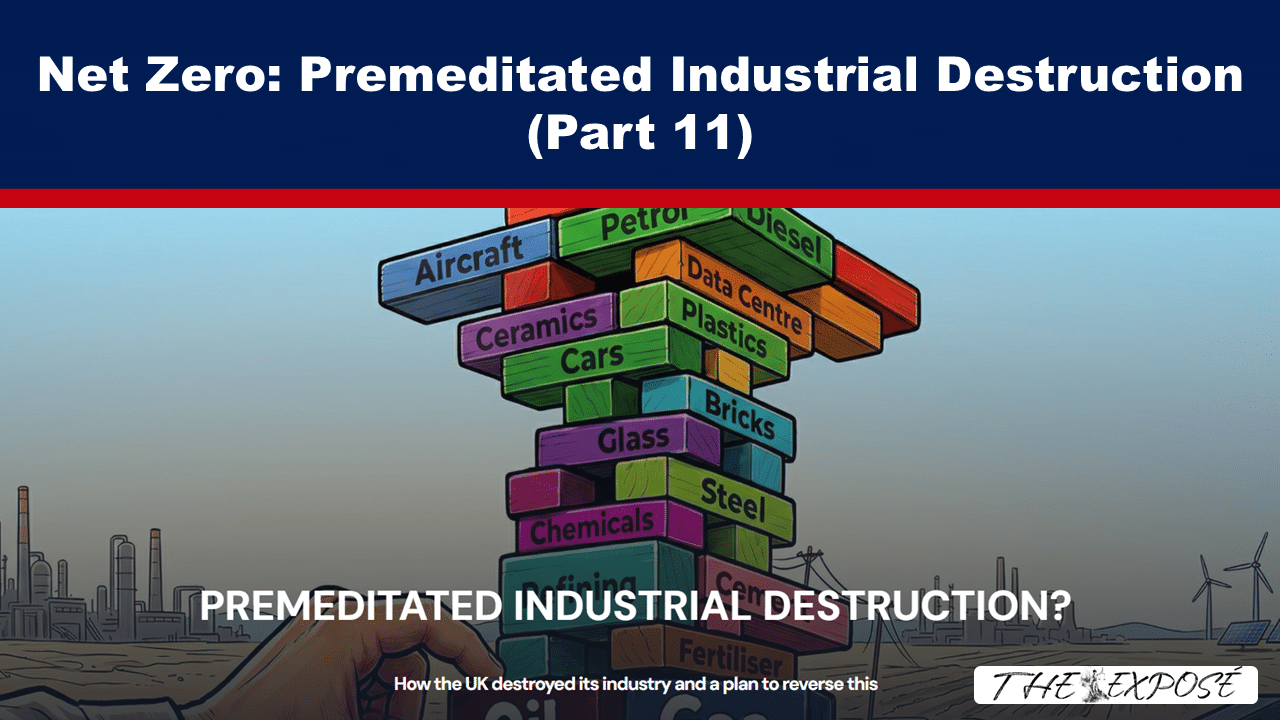
On 1 April, the Great British Business Council (“GBBC”), a newly formed think tank, published a paper titled ‘Premeditated Industrial Destruction: How the UK Destroyed Its Industry and A Plan To Reverse This’.
The paper is authored by economist Catherine McBride, retired engineer and consultant David Turver and public relations consultant Brian Monteith. It demonstrates how the Government’s Net Zero policies are destroying the foundations of the UK economy and provides recommendations on how Net Zero could be reversed.
Because this paper is important in revealing some home truths, we are reproducing it in a series of articles, more manageable chunks if you will, so that, hopefully, more will read it, or at least read part of it. We have made some minor edits for readability purposes. For those who choose to read the paper in one sitting, you can do so HERE.
Chapter 10: Activists add to the cost of production and limit UK GDP
By Great British Business Council, 1 April 2026
Table of Contents
Introduction
The Rosebank field was discovered in 2004 and it took nearly two decades to receive government approval. Following extensive evaluations and delays, the UK government granted development consent in 2023. Environmental groups, such as Greenpeace and Uplift, have played a pivotal role in challenging the approval.
Rosebank, the largest undeveloped oil field in the UK, is estimated to contain 300-500 million barrels of oil equivalent, with peak production of about 70,000 barrels of oil and 44 million cubic feet of gas per day. Drilling has been delayed because the Supreme Court’s 2024 Finch v Surrey County Council ruling required that all new UK oil developments account for their Scope 3 emissions when assessing their environmental impact. Scope 3 emissions are those produced by users of the oil and gas produced from the field. The Scottish Court of Session upheld this ruling as affecting the Rosebank application retrospectively in January 2025.
Rosebank activists encourage complaints from unrelated parties (bots?)
The Rosebank site resubmitted its application, including Scope 3 emissions, in October 2025. This triggered a 30-day public consultation. Activist groups such as Stop Rosebank urged the public to inundate the consultation with messages demanding that the project be halted, arguing that approving the field is incompatible with the UK’s legally binding climate goals and a liveable future. This ruling was upheld by the Scottish Court of Sessions in January 2026. The government has yet to make a final decision on whether to grant fresh approval for the projects but has stated it is consulting on updated environmental guidance.
Critics opposed to the development argued that the UK taxpayer would fund over 80% of the project’s development costs, of about £250 million, while the project’s primary owners, Equinor and Ithaca Energy, stand to gain £1.5 billion in profits assuming an oil price of $70/barrel. This projection appears to ignore that the UK would tax those profits at 78% and that the UK still needs oil. The UK either produces oil and exports some of it, thereby gaining valuable foreign currency, or imports the oil it needs and borrows the funds to pay for it. The projection also ignores downstream industries that use oil as an input, along with the jobs and revenues they generate.
The money that activists describe as a “cost to taxpayers” is not a cost at all. This is a tax incentive designed to encourage investment in the UK, providing tax deductions and allowances for investment expenditure. If the development does not happen, no tax will be paid. The “cost” will not reverse into a profit for the taxpayer. Taxpayers are presently receiving nothing from the undeveloped oil field; if it remains undeveloped, they continue to receive nothing. If the field is developed, taxpayers will eventually realise a substantial return from the site.
The tax allowances and deductions are high because oil companies face a 78% tax rate, making them more valuable. However, the Labour government removed what it described as “unjustifiably generous investment allowances” by abolishing the levy’s 29% investment allowance for qualifying expenditure incurred after November 2024. The government also reduced the extent to which capital allowances, including first-year allowances, can be taken into account in calculating Levy profits. UK Oil and Gas taxes are also ringfenced so that losses from other parts of a business cannot be used to reduce North Sea oil and gas profits. Several companies operating in the UK Continental Shelf (“UKCS”) have merged to combine their accrued losses and reduce their tax obligations.
In contrast, the developers of Rosebank, Ithaca Energy, expect the development to require £8.5 billion of total direct investment, with £6.6 billion likely to be invested in UK-based businesses. To date, the joint venture has committed over £2.2 billion to the development of Rosebank and has awarded key supply chain contracts. The project is expected to support around 2,000 jobs during the construction phase and will continue to support approximately 525 UK-based jobs throughout the field’s lifetime. They also expected production to begin in 2026/27. This will have been delayed by the requirement to reapply for permission. Incredibly, some activist groups are complaining that the delay will allow Rosebank to produce oil after the UK’s additional Energy Profits Levy (“EPL”) of 38% has expired, thereby avoiding an exorbitant tax bill. But this would be the direct result of the activists’ own attempts to block the development and also ignores the new tax regime, the Oil and Gas Price Mechanism, that will replace the EPL when it expires.
The developers also claim that the Rosebank development has been optimised to reduce carbon emissions, in line with the North Sea Transition Deal, with the floating production storage and offloading (“FPSO”) designed to be electrification-ready when arriving at the field. Material work continues on the redevelopment of the Knarr FPSO, a floating production, storage and offloading vessel built for the Norwegian Knarr oil field, now being redeployed to Rosebank, where it is docked for refurbishment and electrification. The Rosebank development has the potential to produce at approximately 3kg CO2/boe – a seventh of the UK average well emissions. This may be why the activists are more concerned with the “cost to taxpayers” than with opposing the development on environmental grounds.
Coal – activists for hire?
A group of activists, the Coal Action Network, worked to force the closure of the Ffos-y-fran mine. The group wants to “end coal use in power generation and steel production, coal extraction and coal imports in the UK.” Their website complains about the CO2 emission of “global steel production” without mentioning that almost all virgin steel production is outside the UK, as the UK has only 2 operational blast furnaces (discussed earlier in this paper). Nor are these activists interested in coal-fired power stations that use carbon capture. But these “all-purpose” activists also target other major employers in the UK, such as the insurance sector, while also supporting Palestinian liberation and migrant justice; how either of these issues will be affected by the closure of a small mine in Wales, let alone global steel making, is not explained on their website.
“Our work includes a campaign targeting the insurance sector, which exposes how insurers enable deadly industries through their backing of coal, fossil fuels, and other forms of extractivism. This campaign links climate justice with the struggles for Palestinian liberation and migrant justice, recognising the shared roots of violence in systems of imperialism and racism.”
The closure of the Ffos-y-fran mine illustrates how Britain was de-industrialised by “all-purpose” activists pressuring politicians. Neither the politicians nor the activists intend to live without the goods made from coal or steel, but they still want the mine closed for ideological reasons and don’t care if 180 miners lose their jobs. Nor do the activists seem to care that the waterproof clothing they wear in the photographs on their website is made in China using petrochemicals.
Activists commission research but never publish it in full
Longannet coal-fired power station on the north bank of the Firth of Forth was not only an iconic physical landmark, with 2400MW installed capacity, but it was also Scotland’s largest carbon-based power station and the last to use coal. Construction began in 1964, electricity was generated by 1970 and it was fully operational from 1973. It was the largest power plant in Europe. Its expected lifespan was thirty years but upgrades kept it legally and economically viable. A carbon capture unit that had access to £1 billion of UK government funding was commissioned in 2009, but closed in 2011.
Originally, half of the coal used was Scottish, including coal supplied directly by the neighbouring Longannet Colliery using a conveyor belt – until a flood closed Scotland’s last deep mine in 2002. Imported coal came in at Ayrshire’s deep water ore-handling facility at Hunterston Terminal. The volume of imported coal congested passenger rail routes and contributed to the opening of the new Stirling-Alloa-Kincardine rail link in 2008 at public expense. Yet such was the politicians’ willingness to abandon coal that only ten years later, the power station was already being demolished.
Open-cast coal mining continued in Scotland until the closure in 2020 of the House of Water pit in Ayrshire. Although licensing is a reserved matter for the UK Government, the Scottish National Party (“SNP”) Scottish government announced in October 2022 that it would use planning powers to block any new coal developments. Following the closure of the Ffos-y-fran mine in Wales in November 2023, there are no remaining opencast coal mines legally operating in the entire UK.
In 2003, Longannet was named as Scotland’s biggest polluter in a report by the Scottish Environment Protection Agency (“SEPA”). The station produced up to 4,350 tonnes of ash per day, which was used for land reclamation or recycled into products such as grout.
To reduce emissions, Longannet was fitted with “Low-NOx” burners to limit the formation of oxides of nitrogen, and a “gas reburn system” that used natural gas to convert nitrogen oxides (NOx) into nitrogen and water vapour. It burned up to 65,000 tonnes per annum of treated and dried sewage sludge, with a calorific value similar to that of low-quality lignite. In 2005, a judge ruled that burning sludge was illegal, but SEPA allowed Scottish Power to continue burning sludge in an agreement to construct and operate a biomass plant in 2010. All burning of Longannet biomass, including sawdust pellets, ceased in 2012.
In 2007, the WWF named Europe’s 30 most climate polluting power stations in absolute terms; of these, Longannet was ranked 21st most polluting in Europe, although the most polluting in the UK (relative to power output). According to a Greenpeace publication called Silent Killers, research it commissioned from Stuttgart University in 2013 on the health impacts of European coal-burning power plants estimated 33,000 years of life were lost annually in Germany. The research report was not fully published and did not stop Germany and 8 other EU countries that rely upon coal to generate electricity from continuing to burn it.
With mounting pressure from environmental groups such as Greenpeace and World Wildlife Fund (“WWF”), Longannet’s owners, Scottish Power, announced it would close by March 2016 after failing to win a tender to supply electricity to the National Grid. Due to its distance from the South of England, Longannet paid connection charges of £40 million per annum to supply the grid and the SNP claimed this had caused its demise – but it was constantly being criticised by climate activists and closure was politically expedient.
Some 370 direct jobs were lost, including 40 port workers who handled imported coal at Hunterston Terminal in North Ayrshire and 20 locomotive drivers. A further 1,000 indirect jobs were estimated to be lost at a cost of £50 million per annum to the local economy. A Scottish Government-led task force was established to mitigate direct job losses. It closed in 2019, reporting 99% of former workers were in new employment or training. However, the actual number in full-time employment was not revealed.
Scotland’s only other coal power station at Cockenzie in East Lothian closed in 2013 after Scottish Power chose to “opt out” of environmental upgrades required by the EU’s Large Combustion Plant Directive. It had been named in a WWF report of 2005 as the UK’s least carbon-efficient power station in terms of CO2 released per unit of energy generated. When the 1200MW power plant opened in 1967, coal accounted for 72% of British electricity generation, but by 2011 that had fallen to 34%. Cockenzie once employed 500 workers but had only 100 when it closed; about half relocated to Longannet only to lose their jobs again three years later.
While both Longannet and Cockenzie power plants operated beyond their intended lifespan, their pollution-mitigating systems allowed them to operate “cleaner” than when they first started up. However, they faced an onslaught of anti-coal campaigns from WWF and Greenpeace that eroded support from politicians. The final demolition of Longannet was conducted with great fanfare by First Minister and EU disciple Nicola Sturgeon, who set off the explosives that brought down the Chimney Stack in 2021. “European directives, eh?” said one Cockenzie worker as his power plant was demolished.
About The Great British Business Council
The Great British Business Council (“GBBC”) was established to enhance public and political understanding of the advantages a thriving business community provides to local security, standard of living and wellbeing. It aims to support British firms and small businesses by promoting well-crafted, practical, evidence-based policy reforms that foster enterprise and innovation. It is independent of any political party, as it hopes that all parties will consider adopting the straightforward, practical policy suggestions it proposes.
The GBBC is funded by private donations from concerned citizens who want the UK to thrive economically as it once did. If you would like to join us or donate to their cause, please contact in**@**BC.UK or follow them on LinkedIn, X (Twitter), Facebook, YouTube, TikTok and Bluesky.
Featured image: Cover of the GBBC paper, ‘Premeditated Industrial Destruction: How the UK Destroyed Its Industry and A Plan To Reverse This’
The Expose Urgently Needs Your Help…
Can you please help to keep the lights on with The Expose’s honest, reliable, powerful and truthful journalism?
Your Government & Big Tech organisations
try to silence & shut down The Expose.
So we need your help to ensure
we can continue to bring you the
facts the mainstream refuses to.
The government does not fund us
to publish lies and propaganda on their
behalf like the Mainstream Media.
Instead, we rely solely on your support. So
please support us in our efforts to bring
you honest, reliable, investigative journalism
today. It’s secure, quick and easy.
Please choose your preferred method below to show your support.

Categories: Breaking News, UK News